
Travel Vision Board: Ideas + How-To

A travel vision board turns dream trips into pictures you see daily. Get 8 travel vision board ideas, a step-by-step method and a plan to book your 2027 trips.

Travel Vision Board: Ideas + How-To
In this guide 11 sections
  1. 01What Is a Travel Vision Board?
  2. 02Does a Travel Vision Board Actually Work?
  3. 03How Do You Make a Travel Vision Board Step by Step?
  4. 04What Are the Best Travel Vision Board Ideas?
  5. 05How Do You Choose Your Dream Destinations?
  6. 06How Do You Turn a Travel Vision Board Into Booked Trips?
  7. 07What Do Different Travellers Put on Their Boards?
  8. 08What Are Good Travel Goals for 2027?
  9. 09When Should You Make Your Travel Vision Board?
  10. 10How Can You See Yourself in the Picture?
  11. 11Sources & Methodology

A travel vision board is a picture-led plan for the trips you want to take. You choose a few places, add an image and a feeling for each, note a month and a rough budget, and keep the board where you see it daily, so dreams turn into bookings.

Key Takeaways
  • Pick three to five trips, not thirty. One big, one medium, and one or two close to home
  • Choose pictures of what you will do and feel, not only famous landmarks
  • Add a month, a rough budget and one first step to every trip
  • Looking forward to a trip is a real pleasure, but the glow fades after you return, so plan several smaller trips
  • Pair each dream with the thing most likely to stop you, and a plan for it
  • Start in the last months of 2026 so January opens with a calendar, not a wish

Most travel boards fail in a quiet way. They look lovely on the wall in January, and by December no trip has been booked. This guide fixes that. You will get board ideas, a simple method, and a way to turn each picture into a date.

What Is a Travel Vision Board?

A travel vision board is a collage, poster or phone wallpaper that shows the places and travel experiences you want in the coming year. It holds pictures, a few words, and ideally a date for each trip. It is a goal list you can see at a glance, made from images instead of bullet points.

It is different from a bucket list. A bucket list holds everything you might ever do. A travel board holds what you plan to do next. If you have a long list, that is fine. Keep it in a notebook (our 2027 bucket list guide can help) and put only the next few trips on the board.

If you want the general method first, start with how to make a vision board, or see the full 2027 vision board guide for every life area. This page covers what is special about travel.

Does a Travel Vision Board Actually Work?

A travel vision board helps in two ways. It keeps trips in front of you so you act on them, and looking forward to a trip is a pleasure in itself. It does not book flights for you, and pretty pictures alone can leave you feeling done before you start.

Here is what the research does and does not say:

  • Looking forward is real. In a Dutch study of 1,530 adults, people planning a vacation reported greater happiness than people who were not, which the researcher suggested may be due to anticipation. After the trip, the boost largely faded, and for very relaxing trips it was gone within eight weeks (Nawijn, reported by ScienceDaily). The takeaway: spread your happy anticipation across the year with several trips, big and small.
  • Daydreaming alone can drain energy. In experiments by Kappes and Oettingen, people who were led to imagine a perfect future felt less energetic than people who also thought about what stood in the way (Kappes & Oettingen, 2011). Those studies were about goals in general, not travel. But the lesson fits: add the obstacle and a plan to your board.
  • Writing goals down helps. A small 2015 study by Gail Matthews found people who wrote goals down achieved more, and those who also sent weekly updates to a friend did best. It was presented at a conference and not peer-reviewed, so treat it as encouraging (Matthews summary).
  • Imagining uses real mental skill. Vivid mental imagery shares machinery with seeing (Pearson et al., 2015). A board gives that skill something concrete to picture.

Some manifestation teachers add that feeling a trip as already real draws it to you (see how to manifest in 2027 for methods). That is a belief, not a finding. The practical part stands either way: clear picture, clear date, small steps.

How Do You Make a Travel Vision Board Step by Step?

To make a travel vision board, list the trips you want, choose three to five, find one image and one feeling word for each, add a month and a rough budget, arrange them on a board, and place it where you see it daily. Plan about two hours in total.

  1. Brain-dump for ten minutes. Write every place and experience you would love. Include small ones: a lake two hours away, a food town, a night in a cabin.
  2. Ask what you want to feel. For each, finish the line "I want to feel ___." Rest? Wonder? Freedom? Closeness? Two different places may give you the same feeling, and one may be cheaper.
  3. Choose three to five. Aim for one big trip, one medium trip, and one or two near-home getaways. Cross out anything that makes you tired just reading it.
  4. Find one image per trip. Choose a picture of a moment, not just a skyline. A breakfast on a balcony beats a postcard. Use magazines, your own photos, or free stock sites.
  5. Add a month and a number. "Lisbon, May, about $2,800." A date and a number are what make a dream real.
  6. Add one first step. Something you can do this week. See the planner below.
  7. Arrange it and hang it. Put it by your desk, bed or door. Or set it as your phone wallpaper. Our guides to a digital vision board and vision board templates help with layout, and a vision board wallpaper keeps the trips on your lock screen.

What Are the Best Travel Vision Board Ideas?

The best travel vision board ideas focus on moments and feelings, not only places. Try a trip you will actually take, a slow-morning image, a food you want to eat, a person you want to travel with, a small local trip, and a picture of you in the scene. Mix big dreams with easy wins.

The cards below give you eight ideas to steal. Pick the two or three that fit you.

๐Ÿ’ก8 Travel Vision Board Ideas
0 of 8 explored

A few more ideas people like:

  • A boarding pass or ticket shape. Print your board as a large ticket with the trip name and month.
  • A map with pins. Mark the places you have been in one colour and the places you plan to go in another.
  • A word for the year. One word, like "wander" or "slow," in the middle. Our word of the year ideas can help.
  • Small mementos. A ticket stub, a pressed leaf, or a foreign coin if you have one.

How Do You Choose Your Dream Destinations?

To choose dream destinations, start with the feeling you want, then match it to a place, a season and a budget. Ask three questions: what do I want to feel, what can I afford in 2027, and when can I get away? The answers narrow a long list fast.

Travel vision board destination idea: a man watches green hills from a train window seat

Here is a simple way to sort your ideas into three trip types:

Trip type How many Typical length What it does for you Example
Big dream 1 1-3 weeks The trip you will talk about for years A month-long rail trip through Japan
Medium trip 1 4-7 days Rest and a real change of scene A week on the Amalfi coast
Close to home 1-2 1-3 days Easy wins that fit any calendar A cabin two hours away
Free or tiny Any A day Keeps the joy going between trips A new town, a hike, a picnic

Notice how this ties back to the research. Because the glow from a trip fades, several smaller trips spread the pleasure through the year better than one giant trip and nothing else.

Two real-world scenarios.

  • Maya wants "everywhere." She writes forty places. When she asks what she wants to feel, one word repeats: quiet. She picks a lake cabin in spring, a week by the sea in September, and one big dream, Iceland, for 2028. Her 2027 board has three trips. It looks calm, and that is the point.
  • Sam and Jo have two kids and one week of leave each. They choose a road trip to a national park in August, a long weekend at Jo's sister's in March, and a day trip each month. Their board has photos of the kids in the scene, not just scenery.

How Do You Turn a Travel Vision Board Into Booked Trips?

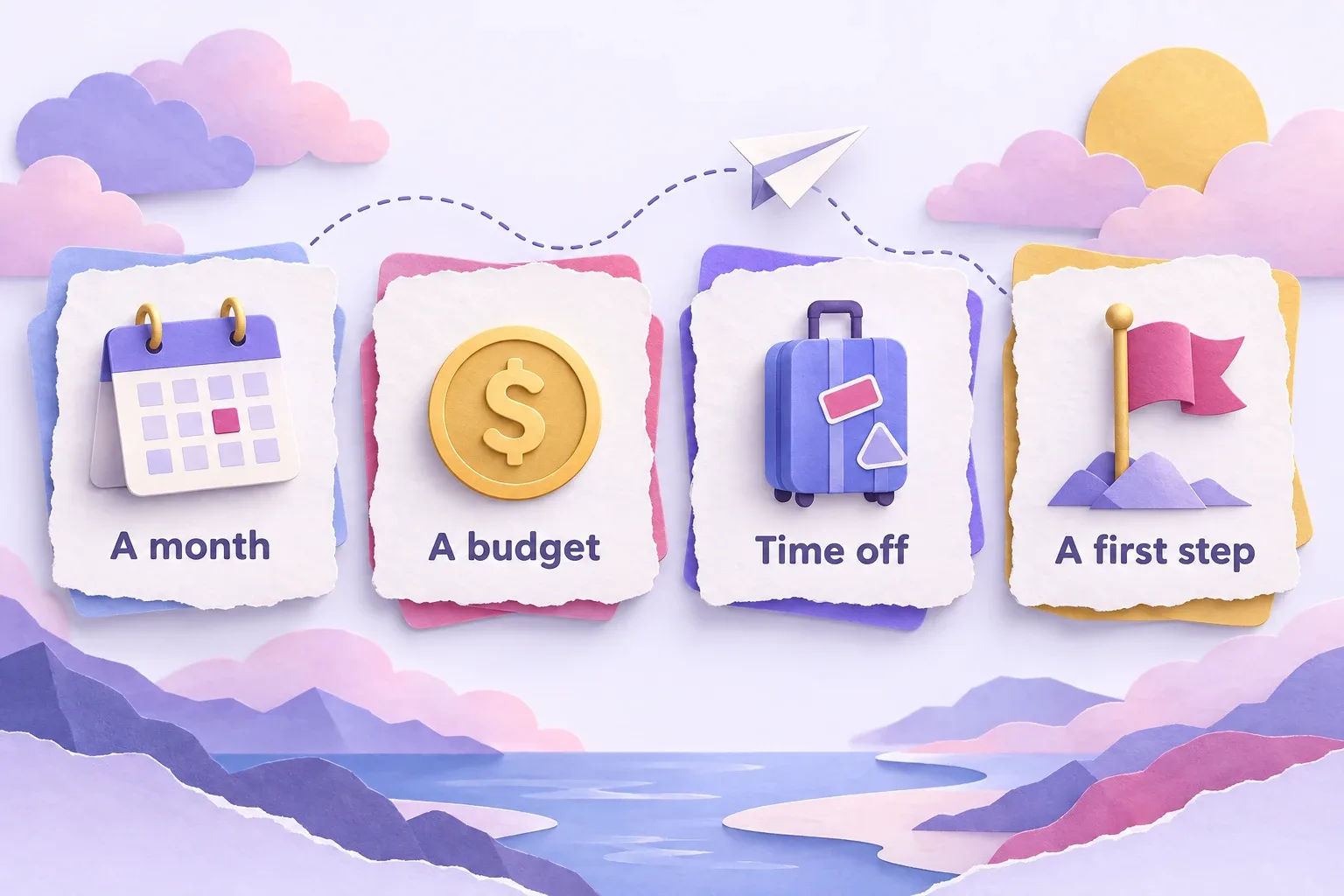
To turn a travel vision board into booked trips, give each picture a month, a total budget, a leave request and one action you can take this week. Then name the obstacle most likely to block you and write an if-then plan. Review the board monthly and book the first trip early.

Travel vision board planner infographic: a month, a budget, time off and a first step

The four things every trip needs:

  1. A month. Even "sometime in spring" becomes "the second week of May."
  2. A budget. Add up flights or fuel, a place to stay, food, and a cushion. Divide by the months left. That is your monthly saving target. A money vision board can hold the savings side of the plan.
  3. Time off. Look at your calendar and your employer's rules. Pencil in the dates now.
  4. A first step. Check your passport's expiry date and the entry rules for your destination early, because they vary by country and can take time to sort out. Or open a separate savings pot named after the trip.

Add the obstacle. Before you hang your board, write under each trip the thing most likely to stop you. Then write an if-then line, as in these examples:

  • If I get paid on the 1st, then I move $150 to my Lisbon pot the same day.
  • If I feel like spending on something small, then I look at the board first and wait a day.
  • If work gets busy in April, then I still book the flight in March.

This is the "mental contrasting" idea from the research above, put to work. It comes from psychologist Gabriele Oettingen, whose WOOP method pairs it with if-then plans, known as implementation intentions. It is not about being negative. It is about making the dream survive a normal Tuesday.

Affirmations and vision boards are a mindset practice, not a substitute for medical, mental-health or financial advice. Only spend what you can afford.

What Do Different Travellers Put on Their Boards?

Different travellers need different boards. A couple wants shared moments, a family wants things everyone can enjoy, a solo traveller wants freedom, and a budget traveller wants low-cost wins. Start from who is travelling, then choose images to match.

Travel vision board for families: a mother and daughter choose trips from a travel guidebook
  • Couples. Build it together. Each person picks one trip and you choose one together. Use photos of the two of you from past trips as anchors.
  • Families. Let each person choose one image. Add a "kid vote" trip. Keep at least one trip that needs no flights.
  • Solo travellers. Focus on the feeling: freedom, self-trust, new people. One image of you alone in a great place is enough to set the tone.
  • Budget travellers. Add the price to each image. Include a free trip: a hike, a new neighbourhood, a night in a tent.
  • Returning after a hard year. Choose rest first. A slow, easy trip can matter more than an epic one.

If you want help finding the mood, the free manifestation style quiz shows how you like to picture your goals.

What Are Good Travel Goals for 2027?

Good travel goals are specific, dated and sized to your life. Instead of "travel more," say "take four trips in 2027: one big, one medium, two close to home." Add a budget and a month for each. Here are goals to borrow.

  • Take one week-long trip by June 2027.
  • Visit one new country, state or region.
  • Do one solo day trip each quarter.
  • Save $200 a month in a "trips" pot.
  • Plan one trip with a friend you have not seen in a while.
  • Try one food or festival you have never tried.
  • Take a real day off, phone away, once a month.
  • Plan the leave days now, and see the career vision board guide if work is what keeps trips off the calendar.

For more on setting goals for the whole year, see goals for 2027, new year's resolutions for 2027, a health vision board for the energy to enjoy the trips, and our list of vision board ideas across every life area.

When Should You Make Your Travel Vision Board?

Make your travel vision board between October and December 2026. That gives you time to check leave, save, and book early, and January starts with a calendar instead of a blank page. If you read this in another month, start now. The board works from the day you begin.

Book the trip you are surest about first. Holiday leave, school breaks and the best prices tend to go early, so an October board gives you a head start. Then set a monthly ten-minute check: Which trip is next? What is my first step this month? Is the board still true?

How Can You See Yourself in the Picture?

Most travel boards show scenery with nobody in it. That makes the trip feel like someone else's holiday. A board that shows you there is easier to believe, and easier to want. To see why, read how to see your future self.

That is what Manifest Mosaic does. You write what you want from 2027, add one selfie, and get photos of yourself already living it: on the coast, on the trail, at the table. The first photo is free. The full board is nine photos of you (one per wish), a print-ready poster, phone wallpapers, three free swaps, and 30 morning letters from your future self. It costs $19, paid once, with no subscription.

Know a traveller? You can give someone their 2027 as a gift. They open it on the day you choose and add their own selfie. For more gift ideas, see manifestation gifts.

See yourself living it in 2027 โ€” make your first picture free โ†’

Sources & Methodology

Oettingen, WOOP science overview โ€” the research behind mental contrasting and if-then planning.

Nawijn (2010), "Vacationers Happier, but Most not Happier After a Holiday," reported by ScienceDaily โ€” anticipation of a vacation and the fading of the boost after returning.

Kappes & Oettingen (2011), "Positive fantasies about idealized futures sap energy," Journal of Experimental Social Psychology โ€” why picturing only the ideal outcome can lower energy.

Matthews (2015), Goals Research Summary, Dominican University of California โ€” small study on writing goals and accountability.

Pearson et al. (2015), "Mental Imagery: Functional Mechanisms and Clinical Applications," Trends in Cognitive Sciences โ€” how mental imagery works in the brain.

Methodology: studies are summarised in plain English and their limits are stated. Examples such as Maya, Sam and Jo are illustrative scenarios, not real people. Trip budgets and lengths are examples, not quotes. Check entry rules and costs with official sources before booking.

Questions

Frequently asked questions

Put two or three trips you truly want, one image for each, plus the feeling you want from it and a target month. Add small moments too, like a table by the sea or a train window, not only famous landmarks.

It can, if it leads to action. A board keeps trips in view, and looking forward to a trip is a real pleasure. But trips get booked through dates, money and leave days, so add those to your board.

Three to five works well: one big trip, one medium trip, and one or two close-to-home getaways. Too many places blur into a wish list, and a board only motivates when each trip feels specific and possible.

Either. A printed board on your wall is a calm daily ritual. A digital board can be your phone wallpaper, so you see it all day. Many people do both, using the same pictures, and update them as plans change.

Give each trip a month, a rough budget and a first step you can do this week, such as checking your passport or opening a savings pot. Then add a simple if-then plan for the obstacle most likely to stop you.

Your first picture is free

See yourself in 2027.

Write what you want from next year, add one selfie, and see a photo of you already living it. Then turn all nine wishes into your board.