
Career Vision Board: Ideas for Your Work

A career vision board shows the work life you want in 2027. See what to put on it, ideas for every situation, and how to add if-then plans so it moves you.

Career Vision Board: Ideas for Your Work
In this guide 10 sections
  1. 01What Is a Career Vision Board?
  2. 02Does a Career Vision Board Work?
  3. 03How Do You Make a Career Vision Board?
  4. 04What Should Go on a Career Vision Board?
  5. 05What Are Good Career Vision Board Ideas for Your Situation?
  6. 06How Do You Turn Each Picture Into a Plan?
  7. 07Should You Put a Salary or Job Title on Your Board?
  8. 08How Do You Use Your Career Vision Board at Work Every Week?
  9. 09How Do You Plan Your Work Year by Quarter?
  10. 10Sources & Methodology

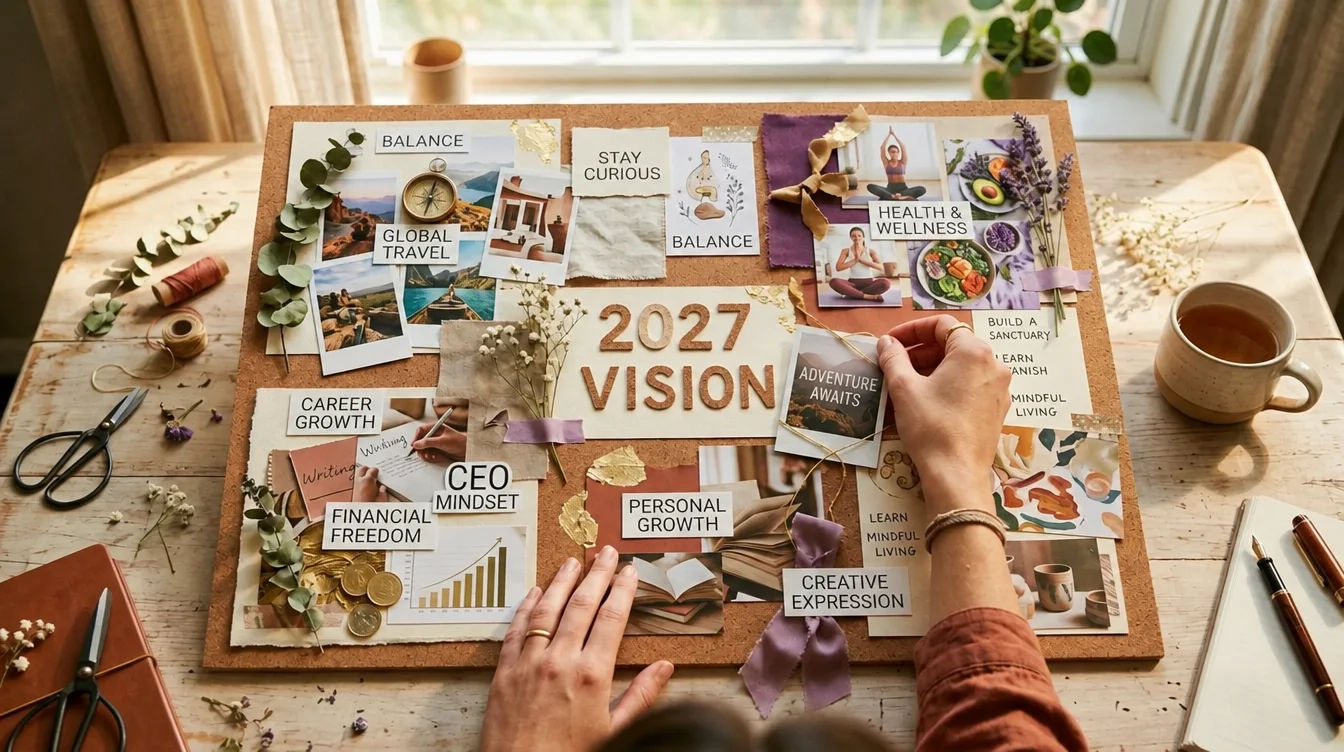
A career vision board is a collage of pictures and words that shows the work life you want, such as the role, the skills, the people and the everyday moments. You build it once, keep it where you see it, and use it to choose your next steps at work in 2027.

Most career boards fail for one reason: they show a job title and a big paycheck, and nothing about how to get there. This guide fixes that. You will get simple steps, picture ideas for every situation, and a way to turn each image into a plan.

Key Takeaways
  • A career vision board is a visual goal list for your work life, and it works best when each picture has a small action attached
  • Choose pictures of real workdays and skills, not only a title and a salary
  • Research suggests that dreaming about success without planning for obstacles can lower effort, so add an if-then plan to each image
  • Pick the situation that fits you: promotion, career change, job search, side project or making your current job better
  • Review the board once a month and break the year into four quarters

What Is a Career Vision Board?

A career vision board is a single page, poster or phone screen that holds pictures, words and numbers for the work you want. It can show a role, a skill, a workplace, a project or a way of working. Its job is to keep your career goals clear and in view.

It is not only for people who want a bigger title. Some people use it to leave a job. Others use it to stay and enjoy their job more. Some use it to start a business, return to work after time away, or make a quiet plan to earn more.

Think of it as a work-focused slice of a bigger 2027 vision board. If you already have a full board, the career section can be this page, made larger and more detailed.

Does a Career Vision Board Work?

A career vision board can help, but it does not work on its own. It keeps your goals clear and visible, and clear goals are easier to act on. It works best when you add steps and plans for the obstacles you know will show up.

Here is what the research does and does not say:

  • Writing goals down helps. In a small 2015 study by Gail Matthews at Dominican University, people who wrote down their goals achieved more than those who did not. Those who also sent weekly progress updates to a friend did best: 76% reached their goals or got more than halfway, against 43% of those who did not write them down. The study was presented at a conference and was not peer-reviewed, so treat it as encouraging, not proof (Matthews summary).
  • Dreaming alone can backfire. Psychologists Gabriele Oettingen and Doris Mayer followed graduates who were looking for a job. Those who had more positive fantasies about their future sent fewer applications and, two years later, reported fewer job offers and lower pay. Those who judged success as likely, based on their own record, did better on each measure (Oettingen & Mayer, 2002). This does not mean vision boards fail. It means a picture of success is not a plan.
  • If-then plans help. An if-then plan links a situation to an action, such as "If it is Friday at 4 pm, then I will spend 20 minutes on my portfolio." Psychologists Peter Gollwitzer and Paschal Sheeran reviewed the evidence on these plans in a 2006 meta-analysis (Gollwitzer & Sheeran, 2006).
  • Habits take time. New habits took an average of 66 days to feel automatic, with a range of 18 to 254 days (Lally et al., 2010). A daily look at your board is a habit, so give it a couple of months.

Nothing here promises a raise or a job offer. For more on the evidence, read do vision boards work, and for other practices that pair well with a board, see seven ways to manifest in 2027. Boards and affirmations are a mindset practice, not a substitute for career, financial or mental-health advice.

How Do You Make a Career Vision Board?

To make a career vision board, name where you want to be at the end of 2027, choose a format, collect pictures of real work moments, add a few words or numbers, and attach one action to each picture. Keep it to six to nine items so it stays easy to read.

  1. Ask four questions (15 minutes). Write answers with a pen. What do I want my typical Tuesday to look like in December 2027? What skill do I want people to know me for? Who do I want to work with? What do I want to stop doing?
  2. Pick your situation. Promotion, change, job search, side project, return to work or "better job, same job." The next sections give ideas for each.
  3. Choose a format. A phone wallpaper is easy to update and always with you. A printed poster works well at a desk at home. You can make both from the same images. See our digital vision board guide for tools.
  4. Collect pictures (30 to 45 minutes). Gather 20 to 30 images, then keep the best six to nine. Choose ones that show a real moment, such as a meeting, a workshop, a quiet desk or a finished project.
  5. Add words and numbers. Use short lines with a date: "Lead the Q3 launch." "Finish my certificate by June." "Three clients by March."
  6. Attach an action to each picture. Write a small step under it. More on this in the plan section below.
  7. Put it where you will see it. Not on a work wall that others see, unless you want that. Your phone lock screen or the inside of a notebook works well.

If you want the full method for any board, see how to make a vision board.

What Should Go on a Career Vision Board?

Put four kinds of things on a career vision board: pictures of real workdays, skills you are building, people you want around you, and one proof point such as a title, a date or a number. Real moments beat glossy stock photos, because they help you decide what you actually want.

A useful test for any picture is: "Would I enjoy being in this photo on an ordinary Tuesday?" A corner office looks great, but if the picture shows a long stream of meetings, you may not want it. If you feel drawn to a quiet desk and a whiteboard full of ideas, that tells you something real.

Here are picture swaps that make a board stronger:

Instead of this picture Try this picture Why it helps
A stock photo of a boss in a suit You leading a small meeting, notes in hand Shows the daily action, not the rank
A stack of cash A payslip line or a number you chose, with a date Makes the money specific
A famous company logo The team, tools or projects you want to work on Shows the work itself
A trophy A finished project on your screen Focuses on the thing you will make
A beach with a laptop Your ideal work week written as a schedule Shows how you want to spend time
A quote about success A short line in your words: "Ask for the raise in April" Turns inspiration into a date

Add one picture for how you want to feel at work, such as calm, proud or trusted. Feelings guide choices when the job list is long.

๐Ÿ’ก8 Picture Ideas for Your Career Vision Board
0 of 8 explored

What Are Good Career Vision Board Ideas for Your Situation?

Good ideas depend on where you are. If you want a promotion, show the next role's daily tasks. If you want to change careers, show two or three paths. If you are job hunting, show the process. If you want a better current job, show what you would change.

Career vision board ideas for a side project: a woman packs her first handmade orders in a sunny ceramics studio

If you want a promotion

Picture the tasks of the next role, not just the title. Add a picture of a project you would lead, the skill that role needs, and a date for a talk with your manager. Example: say you are an analyst. You might put on your board a photo of a team briefing, the words "Lead the quarterly review," and "Book career chat in February."

If you want to change careers

Choose two or three possible paths, not one. For each, add pictures of an ordinary day, the first skill to learn, and one person to talk to. Under each, write a test question, such as "Would I enjoy this every week?" After a few weeks, keep the paths that still feel good and take the others off the board.

If you are job hunting

Make the board about the process. Add a picture of your finished resume, a calendar block for applications, a coffee with a contact, and the type of workplace you want. Add a number you control, such as "Five applications a week." You control the effort, not the answer.

If you are starting something on the side

Show the first small proof: a website page, a first client, a sample product. Add a number and a date, like "First paid project by May." Keep the job you have on the board too, so the plan feels safe and steady.

If you are returning to work

Show the skills you are refreshing, a course, a person to reconnect with and the kind of hours you want. Include your life outside work, too, such as a picture of dinner at home. A plan you can live with is a plan you can keep.

If you want to stay and enjoy your job more

Researchers Amy Wrzesniewski and Jane Dutton call this job crafting: changing your job on your own to fit your strengths and goals. It has three parts: the tasks you do, the people you work with, and how you see the meaning of your work (job crafting overview). Put one picture for each on your board. For example, a task you want more of, a colleague you want to learn from, and a sentence about who your work helps.

For more picture ideas beyond work, see vision board ideas. Work is only one part of a full year, so you may also want a health vision board for energy and rest, or a travel vision board for the time off you plan to take. If money is a big part of your career plan, pair this with a money vision board.

How Do You Turn Each Picture Into a Plan?

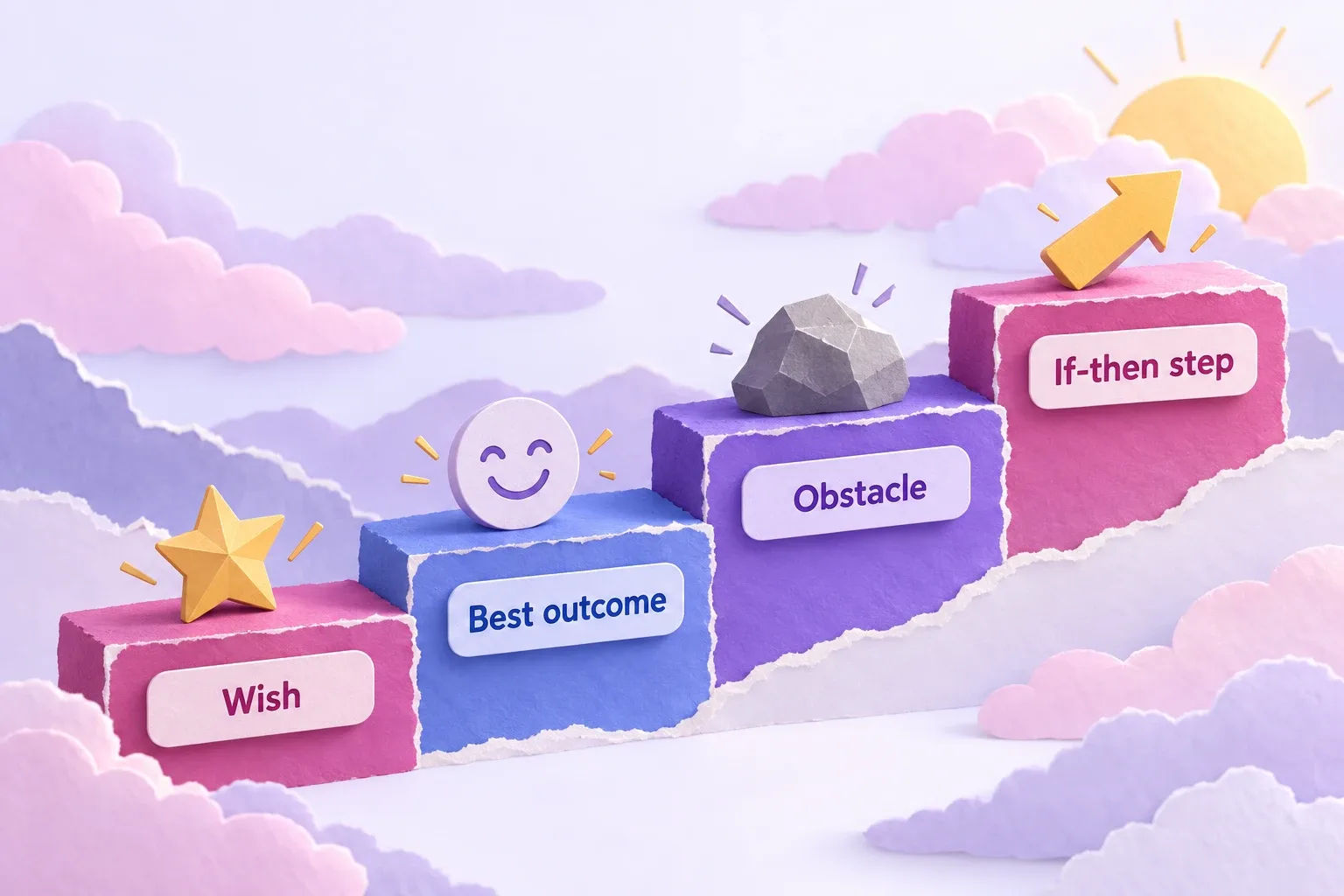
Turn each picture into a plan with four short lines: your wish, the best outcome, the main obstacle, and an if-then step. This is a simple version of WOOP, a method from Gabriele Oettingen, known in research as mental contrasting with implementation intentions, for pairing hopeful thinking with a realistic plan.

Career vision board plan: paper-craft steps from wish to best outcome to obstacle to if-then step

Here is a worked example:

  • Wish: Move from support lead to operations manager by September 2027.
  • Best outcome: I run the weekly ops meeting and feel trusted.
  • Obstacle: I avoid asking for stretch work because I fear saying the wrong thing.
  • If-then plan: If a project comes up in our Monday meeting, then I will say, "I would like to help with that," before the meeting ends.

Another example, for a job seeker:

  • Wish: Get three interviews by March.
  • Best outcome: I feel steady and prepared in the room.
  • Obstacle: I stop applying after two rejections.
  • If-then plan: If I get a rejection, then I will send one new application within 24 hours.

Write the plan on a sticky note or on the back of the printed board. If-then plans work because they decide in advance what you will do when the hard moment shows up. Read them out loud once a week.

If you want a set of daily lines to say alongside your board, try the free affirmation generator.

Should You Put a Salary or Job Title on Your Board?

Yes, you can put a salary or job title on your board, if you choose it with care. A number is helpful when it is real, checked against what your field pays, and paired with a step. A number alone can be a distraction, and a title alone can hide what the job involves.

Use this simple three-part check:

  1. Is it real? Look at job listings or salary surveys for your role and city, and choose a number in that range.
  2. Is it dated? "Earn X by December 2027" is clearer than "earn more."
  3. Is there a step? Under the number, write one action: "Ask for a review in April" or "Apply for two senior roles."

The same goes for a title. Add the title, then a line about what you will do in that role. If the daily work does not excite you, the title will not either.

How Do You Use Your Career Vision Board at Work Every Week?

Use your board in three short habits: one minute each morning to look at one picture, a ten-minute Friday check on your if-then plans, and a longer monthly review. Small, regular use matters more than a perfect board.

  • Morning (1 minute). Pick one picture. See yourself doing it. Name the one step you can take today.
  • Friday (10 minutes). Ask what moved this week, what got in the way, and what you will do differently next week.
  • Monthly (30 minutes). Update the board. Remove what no longer fits, add what you learned, and write your next four if-then plans.

Consider telling one trusted person your top career goal and sending a short update each week. In the Matthews study, that step was linked with the strongest results, though the study was small.

It also helps to remember how work usually goes. In the US, the median time a worker has been with their current employer was 4.1 years in January 2026 (U.S. Bureau of Labor Statistics). Careers include many moves and many chapters, so your board does not have to be a forever plan. It only has to cover 2027.

How Do You Plan Your Work Year by Quarter?

Split 2027 into four quarters, and give each quarter one work goal from your board. Quarters are short enough to feel real and long enough to show progress. Start the plan now, in the last months of 2026, so January is not a blank page.

Career vision board quarterly plan: a man lays out four rows of cards for the year at golden hour on a beach
  • Late 2026 (now to December): Build the board. Do one small test of the plan, such as one networking chat or one skill lesson. Read our goals for 2027 guide to pick your top goals, or browse 101 new year's resolutions for 2027 for work ideas you had not considered.
  • Q1 (January to March): Set up. Book the talk with your manager, start the course, or send the first round of applications.
  • Q2 (April to June): Make the ask or the move. This is a good time to ask for a review, launch the side project, or take interviews.
  • Q3 (July to September): Build proof. Finish a project, collect feedback and write down your wins.
  • Q4 (October to December): Review, rest and reset. Look back at the board and choose what carries into 2028.

Habits take about two months to settle, so give each quarter's habit at least eight weeks before you judge it. If you miss a week, restart with the smallest version. The plan is a guide, not a test.

If the practice of seeing yourself in your future work moves you, you may also like see your future self, which covers ways to make that picture feel real, or try the prompts in future self journaling to describe a working day in 2027 in your own words. With Manifest Mosaic, you can write your work wishes, add one selfie, and get photos of yourself already living them. Each wish becomes a picture of you, and 30 morning letters from your future self keep the board in front of you. You can also read about letters from your future self.

See yourself living it in 2027 โ€” make your first picture free โ†’

Sources & Methodology

Oettingen, G. & Mayer, D. (2002), "The motivating function of thinking about the future: Expectations versus fantasies," Journal of Personality and Social Psychology โ€” supports the finding that positive fantasies, unlike positive expectations, predicted less effort and poorer job-search results in graduates.

Matthews, G. (2015), Goals research summary, Dominican University of California โ€” supports the point that writing goals down and sharing weekly progress goes with better results, in a small conference study.

Gollwitzer, P. & Sheeran, P. (2006), "Implementation intentions and goal achievement: A meta-analysis of effects and processes," Advances in Experimental Social Psychology โ€” the review behind if-then planning.

Lally et al. (2010), "How are habits formed," European Journal of Social Psychology โ€” supports the 66-day average for a new habit.

U.S. Bureau of Labor Statistics, Employee Tenure Summary (January 2026) โ€” supports the median tenure figure.

Implementation intention, Wikipedia and Gabriele Oettingen, Wikipedia โ€” support the definitions of if-then plans and of WOOP (mental contrasting with implementation intentions).

Methodology: We read the Oettingen and Mayer paper in full and checked the other sources on the pages linked above. Job crafting is described from the Wikipedia overview of Wrzesniewski and Dutton (2001). Vision boards are a planning and mindset tool, not a guarantee of any work outcome.

Questions

Frequently asked questions

Put pictures of the work you want to do each day, the skills you want to build, the people you want around you, and one proof point such as a title, a date or a number. Add one small action under each picture.

A board alone will not get you a promotion or a job. It works as a clear, visible goal list. Research on writing goals down and on planning for obstacles suggests the board helps most when you pair it with steps.

You can, if the number is real and you know why you chose it. Treat it as a target, not a wish. Pair it with a picture of the work that earns it, and one step you will take this month.

Write two or three paths you are considering. For each, collect pictures of an ordinary day in that job, not just the title. Add a question like 'Would I enjoy this on a Tuesday?' Keep the paths that still feel good.

Look for one minute each morning, and do a longer review once a month. In the review, mark what moved, name one obstacle, and write one if-then plan for the next four weeks.

Your first picture is free

See yourself in 2027.

Write what you want from next year, add one selfie, and see a photo of you already living it. Then turn all nine wishes into your board.