 Manifest Mosaic
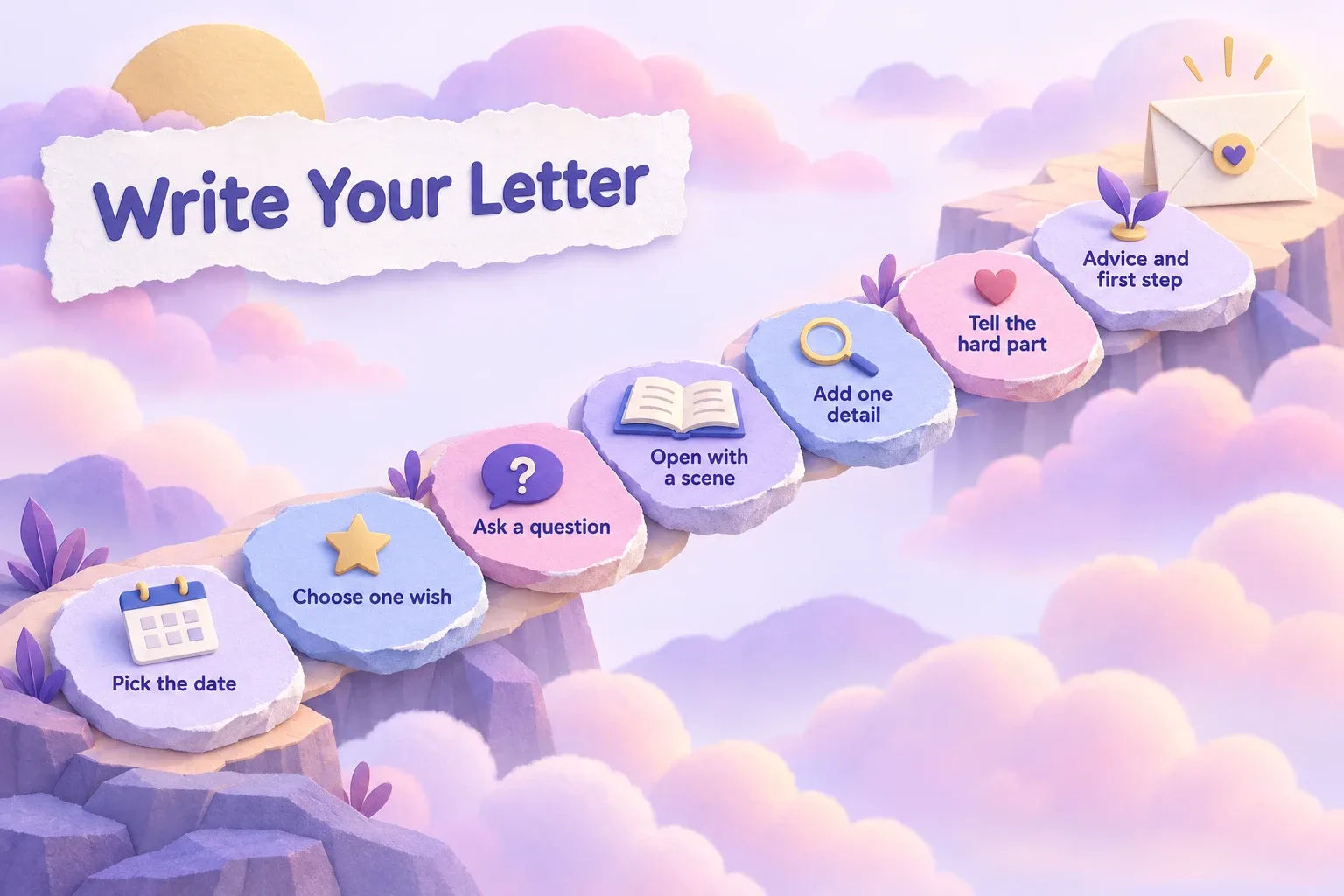
A letter from your future self is a letter you write as the person you'll be at a set future date, addressed to the you of today. You date it ahead, say December 2027, describe one wish as already lived, explain what you did to get there, and end with advice for this week.
It takes one sheet of paper and about 15 minutes. Below is the full method, a complete example letter dated December 2027, and an honest look at what the research does and doesn't show.
- A letter FROM your future self is written in your future voice, dated ahead, about one wish. A letter TO your future self is the opposite: a time capsule from today.
- The best-supported version is a two-way exchange. Write a short question to your future self, then write the reply. In one study, the reply was what made the difference.
- Studies link this kind of writing to better mood, optimism and planning, mostly in students. None show it changes outside events.
- Present tense or "I will" both appear in practice. No study has tested which is better.
- Always include the hard part and what you did about it. Pure daydreams can lower effort.
- Write one letter per wish, reread it weekly, and do the first step it gives you.
What is a letter from your future self?
A letter from your future self is a short letter written in the voice of the person you'll be on a chosen future date, sent back to you now. It describes one wish as already real, names the ordinary steps that got you there, and ends with advice. Manifestation circles call this scripting; psychologists study close cousins of it.
It isn't a prediction or a promise. Think of it as a rehearsal: 15 minutes being the person who already made it, then back to today with a clearer picture and one next step. Our guide to seeing your future self explains why that future person often feels like a stranger.
How is a letter from your future self different from a letter to your future self?
A letter to your future self is written by today's you and opened later, like a time capsule. A letter from your future self goes the other way: you write as the future you, looking back at now. A third format, the two-way exchange, does both. You write a question to your future self, then write the reply.
If you want the time-capsule version, see our guide to writing a letter to your future self.
The exchange has the most direct support. In studies by psychologists Chishima and Wilson, students at a vocational high school in Japan wrote to their future self, then wrote back as that future self. One month later, students who did both showed more career planning and school commitment; students who only sent a letter did not. The write-up puts it simply: "getting a reply may be essential" (SPSP).
No study has tested a "from" letter on its own. That's why the method below starts with two lines to your future self, so your letter becomes the reply.