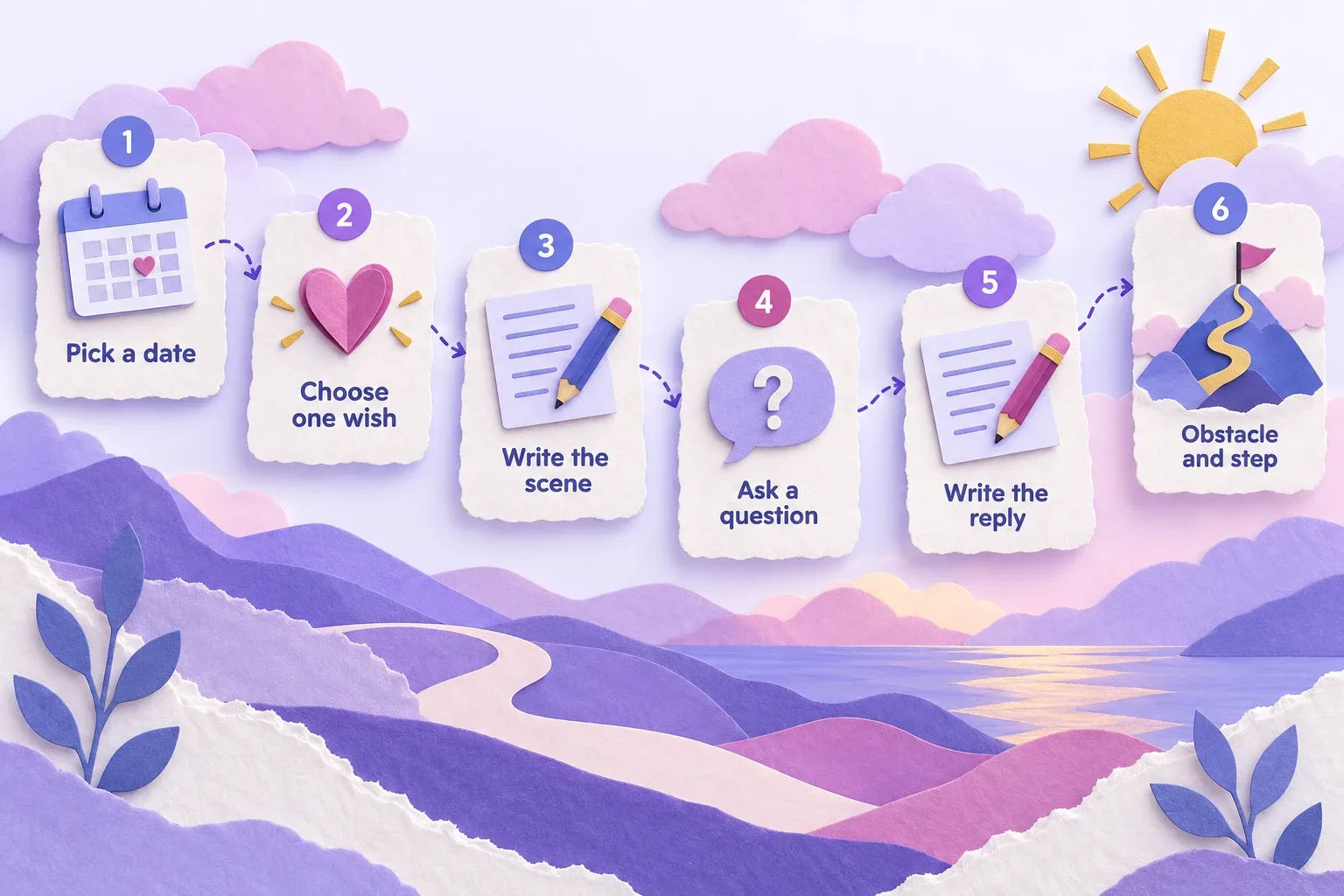
Future self journaling is writing about, to or as the person you're becoming. You pick a future date, describe one moment there in detail, ask your future self a question and write the reply. Then you name one small step for today. It takes about ten minutes.
This guide gives you a step-by-step method, 30 prompts, a full example entry set in December 2027, a 30-day rhythm and an honest look at what research does and doesn't say.
Key Takeaways
- Future self journaling has three modes: writing ABOUT your future self, TO them, and AS them. The best routine uses all three.
- Small studies, mostly with students, link best-possible-self writing to better mood and optimism. None show a journal changes outside events.
- Vivid, specific scenes beat vague goals. "Tuesday, 7 a.m., tea on the porch" beats "be happy."
- Always add the obstacle and one first step. Pure positive fantasy can lower your energy.
- Ten minutes a day is enough. Habits take time: 66 days on average in one study.
- It's a mindset practice, not a prediction or a treatment.
What is future self journaling?
Future self journaling is a writing habit where you spend a few minutes each day with the person you want to become. You write about them, write to them, or write as them. The goal is to make that person feel real and close, so today's choices come more easily.
There are three modes, and they do different jobs:
- About your future self. "In December 2027 I'm working three days a week outdoors." This decides what you want.
- To your future self. "Dear me, did you make the call?" This asks questions. Our guide to a letter to your future self covers the time-capsule version.
- As your future self. "It's a gray Sunday and I'm at the kitchen table." This lets you hear advice. For a one-page version, see the letter from your future self.
Journaling is the daily, low-pressure cousin of those one-off letters. It's also different from a plain diary, which looks back. A future self journal looks ahead, then hands you something to do today. If you also want the bigger picture on the idea, read our pillar guide on how to see your future self.
Does future self journaling work?
It can help in small ways, and the evidence is early. Studies of best-possible-self writing link it to better mood and optimism, and letter studies link future-self writing to more planning and exercise. Most volunteers were students. No study shows that a journal changes events like a job offer or a move.
Here's what each line of research found, and what it left out:
- Writing about your best possible future. In King (2001), 81 undergraduates wrote for 20 minutes a day on four days. Writing about life goals was less upsetting than writing about trauma and was linked to higher well-being. Five months later, those who wrote about optimistic futures had fewer illness visits than a control group.
- Doing it in short bursts. In Meevissen, Peters and Alberts (2011), 54 students imagined their best possible self for five minutes a day for two weeks. Their optimism rose more than that of students who imagined ordinary days. Every measure was a self-report.
- Pulling it together. A review and meta-analysis by Heekerens and Eid (2021), as described in a 2025 trial, found that the exercise raises positive feelings, with a small or non-significant effect on negative ones.
- Answering yourself. Students who wrote to their future self and then wrote a reply as that self showed more career planning and school commitment a month later than students who only sent a letter. The researchers said getting a reply may be essential. They studied vocational high-school students in Japan.
- Feeling close to the future you. Psychologist Hal Hershfield describes future self-continuity as how vivid, how similar and how positive your future self feels to you. Writing gives you a place to build all three.
The honest summary: it's a promising clarity habit. It isn't proof of anything supernatural, and it doesn't cure worry or guarantee a result. Affirmations and vision boards are a mindset practice, not a substitute for medical, mental-health or financial advice.
How do you do future self journaling step by step?
To do future self journaling, set a ten-minute timer and write in this order: date and place, one vivid scene, a question to your future self, their reply, the obstacle and one first step. Do it at the same time each day. You need a pen and paper or a notes app. If you're new to goal-based practices, how to manifest in 2027 explains seven methods you can combine with it, and 101 New Year's resolutions for 2027 can spark the wishes to write about.

Step 1: Pick your date (1 minute)
Write a real day at the top, such as December 31, 2027. A date with a feeling attached, like a birthday, is easier to picture than "someday."
Step 2: Choose one wish for today (1 minute)
One wish per entry. "Start my own business" is an entry. "Business, house, fitness and love" is a list. Rotate wishes through the week.
Step 3: Write the scene (3 minutes)
Use present tense. Give it a place, a time of day, one or two people, two senses and one feeling.
Script: "It's [date], [time]. I'm at [place] with [person]. I can [see/hear/smell] [detail]. I feel [feeling] because [what is now true]."
Step 4: Ask your future self a question (1 minute)
Ask something with a real answer. "What did I do in the first month?" beats "Will it work out?"
Step 5: Write their reply (2 minutes)
Switch voices. Answer in your future self's warm, plain voice. Keep it short and practical. This is the two-way exchange the letter research points to.
Step 6: Name the obstacle and one step (2 minutes)
Finish with two lines: "The thing most likely to stop me is ___." and "If that happens, then I will ___." Put the step in your calendar for today or tomorrow.
What are the best future self journal prompts?
The best prompts are specific and sorted by purpose, so you never face a blank page. Use one per day, or pick three for a longer session. Here are 30, grouped by the kind of writing they trigger. Answer in a line or a page.
Vision (about your future self)
- What does an ordinary Tuesday look like on December 31, 2027?
- Where are you living, and what's the first thing you see in the morning?
- Who is around your table?
- What work fills your day, and what have you stopped doing?
- How does your body feel when you wake up?
Questions (to your future self)
6. What was the hardest month, and how did you get through it?
7. What did I worry about that never happened?
8. What did I get wrong at the start?
9. What small habit mattered most?
10. What should I stop doing this week?
Replies (as your future self)
11. What do you want me to know that I can't see yet?
12. What are you proud of that I would find surprising?
13. What would you say on a day I want to quit?
14. What do you wish I had started sooner?
15. What one thing should I do tomorrow?
Obstacles and plans
16. What is most likely to get in my way?
17. If I feel tired, then I will...
18. Who can I ask for help?
19. What does "good enough" look like for this week?
20. What am I avoiding, and what is the smallest step toward it?
Gratitude and identity
21. What am I already grateful for that my future self will miss?
22. What quality of mine will carry me there?
23. Who am I becoming, in three words?
24. What would I do today if I already believed I could?
25. What did I do today that my future self will thank me for?
Weekly review
26. What moved this week?
27. Which entry felt most true?
28. Which wish still excites me?
29. Which one feels like pressure, and can I let it go?
30. What is next week's one step?
If you like gratitude pairings, our gratitude journal prompts fit well with group five.
What does a future self journal entry look like?
A good entry is short, concrete and honest. It sets a date, paints one scene, asks a question, answers in your future voice and ends with an obstacle and a step. Here is a full example we wrote for illustration. It isn't a real person's journal.
Wish: run my own bakery.
Sunday, December 19, 2027. 6:30 a.m.
I'm in my bakery on the corner, flour on my apron. The first tray of cardamom buns is out and the window is fogged. My sister is chalking prices on the board. I can smell warm sugar and coffee. I feel steady, because next month's rent is covered.
Question: What did I do in the first month?
Reply (future me): You didn't start with the shop. You shadowed a morning shift at a bakery down the road, and you asked what went wrong in their first year. Then you baked for two neighbors every Saturday until you knew your costs. Be patient with the money part. It gets clear.
Obstacle: I freeze when I have to talk about money.
If-then: If I catch myself putting off the bank call, then I'll book it for Tuesday at 9 a.m. and write three questions first.
Today's step: Email two bakeries about shadowing a shift.
A second scenario, with a different wish. Say you want calmer Sundays with your partner. Your scene: "It's Sunday, 7 p.m. Phones are in a drawer. We plan the week in ten minutes, over mint tea." Your question: "How did we start?" Your reply: "You suggested one phone-free dinner and asked what would make it easy." Your step: "Ask tonight."
Notice what both entries do. They use a real place, a real time and a small action. They don't claim to be rich or happy.
How do you keep future self journaling going for 30 days?
Keep it going by making it small, tying it to something you already do, and reviewing weekly. Aim for ten minutes at the same time each day, like your first coffee. Habits take time: one study found new habits took an average of 66 days to feel automatic, with a range of 18 to 254 (Lally et al., 2010).

A simple 30-day rhythm:
| Days |
Focus |
What you write |
| 1 to 3 |
Choose |
Your date, three wishes, and one scene for each |
| 4 to 10 |
Scene and step |
One scene per day, plus one first step |
| 11 to 17 |
Question and reply |
Ask your future self a question, then write the reply |
| 18 to 24 |
Obstacles |
Name the obstacle and an if-then plan |
| 25 to 29 |
Gratitude and identity |
Who you're becoming and what you're thankful for |
| 30 |
Review |
Reread everything, mark what still fits, pick your next wish |
If you miss a day, write a shorter entry the next day. Don't restart. The point is contact, not a perfect streak. If you'd like your wishes gathered first, use our end-of-year reflection questions or goals for 2027 as a starting list.
Some people also like a pen-and-paper habit beside a picture. Manifest Mosaic turns your written wishes and one selfie into photos of you already living them in 2027, and your first picture is free. Seeing yourself in the scene can make the entry easier to write.
Is a future self exercise or meditation the same thing?
Not quite. A future self exercise is any structured activity, like the best-possible-self writing above. A future self meditation is a quiet, eyes-closed version where you picture one future moment in detail. There is little research on meditation by that name, so treat it as a calm warm-up, not a proven method.
A two-minute version before you write:
- Sit comfortably and breathe slowly three times.
- Picture your date, December 31, 2027, and a room you know.
- Notice light, sounds and one smell.
- Picture your future self walking in. Ask them one question.
- Open your eyes and write down what you heard.
This is a private imagination exercise. If it brings up strong grief or worry, stop and take care of yourself.
What if future self journaling feels fake or you cringe?
If your entries feel fake, make them smaller and more believable. Research on affirmations found that positive statements that feel untrue can make people with low self-esteem feel worse (Wood, Perunovic & Lee, 2009). Swap grand claims for a scene you could plausibly live.
Quick fixes:
- "I am a millionaire" becomes "I paid off the last card on March 3 and closed the app."
- "I'm so happy" becomes "I'm laughing at the table, and my shoulders are down."
- Cringe at old entries? That's normal. Read kindly, mark what still fits and cross out what doesn't. Change is the point.
- Scripting teachers? The idea of writing a wish as already true comes from traditions like the law of assumption. Treat it as a belief, and keep the practical parts: clear scenes and real steps.
Can future self journaling backfire?
Yes, if it becomes a pleasant daydream with no action. In four experiments, positive fantasies about an idealized future left people with less energy; the authors wrote that such fantasies "do not generate energy to pursue the desired future" (Kappes & Oettingen, 2011). The fix is to add the obstacle and the step.
Two more studies point the same way:
- Freshmen who pictured the process of studying studied more and did better than those who pictured only a good grade (Pham & Taylor, 1999). It was one group and one exam, so it's a hint, not a law.
- Gabriele Oettingen's WOOP method, short for Wish, Outcome, Obstacle, Plan, builds on the idea that facing obstacles beats pure positive thinking.
Other cautions: don't use your journal to punish yourself if 2027 goes differently. And if writing about the future stirs up hopelessness, set it aside and talk to someone. If you're struggling or thinking about suicide, call or text 988 (US) or contact your local emergency number (988 Lifeline).
How can you make your journal stronger with pictures and letters?
Pair each entry with an image and a reply. A picture keeps the scene in front of you all day, and a reply in your future voice gives you a fresh step. You can do this by hand with cutouts, or with a 2027 vision board you look at each morning.
The full Manifest Mosaic board puts you in the picture: nine photos of you, one per wish, plus a print-ready poster, phone wallpapers, three free swaps and 30 morning letters from your future self, one a day for 30 days. It's $19, paid once, no subscription. Those letters make a nice companion to a journal, since each is about a wish on your board. You can also give someone their 2027 for Christmas, New Year's Eve or a birthday. They open an envelope on the day you choose and add their own selfie.
You can also turn your reply line into a short daily phrase with the free affirmation generator.
See yourself living it in 2027 — make your first picture free →
Sources & Methodology
- King (2001), "The Health Benefits of Writing about Life Goals," Personality and Social Psychology Bulletin — best-possible-self writing linked to well-being in 81 undergraduates.
- Meevissen, Peters & Alberts (2011), "Become more optimistic by imagining a best possible self," Journal of Behavior Therapy and Experimental Psychiatry — five minutes a day for two weeks raised optimism in 54 students.
- Chishima & Wilson (2021), letter-exchange exercise, via SPSP — writing the reply, not only the letter, raised career planning and commitment.
- Kappes & Oettingen (2011), "Positive fantasies about idealized futures sap energy," Journal of Experimental Social Psychology — purely positive fantasy lowered energy.
- Lally et al. (2010), "How are habits formed," European Journal of Social Psychology — habits took 66 days on average to feel automatic.
Methodology: This guide draws on published studies of best-possible-self writing, future self-continuity, letter writing and positive fantasy. Results are described with their limits, and manifestation ideas are presented as traditions, not research. The example entries and the 30-day plan are illustrations we wrote. Sources checked September 2026.

 Manifest Mosaic