Gratitude journal prompts are specific questions that guide you to write about what you appreciate, such as "Who showed up for me recently that I haven't thanked?" They move you past generic lists toward real moments and feelings. Research links regular gratitude writing with feeling better about life, and the 50+ prompts below are sorted by theme.
Key Takeaways
- In a well-known study, people who wrote weekly gratitude lists for ten weeks felt better about their lives than people who wrote about hassles
- Organized prompts by theme (morning, relationships, career, healing, spiritual) target specific life areas
- Specific, felt gratitude works better than rushed generic lists; five focused minutes is enough
- Many manifestation teachers treat gratitude as the foundation of the practice—research supports its mood benefits, not claims about attracting outcomes
What Are Gratitude Journal Prompts and Why Do They Work?
Gratitude journal prompts are specific questions or statements that help you explore what you appreciate in your life. Instead of writing "I'm grateful for my family," a prompt might ask "What moment with my loved ones reminded me of their support?" That specificity matters because it brings back the real feeling, not just the idea of being thankful.
The Greater Good Science Center at UC Berkeley describes gratitude as noticing and appreciating the good things in life, including the good that comes from other people. A review of the research links gratitude with better well-being, and a controlled trial of positive-psychology exercises found that writing down three good things each day lifted happiness for six months (see Gratitude on Wikipedia for the wider definition).
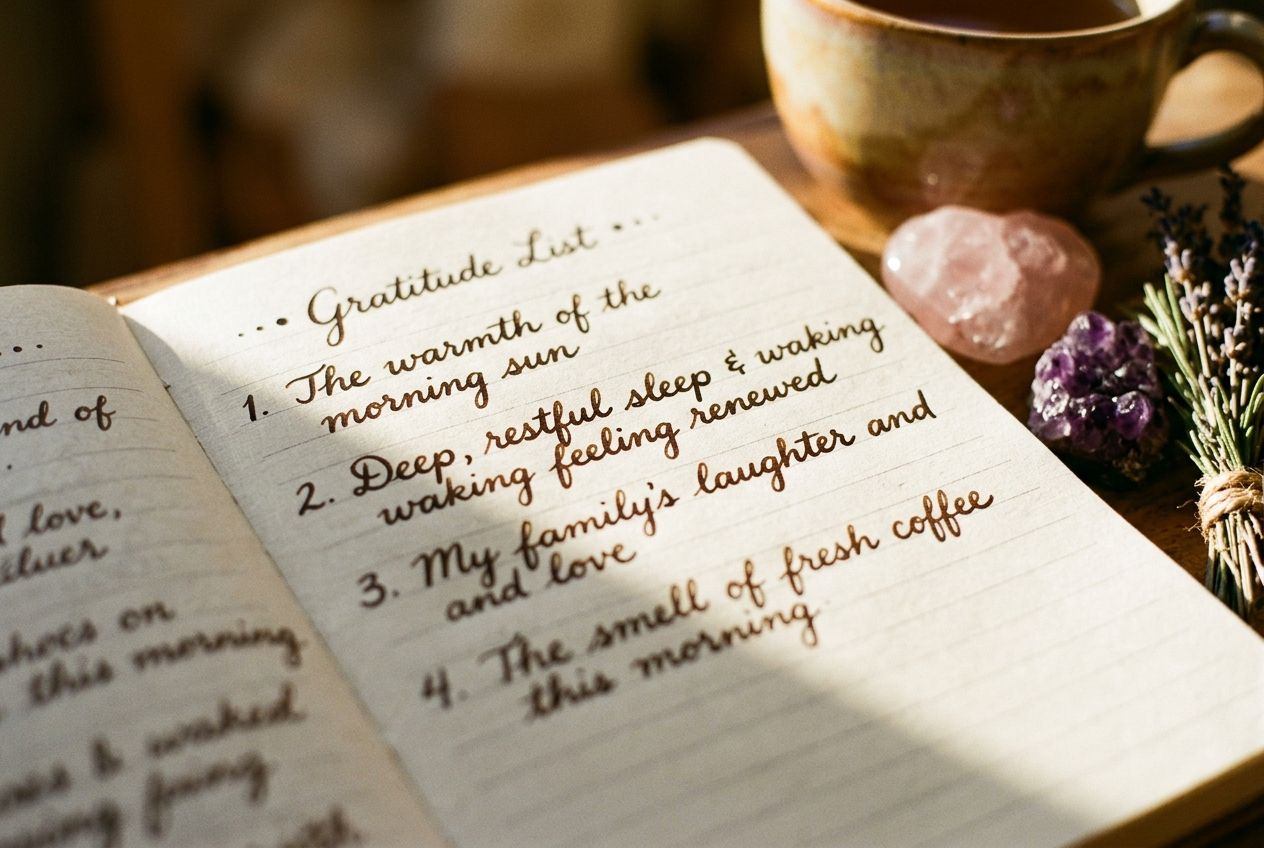
Gratitude journal prompts work because they:
- Ground appreciation in specific moments rather than abstract concepts
- Retrain your attention toward what's working instead of what's missing
- Build a record of good moments you can reread on hard days
- Make gratitude a habit by giving you a fresh question each time
- Connect you to other people by reminding you who has helped you
In manifestation circles, gratitude holds a special place. Abraham Hicks teaches that appreciation is one of the quickest ways to feel good, and Joe Dispenza teaches gratitude as a way to feel your future as if it has already happened. These are spiritual teachings rather than research findings, but they point in the same direction as the science: appreciation tends to lift your mood. Neville Goddard's law of assumption leans on the same feeling of "already having", and some people give that feeling a picture with a 2027 vision board.
How Do You Use Gratitude Journal Prompts Effectively?
You use gratitude journal prompts effectively by picking one or two a day, writing specific details by hand, and pausing to actually feel the appreciation before moving on. Choose a consistent time, like morning coffee or just before bed, and keep entries to about five to ten minutes. How you use the prompt matters more than which one you pick.
-
Choose a consistent time. Morning entries set a positive tone for the day. Evening entries help you close the day by noticing what went well.
-
Create the right environment. Quiet space, warm tea, soft lighting—these aren't luxuries. They signal that this time is for you.
-
Write by hand. Handwriting slows you down, which gives you more time to remember and feel each moment. A dedicated manifestation journal keeps your entries in one place.
-
Feel while you write. Don't just describe gratitude; feel it in your body. Where do you feel it? Chest? Heart? Let the emotion guide your pen.
-
Be specific and recent. General gratitude ("I'm grateful for my house") is good. Specific gratitude ("Today my bedroom light hit the wall just right at 7am and reminded me of that summer at my grandmother's house") creates powerful emotional activation.
What Are Good Morning Gratitude Journal Prompts?
Good morning gratitude journal prompts ask what you're looking forward to, who has supported you, and what small things are already going right, so you start the day noticing the good. Answer one or two before you check your phone. Pair them with a few morning affirmations for a five-minute routine.
- What am I excited to experience today? Name three specific things, no matter how small.
- Who showed up for me recently that I haven't fully appreciated? Describe one way they supported you.
- What part of my body is functioning beautifully right now? (Notice your breath, your heartbeat, your ability to move.)
- What abundance is already flowing toward me that I took for granted? (Home, clean water, internet, people who love you.)
- How am I different from last year? Name three specific ways you've grown.
- What opportunity showed up that I almost missed? Why am I grateful you noticed it?
- What do I have today that someone else is desperately wishing for? Feel the privilege and responsibility of that.
- What's one thing I did well yesterday, even if it was small? Celebrate yourself.
- How has a past disappointment led to something better? Trace the hidden blessing.
- What am I looking forward to in the next 24 hours? Get specific about the feeling.
What Gratitude Prompts Help You Appreciate Relationships?
Gratitude prompts for relationships ask you to notice small, specific things people do for you, like a kind text, a favor or an inside joke, and how those moments made you feel. Writing them down helps you appreciate people you might take for granted, and sharing what you wrote can strengthen the bond.
- What did my partner/friend do today that I normally overlook? Describe the moment in detail.
- How has this person challenged me to grow? What strength did I develop because of them?
- What small gesture from someone recently reminded me I'm loved? What did it feel like to receive it?
- Who in my life believes in me even when I don't believe in myself? Why am I grateful for their faith?
- What conversation healed something between me and another person? How do I feel now?
- Which family member's trait annoyed me but actually taught me something valuable? What did I learn?
- When did someone show up for me without being asked? How did that make me feel?
- What inside joke with my loved ones never gets old? Why does it matter so much?
- How has my closest friend reflected my best self back to me? When did you most need that?
- What's one relationship I'm grateful shifted or deepened? What made the difference?
Career and Purpose Gratitude Journal Prompts
These prompts help you notice progress, support and meaning in your work, even on ordinary days. If money is part of your goals, our guide to how to manifest money and these money manifestation methods pair well with them:
- What skill of mine did I use successfully today? How is this skill leading me toward my goals?
- Who recognized my work or effort recently? What did their recognition activate in you?
- What project or task energized me instead of draining me? Why does that type of work light me up?
- How am I making a difference through my work, even in small ways? What impact matters most to you?
- What opportunity came because of my previous effort or success? How is momentum building?
- When did I handle a challenge at work with more confidence than I used to? How have you grown?
- What financial abundance has my work generated recently? How are you using or saving it?
- Which professional relationship has deepened or become more supportive? What shifted?
- What compliment about my work stayed with me? Why did it matter?
- How is my career becoming more aligned with my values? What's shifting?
Healing and Shadow Work Gratitude Journal Prompts
These prompts help you find strength and meaning in difficult experiences, without pretending they didn't hurt. Go gently. Affirmations and vision boards are a mindset practice, not a substitute for medical, mental-health or financial advice—if a prompt stirs up more than you can handle alone, reach out to a therapist or someone you trust:
- What challenge taught me resilience I didn't know I had? When have you used this strength since?
- How has my struggle made me more compassionate toward others? Who have you helped because of what you survived?
- What would I still not know about myself if this difficult experience hadn't happened? What did you discover?
- How is my body healing? Notice any improvement, no matter how small.
- Who supported me during my hardest time? What would you tell them about what their presence meant?
- What limiting belief am I releasing, and what's replacing it? Celebrate this internal shift.
- How have I protected myself better because of past hurt? What healthy boundary did you establish?
- What am I learning to forgive myself for? Why is that forgiveness important?
- How has my pain made space for new joy? What's filling that space?
- What part of my shadow self am I grateful to finally understand? What shifts now that you see it with compassion?
Spiritual Growth Gratitude Journal Prompts
These prompts connect you to something larger than yourself and deepen your spiritual or manifestation practice. If you like counted rituals, try them beside the 369 method; for a private, adult visualization practice, see the O Method guide:
- When did I feel most connected to my intuition this week? What was I being guided toward?
- What synchronicity or sign confirmed I'm on the right path? What did it mean to you?
- How am I becoming the person my highest self knows I can be? What qualities are emerging?
- What spiritual practice has helped me most lately? How do you feel different?
- When did I feel the presence of something greater than myself? Describe that moment.
- How has my meditation/prayer practice deepened my trust in the universe? What have you surrendered?
- What manifestation came that surprised me with its timing or form? How has this built your faith?
- Which spiritual teacher, book, or message transformed my perspective? What did you learn?
- How am I becoming more aligned with my purpose? What signs show you're on track?
- What spiritual lesson did I resist before finally understanding? Why does the truth now feel clear?
Which Gratitude Prompt Type Should You Choose?
Choose the gratitude prompt type that matches what you need most right now: morning prompts if you want a brighter start to the day, relationship prompts if you feel disconnected, career prompts if work feels draining, and healing prompts if you're moving through something hard. You can rotate themes weekly to keep the practice fresh.
| Prompt Type |
Helps You Notice |
Best Time |
Example Prompt |
| Morning |
Small good things already in your day |
Right after waking |
"What am I excited to experience today?" |
| Relationship |
People who support you |
Evening |
"Who showed up for me without being asked?" |
| Career and purpose |
Progress and meaning at work |
After work |
"What skill did I use well today?" |
| Healing |
Strength gained from hard times |
Quiet weekend time |
"What challenge taught me resilience?" |
| Spiritual |
Meaning, signs and connection |
Before bed |
"When did I feel part of something bigger?" |
✨ Key Insight: Gratitude isn't about toxic positivity or pretending hard things don't hurt. It's about recognizing that even difficult experiences can hold something of value. When you find honest gratitude for the lesson, the person, or the growth, the practice starts to feel real instead of forced.
How Do You Create Your Own Gratitude Journal Prompts?
You create your own gratitude journal prompts by choosing a life area you care about, then turning "What am I grateful for?" into a specific question about a moment, person or detail in that area. Make it emotional, tie it to your values, and refresh your list every month so the questions stay interesting.
-
Identify your current focus. Are you manifesting a specific relationship? Financial abundance? A new career? Health? Your prompts should target that area.
-
Ask yourself deeper questions. Instead of "What am I grateful for?" ask "What specific moment today showed me I'm worthy of love/success/abundance?" You can also answer as the person you are becoming; seeing your future self shows how.
-
Make them emotionally specific. Replace "I'm grateful for my job" with "What about today's work reminded me that I'm building something meaningful?"
-
Ground them in your values. Your prompts should reflect what actually matters to you, not what you think should matter.
-
Rotate them monthly. Your life changes. Refresh your prompts every 30 days to match what's happening now. Stuck? The free affirmation generator can spark ideas you can turn into questions.
✨ Key Insight: Gratitude journal prompts work best when they're emotionally specific and rooted in your actual life. A prompt about your real experience brings back far more feeling than a generic question about abstract gratitude.
What Mistakes Weaken a Gratitude Practice?
The mistakes that weaken a gratitude practice most are writing lists without feeling them, rushing through prompts, using gratitude to cover up real pain, and expecting journaling alone to change your circumstances. Each one turns a meaningful habit into a chore. Slow down, feel each item, and pair gratitude with honest emotion and action.
⚠️ Common Mistake: Writing gratitude lists without feeling. "I'm grateful for: coffee, my house, my job" is surface-level. Your nervous system recognizes the difference between thinking about gratitude and feeling it. Always pause and feel each item before writing.
⚠️ Common Mistake: Rushing through your prompts. Five minutes of authentic, felt gratitude beats thirty minutes of rote writing. Quality of presence matters infinitely more than quantity of words.
⚠️ Common Mistake: Using gratitude to bypass authentic emotion. If you're grieving, angry, or scared, honor those feelings first. Gratitude layered on top of suppressed emotion tends to feel hollow.
⚠️ Common Mistake: Journaling but never acting. Gratitude can lift your mood and help you notice opportunities, but it doesn't replace effort. Pair your prompts with clear goals and small, real steps.
💜 Pro Tip: Write gratitude prompts in the present tense and with specific detail. Instead of "I want to be grateful for my dream job someday," write "I'm grateful for the creative energy I felt during today's brainstorm—this is what I'm building toward." This keeps your attention on what's already moving in the right direction.
What Does the Science Say About Gratitude Journaling?
Research suggests gratitude journaling can modestly improve how you feel about your life. In a well-known 2003 study, people who wrote down five things they were grateful for once a week for ten weeks felt better about their lives overall and more optimistic about the coming week than people who wrote about hassles (Emmons & McCullough, 2003).
That same research found the gratitude group also reported exercising more and having fewer physical complaints. Harvard Health summarizes this and related studies: gratitude is consistently linked with greater happiness, and it helps people feel more positive emotions and build stronger relationships. Harvard's older piece, In Praise of Gratitude, covers the same ground.
The effects are real but modest, and they come from steady practice, not a single entry. When you engage with a gratitude prompt and feel the appreciation, you're:
- Shifting your attention from what's missing to what's working
- Savoring good moments a second time as you write them down
- Noticing other people's kindness, which can strengthen relationships
- Building a habit of looking for the good, which gets easier with repetition
This is why affirmations and gratitude pair so well—one focuses on who you're becoming, the other on what's already good. Try adding a few self-love affirmations after your entry.
How Do You Build a 30-Day Gratitude Journal Practice?
You build a 30-day gratitude journal practice by focusing on one theme per week—mornings, relationships, work, then a mix—and writing for about five minutes at the same time each day. Keep a pen and journal where you'll see them. After 30 days, keep the parts you enjoyed and let the rest go.

-
Days 1-7 (Morning Focus): Use morning gratitude prompts to set the tone for the day. Notice how your mood and energy shift.
-
Days 8-14 (Relationship Focus): Shift to relationship prompts. Notice how you feel about the people around you.
-
Days 15-21 (Career/Purpose Focus): Target your work and contribution. Track opportunities that emerge.
-
Days 22-30 (Integration Focus): Cycle through all categories, choosing prompts that speak to your current growth. By day 30, you'll have a month of good moments to look back on.
After 30 days, keep going. Research on habits found new routines took about 66 days on average to become automatic (Lally et al., 2010), so the second month is when gratitude starts to feel effortless. Families can try simple versions with children, too; see our morning affirmations for kids for a kid-friendly routine.
Final Thoughts: Gratitude as the Heart of Your Practice
Gratitude journal prompts are more than a feel-good exercise. Used with intention, they train your attention toward what's already good, lift your mood and help you appreciate the people around you. Many manifestation teachers believe gratitude also signals you're ready to receive more; either way, it's a steady foundation for any goal.
Start with whichever category resonates most. Morning prompts if you want to shift your daily energy. Relationship prompts if you're manifesting deeper connections. Career prompts if abundance is your focus. The category matters less than your commitment to showing up authentically.
Use these prompts daily, feel deeply, and let your gratitude practice be the steady ground under the life you're building.
Ready for the next step? Pair your gratitude journaling with morning affirmations and our step-by-step guide on how to manifest. You'll find more tools on the Manifest Mosaic home page.
See yourself living it in 2027 — make your first picture free →
Sources & Methodology
This article combines published gratitude research with the teachings of manifestation authors. Research is described as reported, including its limits; spiritual teachings are presented as teachings, not findings:
- Emmons & McCullough (2003), "Counting Blessings Versus Burdens," Journal of Personality and Social Psychology — weekly gratitude lists and well-being over ten weeks.
- Harvard Health Publishing, "Giving Thanks Can Make You Happier" — plain-English summary of gratitude research.
- Greater Good Science Center, UC Berkeley, "What Is Gratitude?" — definition of gratitude and links to research.
- Wood, Froh & Geraghty (2010), "Gratitude and well-being: a review," Clinical Psychology Review — gratitude and well-being across studies.
- Seligman et al. (2005), "Positive psychology progress," American Psychologist — the three-good-things exercise.
- Lally et al. (2010), "How Are Habits Formed," European Journal of Social Psychology — new habits took 66 days on average to become automatic.
- Abraham Hicks and Joe Dispenza — manifestation teachers whose ideas about gratitude are described as their teachings.
All prompts are original. Affirmations and vision boards are a mindset practice, not a substitute for medical, mental-health or financial advice.

 Manifest Mosaic