What Are Some Law of Assumption Examples?
Law of assumption examples follow one pattern: a clear wish, a finished scene, a feeling, and an action taken as the person who already has it. Here are two worked scenarios for 2027, written as illustrations, not success stories.

Example 1: A new job by spring 2027
Say you want to move from retail into a junior office role.
- The assumption: "I work in an office team I like, and I'm good at it."
- The end scene: Your first Monday. Your new badge clips onto your shirt. A coworker says, "Welcome aboard, we've been waiting for you."
- Acting from it: You rewrite your CV as someone who expects to be hired, send two applications a week and ask one person in the field for a 15-minute chat.
For a longer plan, see our guide on how to manifest a job.
Example 2: Moving to a new city
Say you want to live in Denver by September 2027.
- The assumption: "I live in Denver."
- The end scene: You carry the last box up the stairs, open the window and hear the city below. A friend texts, "How's the new place?"
- Acting from it: You check rents in two neighborhoods, start a moving fund and look for remote roles or local openings.
- Handling doubt: When the savings number looks small, you replay the text message and move $50.
In both, the scene gives direction and the actions do the work. Some people pair the scene with a counting ritual such as the 369 method, or with a private visualization practice like the O Method; the same rule applies to both.
Why Is the Law of Assumption Trending on TikTok?
The law of assumption trends on TikTok because it is easy to explain in 60 seconds, it promises agency, and it comes with named techniques to try. Tags like #lawofassumption host many videos on revision, the Pinterest method and "shifting." Much of what you see there is modern paraphrase, not Neville's words.
Before you follow a video:
- Revision usually means replaying a moment from your day the way you wish it had gone. People link it to a chapter in The Law and the Promise titled "Turn the Wheel Backward."
- The Pinterest method and shifting are internet-era add-ons. Neville died in 1972, so neither is in his books.
- Some clips use cloned voices made to sound like Neville. If a quote sounds too modern, it probably is.
The simple fix is to read the source; Feeling Is the Secret is short. If you want to know which style of practice suits you, try the free manifestation style quiz.
Does the Law of Assumption Work? What Research Does and Doesn't Show
No study shows that assuming something changes outside events by itself. But real mechanisms sit close to the practice. Expectations can shape behavior, usually in small ways. Picturing the steps toward a goal helps more than picturing only the result. And pure positive daydreaming can lower your energy.
Self-fulfilling prophecies are real, and they run through behavior
Sociologist Robert K. Merton popularized the term "self-fulfilling prophecy" in 1948 with a bank run: fear that a bank would fail made customers pull their money, which made it fail. "The prophecy of collapse led to its own fulfillment." (Wikipedia: Self-fulfilling prophecy). This describes people changing how they act, not the world bending to thought.
The famous classroom study is smaller than its fame
In Pygmalion in the Classroom (1968), teachers were told certain pupils were about to "bloom," and those pupils gained more on an IQ test by year's end. Critics questioned the test, replications were limited, and the effect was near zero when teachers had known their students for more than two weeks (Wikipedia). A review of 35 years of teacher-expectation research found that self-fulfilling effects do happen, but they are usually small, don't build up much and may fade (Jussim & Harber, 2005).
Picturing the process beats picturing only the prize
In a study of students before a midterm, those who pictured themselves studying studied more and got better grades than those who only pictured getting a good grade. The benefit came through better planning and less anxiety (Pham & Taylor, 1999). This is why Step 6 above matters.
Pure positive fantasy can drain your energy
Across four experiments, people who daydreamed about an ideal future showed lower energy than people who had questioning, negative or neutral thoughts about the future. The drop was bigger when the need felt more pressing (Kappes & Oettingen, 2011). "Feel it's done and wait" has a real downside when it replaces action.
A useful counterweight: WOOP
Psychologist Gabriele Oettingen's method, WOOP (Wish, Outcome, Obstacle, Plan), keeps the dream but adds the inner obstacle and a plan for it (WOOP). Pair your end scene with one line: "If I start doubting, then I'll replay the scene and do one task."
The honest summary: the feeling and the picture can help you focus and act with confidence. The action moves outside events.
What Are the Risks of the Law of Assumption?
The biggest risk is the blame trap: believing that anything bad in your life, or in someone else's, happened because of a wrong assumption. That is not true, and it is not kind. Other risks are waiting instead of acting, ignoring facts you need, and trying to control other people.
- The blame trap. Illness, abuse, loss, layoffs and accidents are not caused by your thoughts. Neither are other people's hardships. If the practice ever makes you feel guilty for something that happened to you, put it down.
- Health claims. Some of Neville's writing links illness to buried emotions. Medicine doesn't support that, so don't use this practice to judge your health or anyone else's. Affirmations and vision boards are a mindset practice, not a substitute for medical, mental-health or financial advice.
- "Denying the evidence of the senses." Read this as "don't let today's facts shrink your picture of the future," not "ignore your bank balance or your symptoms." You need real facts to make good plans.
- Waiting instead of acting. A daydream alone can sap energy. Every scene needs a next step, and a monthly review beats checking hourly whether "it's working."
- Other people. You can assume things about yourself, such as being loved, respected or chosen. You can't override another person's choices. Assume the relationship you want, and respect the real person's answer.
How Can You Try the Law of Assumption for 2027?
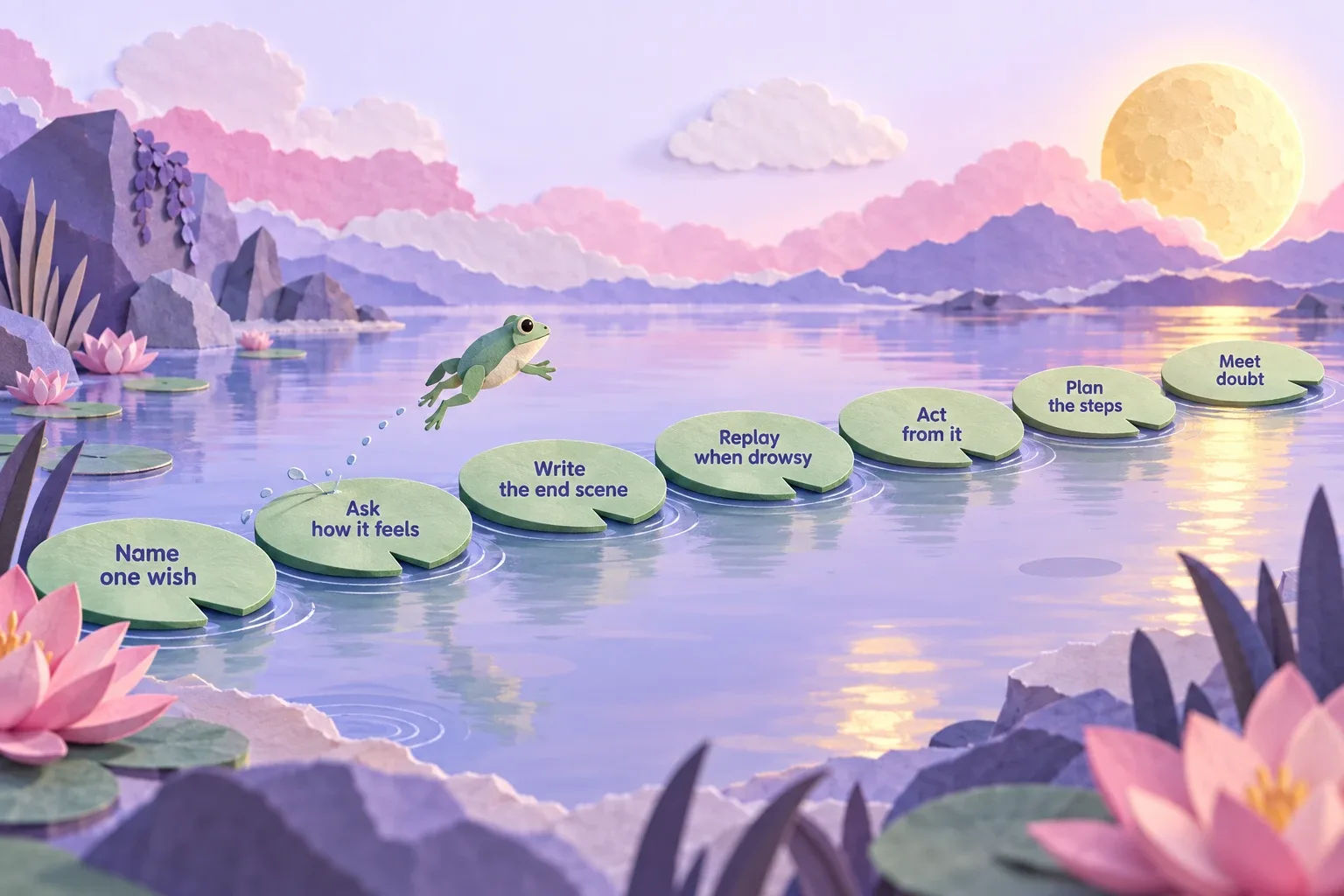
Try it for 2027 by writing one finished scene for each wish, setting each scene late in 2027, and attaching one weekly action to each. Replay one scene at bedtime, keep the actions on your calendar, and review everything once a month. Start in the last months of 2026 so January begins with scenes, not blank pages.

- October–November 2026: List up to nine wishes for 2027. Write a three-line end scene for each.
- December 2026: Choose the one sensory detail per scene that makes it real. Pick one weekly action per wish.
- Every night: Replay one scene in the drowsy state before sleep.
- Every week: Do the action. Tick it off.
- Every month: Ask which scenes feel more normal now, and which plans need changing.
The hardest part is making the end scene concrete. It helps to see it. With Manifest Mosaic, you write what you want from 2027, add one selfie, and get photos of yourself already living it. That's a finished scene to think from.
The full board is nine photos of you, one per wish, plus a print-ready poster, phone wallpapers and three free swaps. It also comes with 30 morning letters from your future self, one a day for 30 days, each about a wish on your board. It's $19, paid once, and the first photo is free. Pair each photo with its weekly step: the end to live from, and the next move.
See yourself living it in 2027 — make your first picture free →
Sources & Methodology
- Goddard, N. (1944), "Feeling Is the Secret," full text via Internet Archive — source of "assume the feeling" and "a state akin to sleep."
- Goddard, N. (1952), "The Power of Awareness," full text via Cool Wisdom Books — where the phrase "law of assumption" appears.
- Jussim & Harber (2005), "Teacher Expectations and Self-Fulfilling Prophecies," Personality and Social Psychology Review — self-fulfilling effects are real but usually small.
- Pham & Taylor (1999), "From Thought to Action," Personality and Social Psychology Bulletin — picturing the process beat picturing only the outcome.
- Kappes & Oettingen (2011), "Positive fantasies about idealized futures sap energy," Journal of Experimental Social Psychology — idealized daydreams lowered energy.
Methodology: Neville Goddard's words are quoted only from full texts of his 1944, 1952 and 1961 books and a 1968 lecture transcript, with book and year given. Community terms such as SATS and "living in the end" are labeled as paraphrase. Biographical details come from Wikipedia and Mitch Horowitz's published timeline. The job and city examples were written by us for illustration. Spiritual ideas are presented as the teachings of their authors, not as research findings. Sources checked September 2026.
 Manifest Mosaic