How to See Your Future Self (Not Older)

See your future self living the life you want, not just an older face. A 7-step method, what the research really shows, and a photo app privacy checklist.

How to See Your Future Self (Not Older)
In this guide 12 sections
  1. 01How can you see your future self?
  2. 02What do face-aging apps actually show you?
  3. 03Does seeing your future self change what you do?
  4. 04Why does a scene matter more than a face?
  5. 05How do you see your future life step by step?
  6. 06Should you picture the finish line or the first step?
  7. 07How do letters help you meet your future self?
  8. 08Are face-aging apps safe for your privacy?
  9. 09Age filter, journal, letter or picture: which should you use?
  10. 10What can seeing your future self not do?
  11. 11How do you start today?
  12. 12Sources & Methodology

To see your future self, you can use a face-aging app, which shows an older version of your face, or you can build a clear picture of your future life: the place, the people and the moment you want, with you in it. The first shows how you might look. The second shows the life you're working toward.

This guide covers both, with a seven-step method for the second, an honest read of the famous studies, and a privacy checklist for any photo app.

Key Takeaways
  • There are two ways to see your future self: an age filter (an older face) or a picture of your future life (a scene you want to live).
  • In the well-known studies, people who saw their own aged face chose to save more in hypothetical money tasks and cheated less on a quiz. Samples were small, and the authors called the results preliminary.
  • Vivid, specific future events also make people more patient. The key ingredient is vividness, not wrinkles.
  • Picturing only the happy ending can lower your energy. Pair every picture with one first step you can take this week.
  • Before you upload a selfie anywhere, check how long it's kept, who processes it and how to delete it.
  • Seeing your future self is a planning and motivation practice, not a prediction.

How can you see your future self?

You can see your future self in two honest ways. An age filter shows how your face might look in 30 or 40 years. A future-life picture shows you inside a specific scene you want to live, like running your own shop or a calm Sunday at home. Pick the one that matches your real question: "How will I look?" or "What will my life look like?"

Most search results for this phrase are face-aging apps. They're quick and often fun. But many people who type "see your future self" mean something bigger: who they'll be, where they'll live, whether their plans will work out. An older face can't answer that. A picture of your future life can, whether it lives in your head, on paper as a journal entry or letter, or as images on a vision board.

What do face-aging apps actually show you?

Face-aging apps take a selfie and return a made-up older version of your face. FaceApp, one of the best known, uses neural networks to add signs of age such as wrinkles and gray hair (Wikipedia: FaceApp). The result is a synthetic image, not a forecast. It can't know your genes, habits, sleep or how much sun you'll get.

It also shows a face, not a life: not your work, your home, your friendships, or how you feel on an ordinary Tuesday. Still, the older face has an interesting history in research.

Does seeing your future self change what you do?

In some lab studies, yes, a little. People who saw a realistic aged version of their own face chose to set aside more money in hypothetical savings tasks, and cheated less on a quiz. The samples were small, mostly students or online volunteers, and the authors called the results preliminary. It's a promising idea, not a proven life hack.

Here's what was actually tested:

  • Saving (Hershfield et al., 2011). In the first of four studies, 50 undergraduates saw either their current face or an aged one in a virtual mirror. Asked how to split an imagined $1,000 windfall, the aged-face group put an average of $172 into a retirement fund, versus $80 for the others. The money was hypothetical. The authors wrote that "the results should be interpreted as preliminary" (Hershfield et al., 2011). NYU Stern's summary describes one experiment where people who saw aged photos set aside about a third more of a paycheck for retirement (NYU Stern).
  • Honesty (van Gelder et al., 2013). In a small virtual-reality study of 67 undergraduates, 6.1% of those who met their aged self cheated on a later quiz, versus 23.5% of the comparison group. In a separate study in the same paper, writing a letter to your future self had a similar effect on choices (van Gelder, Hershfield & Nordgren, 2013).

Researchers have a name for the idea behind these studies: future self-continuity. It means how connected you feel to the person you'll become. Psychologist Hal Hershfield describes three parts: how vivid that future self is, how similar they feel to you, and how positive you feel about them (Hershfield, 2011).

If your future self feels like a stranger, it's easy to leave them the bills and the hard jobs. (These savings findings are research summaries, not financial advice.)

Why does a scene matter more than a face?

Because the studies point to vividness and connection, not wrinkles. An aged face was one way to make the future feel real. Research on imagining future events suggests another: picturing a concrete moment, in a real place with real details, also helps people make more patient choices. A scene gives your brain far more to hold on to than a face.

See your future self: a red-haired woman pulls a book of seaside towns from a bookshop shelf
  1. Specific future events make people more patient. In a brain-imaging study, people choosing between a smaller reward now and a larger one later chose more patiently when reminded of a real personal event planned for the reward date. The more vividly they pictured it, the more patient they were (Peters & Büchel, 2010, via ScienceDaily).
  2. Your brain builds the future out of memories. Remembering the past and imagining the future use a shared brain network. To picture a future moment, your brain recombines details you've lived, like a kitchen, a smell or a friend's laugh, into a new scene (Schacter, Addis & Buckner, summarized in Addis et al.).
  3. Writing to a distant future self nudged exercise. People randomly asked to write a letter to themselves 20 years ahead, instead of 3 months ahead, exercised more in the days that followed (Rutchick et al., 2018).

Here's the honest part: no study has tested photos of you living your future goals. Moving from "an older face" to "you inside the life you want" is a reasoned step from these findings, not a tested result. It fits the same ingredients (vivid, clearly you, positive), so treat it as a practice worth trying, not a proof.

How do you see your future life step by step?

To see your future life, pick a real date, choose three to nine wishes, and write each as one scene: where you are, who's with you, what you see and hear. Then add one first step under each scene, give it a picture with you in it, and look at it for two minutes a day. The setup takes about an hour.

Step 1: Pick a real date

"Someday" is blurry. Pick a day, like December 31, 2027 or your next birthday, and write it at the top of the page.

Step 2: Choose three to nine wishes

One per life area works well: work, money, home, health, love, friends, growth, rest and fun. Three is plenty to start. Not sure how you like to work toward goals? Our guide to how to manifest compares seven methods, and the free manifestation style quiz takes a few minutes.

Step 3: Write each wish as one scene

Not "be successful." A moment, in first person and present tense, with a real place, a time of day, one or two people, two senses and one feeling.

Script: "It's [date], [time of day]. I'm at [place] with [person]. I can [see/hear/smell something] and [feel something]. I feel [feeling] because [what's now true]."

Step 4: Add one first step under each scene

Under each scene, write one small action you could take this week. Most people skip this line; the next section explains why it matters.

Step 5: Put yourself in the picture

Give each scene an image: magazine cutouts, stock photos or your own photos all work. You can also put yourself in the frame: Manifest Mosaic turns your written wishes plus one selfie into photos of you already living them, and the first picture is free.

Step 6: Look for two minutes a day

Each morning, choose one scene, read it once, then decide when you'll do its first step today. If you like to write it out, a manifestation journal is a good home for the scenes.

Step 7: Write to your future self once a week

Write a few lines to the future you, then a short reply in their voice. It keeps the scene alive and gives you a fresh first step.

🗺️See your future life (not an older face) in 7 steps
1
📅 Step 1Pick a real date

Choose a day, like December 31, 2027 or your next birthday, not "someday."

2
🎯 Step 2Choose 3 to 9 wishes

One per life area: work, money, home, health, love, friends, growth, rest, fun. Three is plenty to start.

3
🌅 Step 3Write each wish as a scene

First person, present tense: a place, a time of day, a person, two senses and one feeling.

Two worked examples

Scenario 1: you want to open a small bakery.

  • Date: December 31, 2027.
  • Scene: "It's 6:30 a.m. on New Year's Eve. I'm in my bakery on the corner, flour on my apron. The first tray of cardamom buns is out and the front window is fogged. My sister is chalking prices on the board. I feel steady, because next month's rent is already covered."
  • First step: "On Saturday, ask two local bakeries if I can shadow a morning shift."

Scenario 2: you want calmer Sunday evenings with your partner.

  • Date: your anniversary in 2027.
  • Scene: "It's Sunday, 7 p.m. The dishes are done. We're on the couch, phones in a drawer, mint tea between us. We plan the week in ten minutes, not two hours. I feel close instead of tired."
  • First step: "Suggest a phone-free Sunday dinner this week."

Neither scene says "rich" or "happy." Each names a place, a time and a detail you could almost touch.

Should you picture the finish line or the first step?

Picture both, but never skip the first step. In a classic study, students who pictured the process of studying studied more and got better grades than students who pictured only the good grade. Other research found that purely positive daydreams about an ideal future can lower your energy. The finish line inspires you; the first step gets you moving.

See your future self: a father ties his son's boot at a trail overlook with a summit ahead
  • Process beats outcome alone. For 5 to 7 days before a midterm, college freshmen pictured the process (where, when and how they'd study), the outcome (a good grade), both, or nothing. Picturing the process led to more studying and better grades, through better planning and less worry. Picturing only the outcome didn't show that benefit (Pham & Taylor, 1999). It was one group of students and one exam, so treat it as a hint, not a law.
  • Pure fantasy can drain energy. Across four experiments, positive fantasies about an idealized future left people with less energy than other ways of thinking about it. The authors put it plainly: such fantasies "do not generate energy to pursue the desired future" (Kappes & Oettingen, 2011).

A practical fix comes from psychologist Gabriele Oettingen's WOOP method: Wish, Outcome, Obstacle, Plan (WOOP). Add three lines to each scene:

  • See it: "It's December 31, 2027, and I'm unlocking my bakery at dawn."
  • Name the obstacle: "The thing most likely to stop me is that I freeze when I have to talk about money."
  • Plan the first step: "If I catch myself putting off the bank call, then I'll book it for Tuesday at 9 a.m. and write down three questions first."

That "if… then…" line is what most vision boards leave out. Keep it next to the picture.

How do letters help you meet your future self?

Letters give your future self a voice. In small studies, writing a letter to your future self was followed by more exercise in one and less willingness to break rules in another. Writing about your best possible self lifted mood. Letters don't change events on their own, but they make the future you easier to hear.

Be clear about direction. A letter to your future self, written by you today, is the version those studies tested. A letter from your future self, written in the future voice looking back, is a popular practice that hasn't been tested on its own. The best possible self exercise asks you to imagine your life going as well as it reasonably could, then write about it for 15 minutes a day for two weeks. Students who did it showed a rise in positive emotions right afterward (Greater Good in Action).

A letter from your future self might open like this:

"Dear me, it's December 31, 2027, and I'm writing from the back room before we open. I know you're dreading the bank call. Make it anyway, with your three questions written first."

For the full method, read our guide to writing a letter from your future self. For the time-capsule version, see letter to future self; for daily prompts, try future self journaling.

The full Manifest Mosaic board includes 30 morning letters from your future self, one a day for 30 days, each about a wish on your board. Think of them as a daily practice, not a tested treatment.


Are face-aging apps safe for your privacy?

Face-aging apps can be fine to try if you know what happens to your photo first. Your face is personal data, and face-scanning products have drawn legal and political scrutiny. Before you upload a selfie to any app, including ours, check how long it's kept, who processes it, how to delete it, and what else it's used for.

In July 2019, as FaceApp went viral, US Senator Chuck Schumer asked the FBI and FTC to look into how long it kept data and who could access it (UPI). FaceApp said it doesn't sell or share user data with third parties, doesn't transfer it to Russia (where its research team is based), and deletes most images within 48 hours. The Moscow Times noted there was no evidence it gave data to the Russian government (The Moscow Times). Its current policy says photos may stay in the cloud for 24 to 48 hours, names Google Cloud Platform and Amazon Web Services, and lets you ask for cached photos to be removed (FaceApp privacy policy). Those are the company's own statements, and they're the kind of detail to look for in any app.

Some places also regulate face data. Illinois' Biometric Information Privacy Act (2008) requires consent before a company collects biometric identifiers and lets people sue if it doesn't (Wikipedia: BIPA).

Photo app privacy checklist

Look in the privacy policy or FAQ for these answers:

  1. Retention: How long is your photo kept? Hours, days, or until you close your account?
  2. Deletion: Is there a clear way to delete your photo and account, or an address for removal requests?
  3. Processing: Which companies store or process it, such as cloud providers or partners?
  4. Training: Is your photo used to train or improve their systems? Can you opt out?
  5. Sharing: Does the policy say your data isn't sold or shared with third parties?
  6. Permissions: Does it want your contacts, location or whole photo library when one photo would do? Choose "selected photos" if your phone offers it.
  7. Other people: Upload only your own face, or the face of someone who has said yes.

If you can't find clear answers, skip that app or email the company and ask.

Age filter, journal, letter or picture: which should you use?

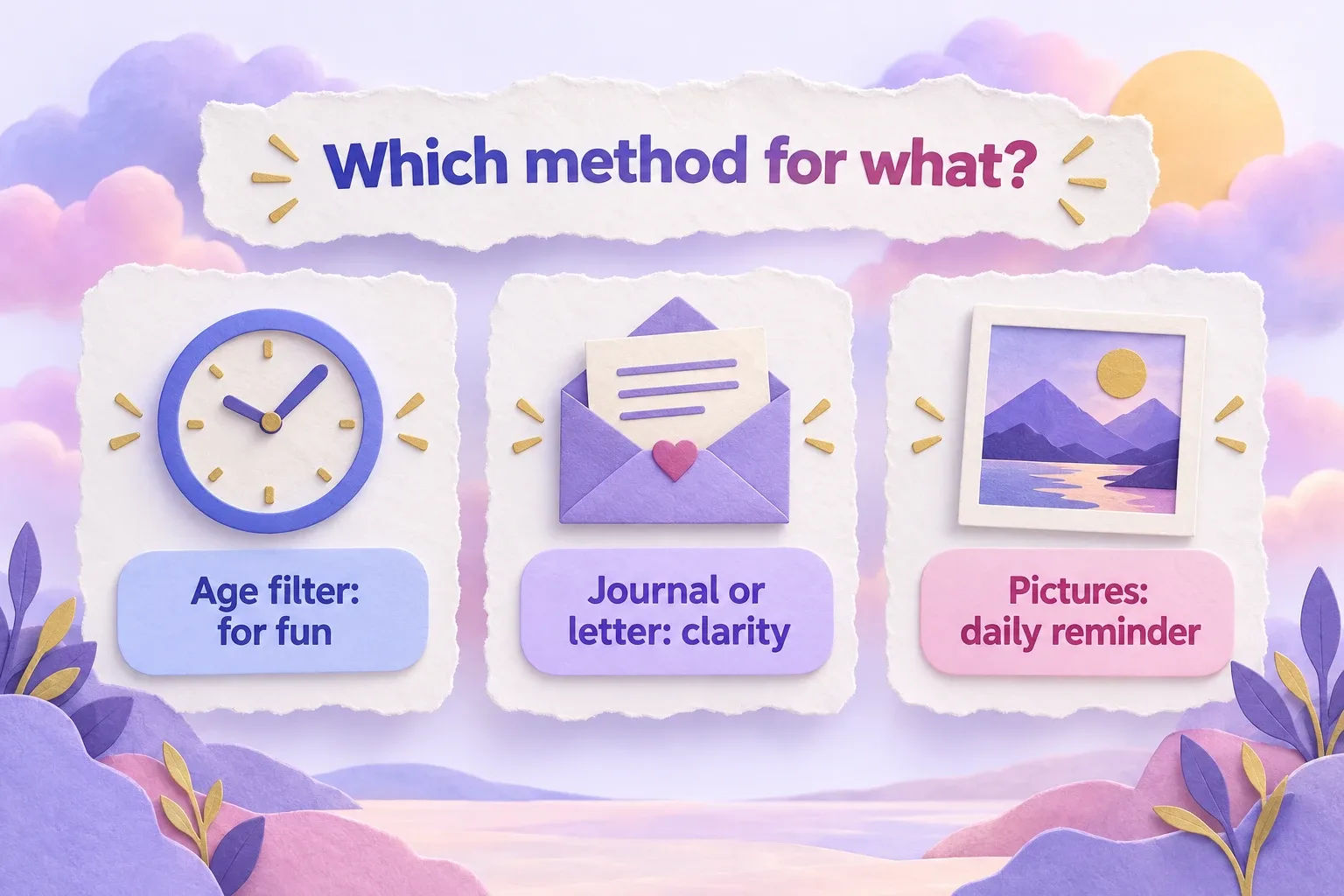
Use an age filter for fun and a quick nudge about your older self. Use journaling or letters to get clear on what you want. Use pictures of your future life to keep that clarity in front of you every day. They combine well: write the scene, make the picture, then check in with a short letter each week.

See your future self: paper-craft columns matching age filter, journal or letter, and pictures to their uses
Method What it shows you What research supports Time Privacy note
Face-aging app An older version of your face Aged faces nudged saving and honesty in small lab studies About a minute You upload a selfie; run the checklist
Best possible self journaling Your ideal future, in words A short-term lift in positive mood (students, two weeks) 15 minutes a day Stays in your notebook or device
Letter to your future self Your hopes and questions, from today Linked to more exercise and less rule-breaking in small studies 15 to 20 minutes Private unless you use an online service
Letter from your future self Your future voice, looking back Not tested on its own; a popular practice About 15 minutes Private
Photos of you living your wishes You inside the scenes you want Not tested directly; builds on the vividness research Under an hour You upload a selfie; run the checklist

For more on the evidence, see our honest look at whether vision boards work.

What can seeing your future self not do?

Seeing your future self can't predict what will happen, guarantee a result, or replace action. An aged face isn't a health forecast, and a picture of your dream home isn't a savings plan. What it can do is make your goals clearer and your future self feel closer, which can make the next small step easier.

  • It's not a prediction. An age filter guesses at a face. A vision board shows a wish. Neither knows what 2027 holds.
  • It's not advice. Affirmations and vision boards are a mindset practice, not a substitute for medical, mental-health or financial advice. If a scene is about your health or money, pair it with a real plan and, where needed, a professional.
  • It can backfire as pure fantasy. If looking at the picture starts to feel like the win, you may do less. Keep the first step next to the image.
  • It won't help if the wish isn't yours. If a scene brings pressure instead of pull, swap it.

How do you start today?

Start with ten minutes: pick one date, write one scene, and name one first step. Then give that scene a picture you'll see every morning. One vivid scene you look at daily beats a full board you never open.

A 10-minute start:

  1. Minutes 1 to 2: Write a date at the top of a page, like December 31, 2027.
  2. Minutes 3 to 7: Write one scene using the script from Step 3.
  3. Minutes 8 to 10: Write one first step and put it in your calendar for this week.

Then add the picture. Wondering which scenes to choose? Start from 101 New Year's resolutions for 2027 and turn your favorite into a scene. If you'd rather see yourself in it than a stranger, your first Manifest Mosaic picture is free. The full board is nine photos of you, one per wish, plus a print-ready poster, phone wallpapers, three free swaps and those 30 morning letters, for $19 paid once, no subscription. You can also give someone their 2027 for Christmas, New Year's Eve or a birthday. They open an envelope on the day you choose and add their own selfie. For layout and placement ideas, see our guide to making a 2027 vision board.

More guides to go with this one:

See yourself living it in 2027 — make your first picture free →

Sources & Methodology

Methodology: This guide reviews published studies on future self-continuity, future thinking, mental simulation and positive fantasy, plus company statements and news reporting on face-aging app privacy. Company claims are presented as the companies' own statements. No study has tested photos of people living their future goals; we describe that as a reasoned extension of the research. The scenarios and example letter are illustrations we wrote. Sources checked September 2026.


Questions

Frequently asked questions

Yes. Many face-aging apps offer a free older-face filter, and writing a dated scene or letter from your future self costs nothing. To see yourself living a future goal, Manifest Mosaic makes your first picture free from one written wish and one selfie.

They aren't predictions. A face-aging app makes up an older version of your face from patterns in many other faces. It can't know your genes, habits, sleep or sun exposure, so treat the result as a fun sketch of one possible older you, not a forecast.

Many are fine to try if you read the privacy policy first. Check how long your photo is kept, who processes it, how to delete it, and whether it's used to train their systems. FaceApp, for example, says photos may stay in the cloud for 24 to 48 hours.

Small studies suggest it can help. Seeing an aged face nudged saving and honesty in lab tasks, and picturing specific future events made choices more patient. Picturing only the happy ending can lower your energy, so pair each picture with a first step. It isn't a guarantee.

Future self-continuity is how connected you feel to the person you will become. Psychologist Hal Hershfield describes three parts: how vivid your future self is, how similar they feel to you, and how positively you see them. Feeling more connected is linked to saving more.

No app or test can tell you. What you can do is decide what you want it to look like, write it as a specific scene with a real date, and name one small step for this week. That turns a guess into a plan you can act on.

Your first picture is free

See yourself in 2027.

Write what you want from next year, add one selfie, and see a photo of you already living it. Then turn all nine wishes into your board.