

Letter to Future Self: Prompts + Examples

Write a letter to your future self in 7 steps. Get 25 prompts, a copy-paste template, four short examples and the best date to open it, with a plan for 2027.

Letter to Future Self: Prompts + Examples
In this guide 11 sections
  1. 01What is a letter to your future self, and why does it work?
  2. 02How do you write a letter to your future self?
  3. 03What should you include in a letter to your future self?
  4. 04What are the best letter to future self prompts?
  5. 05What is a good letter to future self template?
  6. 06What do good letter to future self examples look like?
  7. 07When should you open your letter?
  8. 08Should you write it by hand, email it or use an app?
  9. 09Does writing to your future self really work?
  10. 10Is there a numerology angle for 2027?
  11. 11Sources & Methodology

A letter to your future self is a note you write today and open on a date you choose, such as December 31, 2027. You describe your life right now, name your hopes, ask a few questions and make one small promise. Then you seal it and forget it.

It takes about 20 minutes. Below you'll find seven steps, 25 prompts, a template, four short examples and honest notes on what the research does and doesn't show.

Key Takeaways
  • Start with a snapshot of today, then hopes, three questions and one small promise with a check-in date.
  • A year is a good default wait. Long enough to forget the details, short enough to still recognize yourself.
  • Be specific. "I'm nervous about the March interview" beats "I'm worried about work."
  • Leave out passwords, account numbers and other people's secrets.
  • The research is small and promising, not proof. In one experiment, people who wrote to a self 20 years ahead exercised more than those who wrote to a self 3 months ahead.
  • This guide is about writing TO your future self. Writing AS your future self is a different exercise, covered in our companion guide.

What is a letter to your future self, and why does it work?

A letter to your future self is a private message from the you of today to the you of some later date. It works because it makes that later person feel real. Psychologists call this "future self-continuity": how connected you feel to the person you'll become. Feeling closer to that person may change how you treat them.

The idea is old and simple: it's a cousin of the time capsule, a container sealed to be opened on a later date. The site FutureMe has been delivering letters since 2002 and says it has sent over 20 million letters in 20 years. A letter is a small tool for a big habit: pausing to look at your life from the outside.

Letters pair well with a picture of the same year, so if you're planning the whole thing, start with our guide to making a 2027 vision board. Set fair expectations. A letter is a reflection and commitment tool. It won't fix a hard year or make anything happen by magic. What it can do is get you clear on what you want, give you something to measure yourself against, and hand you a surprise a year from now.

If you want to go deeper on the daily habit, our guide to future self journaling has prompts and a method. If you want the flip side, where you write in the voice of your future self, read our guide to the letter from your future self. The two work well as a pair, and this article won't repeat that guide's example letter.

How do you write a letter to your future self?

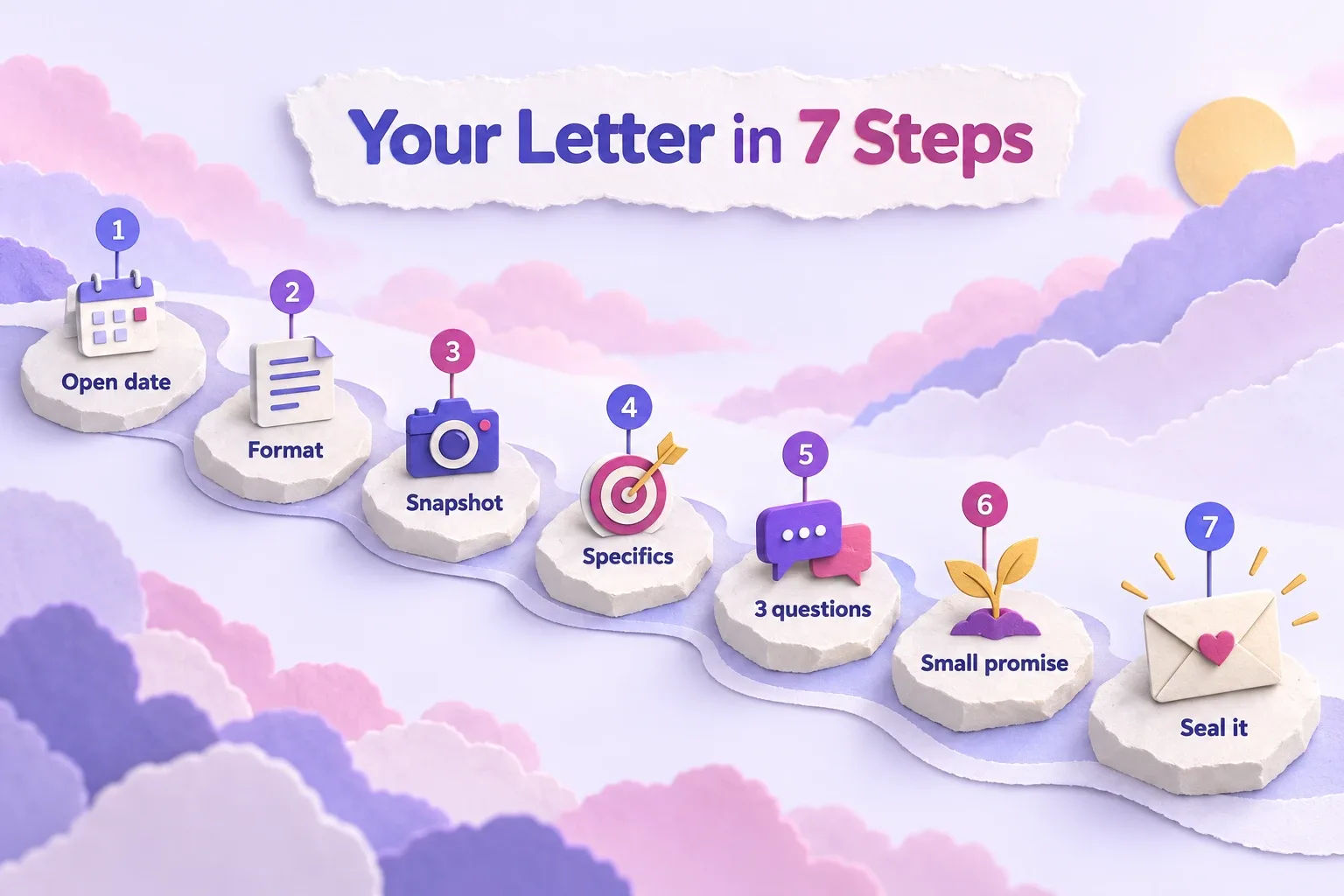
To write a letter to your future self, choose an open date, pick paper or email, and describe today in specific detail. Add a few hopes, ask three questions your future self must answer, make one small promise with a check-in date, then seal the letter and set a reminder.

  1. Pick your open date. Choose a real day, not "someday." December 31, 2027 works well if you're writing in late 2026. A birthday also works.
  2. Pick a format. Paper, email or a keepsake you can print. (More on this below.)
  3. Start with a snapshot of today. Write the date, where you are, the weather, what you did this morning and what's on your mind. Small details are what you'll enjoy most later.
  4. Write three to five specifics. Name real people, real numbers and real plans. "I'm saving for the deposit, and I have $2,300 so far" is a better time capsule than "I'm working on money."
  5. Ask three questions. Make them ones your future self can answer with a fact: "Did you finish the course? Are we still living here? What are you proud of?"
  6. Make one small promise and a check-in date. For example: "I'll walk after dinner three times a week. Check in on March 1."
  7. Seal it and set a reminder. Put the open date in your calendar today. A letter you forget to open is a waste.
✅Is Your Letter Ready to Seal?
0/9

Set it up

Write it

Seal it

Aim for one to two pages. You're not writing a masterpiece. Write like you're talking to a friend who lives a year away.

What should you include in a letter to your future self?

Include a snapshot of today, the people who matter, a recent win, a worry, your hopes for 2027, one habit you want to build, three questions and one kind sentence. Those eight pieces give your future self both a memory and a to-do list, without turning the letter into a wish list.

  • Snapshot. The date, the place, the weather, what you're doing.
  • People. Who's in your life, and one thing you love about each.
  • A win. Something you're proud of right now, however small.
  • A worry. Name it plainly. You'll love seeing how it turned out.
  • 2027 hopes. Three at most. Fewer is better.
  • One habit. One, not five.
  • Three questions. Ones with real answers.
  • One kind sentence. Something you'd say to a friend.

What to leave out

Never put passwords, bank or account numbers, or anyone else's secrets in a letter, especially one stored online. Skip anything you'd hate a stranger to read. Check the privacy settings on any service you use.

Write to a further-out self, too

Distance seems to matter. In an experiment reported by Columbia Business School, 250 people wrote a letter to themselves 20 years ahead and 250 wrote to themselves 3 months ahead. The 20-year group were 1.43 times more likely to exercise and exercised 1.40 times longer in the following days. So consider two letters: one to open in a year, and one deep letter for a much later date, like your 50th birthday.

What are the best letter to future self prompts?

The best prompts are specific and sorted by purpose, so you never stare at a blank page. Pick five for a quick version or work through all 25. Each group below does a different job. Answer in a sentence or a paragraph, whatever comes.

Letter to future self prompts: three friends share ideas on a mountain cabin porch with tea and clipboards

Right now (the snapshot)

  1. What did you do this morning, in order?
  2. What's the weather, and what can you hear right now?
  3. What's taking up most of your mind this week?
  4. What song, show or meal is on repeat?

2027 goals

  1. What is the one thing you most want to be true by December 2027?
  2. What would a great ordinary Tuesday in 2027 look like?
  3. What are you ready to stop doing?
  4. What would you try if you knew nobody was watching?

Hard seasons

  1. What's the hardest thing you're facing today?
  2. What are you afraid will happen? What might actually happen?
  3. What do you need to hear on a bad day?

Relationships

  1. Who do you want to be closer to by next year?
  2. What have you been meaning to say to someone?
  3. Who has been kind to you lately?

Habits and health

  1. What's one habit you'd like to be automatic by then?
  2. How do you feel in your body today, from 1 to 10?
  3. What does rest look like for you?

Gratitude

  1. What are five small things you're grateful for today?
  2. What did you take for granted this year?

The wildcards

  1. What advice would you give to the you of five years ago?
  2. What are three things you're certain will still be true in a year?
  3. Which of your beliefs might have changed by then?
  4. What's your biggest guess about who you'll be?
  5. What do you hope your future self is proud of?
  6. What do you want to say thank you for, in advance?

The researched prompt

The Columbia experiment above used a simple prompt: think about who you'll be in 20 years, then write about the person you are now, the topics that matter to you and how you see your life. Try it as a warm-up. If you like daily writing, our gratitude journal prompts and manifestation journal guide pair well with any of the groups above.

What is a good letter to future self template?

A good template has a date, a snapshot, hopes, worries, questions, one promise and a sign-off. Copy the one below and fill in the blanks. It works on paper or in an email, and it takes about 15 minutes. The short version keeps only the lines in bold.

Letter to future self template: paper-craft path of seven steps from open date to seal it

Dear [your name],

Today is [date]. I'm writing from [place]. Right now, I'm [what you're doing]. The weather is [weather].

Three things on my mind: 1. ___ 2. ___ 3. ___

Three things I'm proud of or grateful for: 1. ___ 2. ___ 3. ___

Three hopes for [year]: 1. ___ 2. ___ 3. ___

Three fears I'm carrying: 1. ___ 2. ___ 3. ___

Three questions for you: 1. ___ 2. ___ 3. ___

One promise: I'll [tiny action]. I'll check in on [date].

One kind thing I want you to know: ___

With love, [your name], [date]

Print it, hand-write it, or paste it into an email. Save a copy, since the reminder is only useful if the letter survives.

What do good letter to future self examples look like?

Good examples are concrete, honest and gentle. They name real details, ask real questions and end with a small next step. Here are four short originals, each about 80 words, with a note on why it works. We wrote them for illustration; they aren't real people's letters.

Example 1: A New Year letter (write December 31, 2026; open December 31, 2027)

Dear me, it's 11:40 p.m. and the takeout is cold. This year I finally stopped saying "one day" about the pottery class. Next year I want to be less tired. I'm scared I'll still be answering emails at midnight. Did you sign up? Did you leave the job that keeps you up? Did you call Mom more? My promise: I'll book the class this week. Check in on March 1.

Why it works: a sensory detail, an honest fear, three real questions, a dated promise.

Example 2: A hard-season letter

Dear future me, right now I can't tell if this will get better. I'm not sleeping much and I've cancelled on two friends. Today I did the dishes and took a short walk, and that's enough for a Tuesday. If you're reading this and it did get easier, please be kind to the version of me who kept going. If it hasn't, I hope you asked someone for help.

Why it works: it doesn't fake cheer, and it ends with kindness. If a hard season feels bigger than a letter can hold, please talk to someone; there is a note on that in the research section.

Example 3: A move-to-a-new-city letter

Dear you, the boxes are still in the hall. I don't know anyone here, and the streets don't feel like mine yet. I'm proud that I said yes to the invite on Saturday. By the time you read this, I want a regular coffee shop, two friends and a route I don't need a map for. Where's your favorite place now? Who did I meet first?

Why it works: clear markers of success that a future self can check off.

Example 4: A letter to open at 40

Dear 40-year-old me, I'm 32 and sure I know how life goes. I bet I'm wrong about a few things. Right now I care about being liked at work and about getting to the gym. I hope you care less about the first. I hope you're still close with Sam. Is my knee okay? Do you still make pancakes on Sundays? Tell me what surprised you.

Why it works: it expects to be wrong, and it asks the older you to report back.

When should you open your letter?

Open your letter after a length of time that fits its purpose. A year is the best default, because it's long enough to forget the details and short enough to recognize yourself. FutureMe's own quick options are 6 months, 1 year, 3 years, 5 years and 10 years, and its date picker goes much further.

Letter to future self open date: a man tucks a sealed envelope into a wall calendar on a city balcony
Open after Good for Watch for
6 months A short project, a new job, a move You may remember everything you wrote
1 year A New Year letter, a birthday, a 2027 plan The best all-round choice
3 years A degree, a big goal, a new relationship You may have forgotten the letter exists
5 years A life stage, a big decision Your email or address may change
10 years A time capsule for your future self Store a paper copy somewhere safe
20 years The "distant self" letter Best as a second, deeper letter

A simple 2027 plan: write it on December 31, 2026 and open it on December 31, 2027. Or write it on your birthday and open it on your next one. When you open it, don't just read it. Mark what came true, cross out what didn't, and write a short reply. Then write the next letter.

Researchers have found that people tend to underestimate how much they'll change. In a well-known 2013 paper, people expected to change less over the next decade than they had changed over the last one. The finding is contested, because it compared different people rather than following the same people over time. Treat it as a hint, not a law. Still, it's a good reason to write to a self you might not recognize.

If you'd like a picture to go with your words, Manifest Mosaic can turn your wishes into photos of you already living them in 2027, and your first picture is free. Some people tape a photo to the outside of the envelope. And if you're planning your year, our guides to 2027 goals and New Year's resolutions for 2027 make good companions.

Should you write it by hand, email it or use an app?

Any format works, so pick the one you'll actually finish. Paper is private and personal, but it can be lost. Email is easy to schedule, but it only works if the address and service still exist. A service like FutureMe handles delivery for you. Whatever you choose, keep a backup copy.

  • Paper. Feels the most personal. Store it in a fireproof folder or with something you'll open on that date. Write the open date on the envelope.
  • Email to yourself. Use a scheduled-send feature or a service like FutureMe. Use an address you'll keep for years, not a work address.
  • A letter service. Handy for delivery. At the time of writing, adding images, video or files on FutureMe needs a paid upgrade. Check the current terms and privacy settings before you write anything sensitive.
  • A keepsake. Print your letter, sign it and tuck it into a book you'll reread.

The safest plan is two copies: a handwritten one in a drawer and a typed one scheduled by email. If you're giving this idea to someone else, our gift is a way to hand a friend their 2027 to open on a day you choose.

Does writing to your future self really work?

It can help, in small ways, but the evidence is early. The best-known studies look at how connected people feel to their future selves and at short-term behavior. None prove that a letter changes your life. Here is what each study did and did not find.

  • Rutchick, Slepian, Hershfield and colleagues. In a survey of 191 people, those who felt closer to their future self reported better health. That was a link, not a cause. In the experiment above, writing to a self 20 years ahead was followed by more exercise than writing to a self 3 months ahead. It measured exercise afterward, not general life outcomes.
  • Hershfield and colleagues (2011). Across four studies, people who saw realistic, age-progressed images of themselves in virtual reality were more likely to choose a later reward over a smaller, immediate one. That was a lab task, not proof of real-world saving. It isn't financial advice.
  • Quoidbach, Gilbert and Wilson (2013). In six studies of more than 19,000 people aged 18 to 68, people underestimated how much their personality and values would change in the next decade. This "end-of-history illusion" is debated, and it says nothing about letters directly.

If you want the wider picture of how seeing your future life more vividly can shape choices, read how to see your future self. And for other ways to turn intentions into action, see how to manifest in 2027. The honest summary: a letter is a promising nudge. Affirmations and vision boards are a mindset practice, not a substitute for medical, mental-health or financial advice. If writing brings up dark feelings, set it aside. If you're struggling or thinking about suicide, call or text 988 (US) or contact your local emergency number (988 Lifeline).

It also helps to know habits take time. In one study, a new habit took an average of 66 days to feel automatic, with a range of 18 to 254. If your letter includes a promise, give it more than a week.

Is there a numerology angle for 2027?

In numerology, 2027 adds up as 2 + 0 + 2 + 7 = 11, which reduces to 2, so numerologists call it a Universal Year 11/2. Numerology is a belief system, and there is no scientific evidence that numbers shape events. It can still be a fun frame for a reflective letter.

If the number interests you, read our guides to 2027 numerology and your personal year number for 2027, then pick a theme from them as the focus of your letter. You can also check your numbers with the free numerology blueprint. The letter works through reflection, not numbers. Choose a one-word theme, as in our word of the year ideas, and let it guide what you write.

The full Manifest Mosaic board also includes 30 morning letters from your future self, one a day for 30 days, each about a wish on your board. It's $19, paid once, with no subscription.

See yourself living it in 2027 — make your first picture free →

Sources & Methodology

Methodology: This guide draws on published studies of future self-continuity and on the practice of writing time-capsule letters. Study results are described with their limits, and beliefs such as numerology are presented as traditions, not research. The example letters were written by us for illustration. Sources checked September 2026.

Questions

Frequently asked questions

It can be a calm, reflective habit, and small studies link future-self exercises to feeling more connected to your later self. It is not therapy and does not treat anxiety or depression. If you are struggling, talk to a professional or someone you trust.

One year is a good default because it is long enough to forget what you wrote. Six months suits a short project, and five or ten years gives bigger surprises. Pick a date you can picture, like December 31, 2027.

Both work. Paper feels personal and needs no account, but it can get lost. Email is easy to schedule but only works if the address survives. Many people write by hand, then type a copy and schedule it.

That is normal, and it often means you have grown. Read it kindly, mark what came true, cross out what no longer fits, and write a short reply as your present self. The cringe is part of the point.

A letter to your future self is written by today's you and opened later. A letter from your future self is written in the voice of the person you will be, looking back. Many people do both as a pair.

Your first picture is free

See yourself in 2027.

Write what you want from next year, add one selfie, and see a photo of you already living it. Then turn all nine wishes into your board.