What does a quarterly plan for 2027 look like?
A quarterly plan splits 2027 into four 13-week blocks, plus a preparation runway this autumn. Q4 2026 is for reflecting and choosing, Q1 is for starting, Q2 and Q3 are for adjusting, and Q4 2027 is for finishing, resting and reviewing.
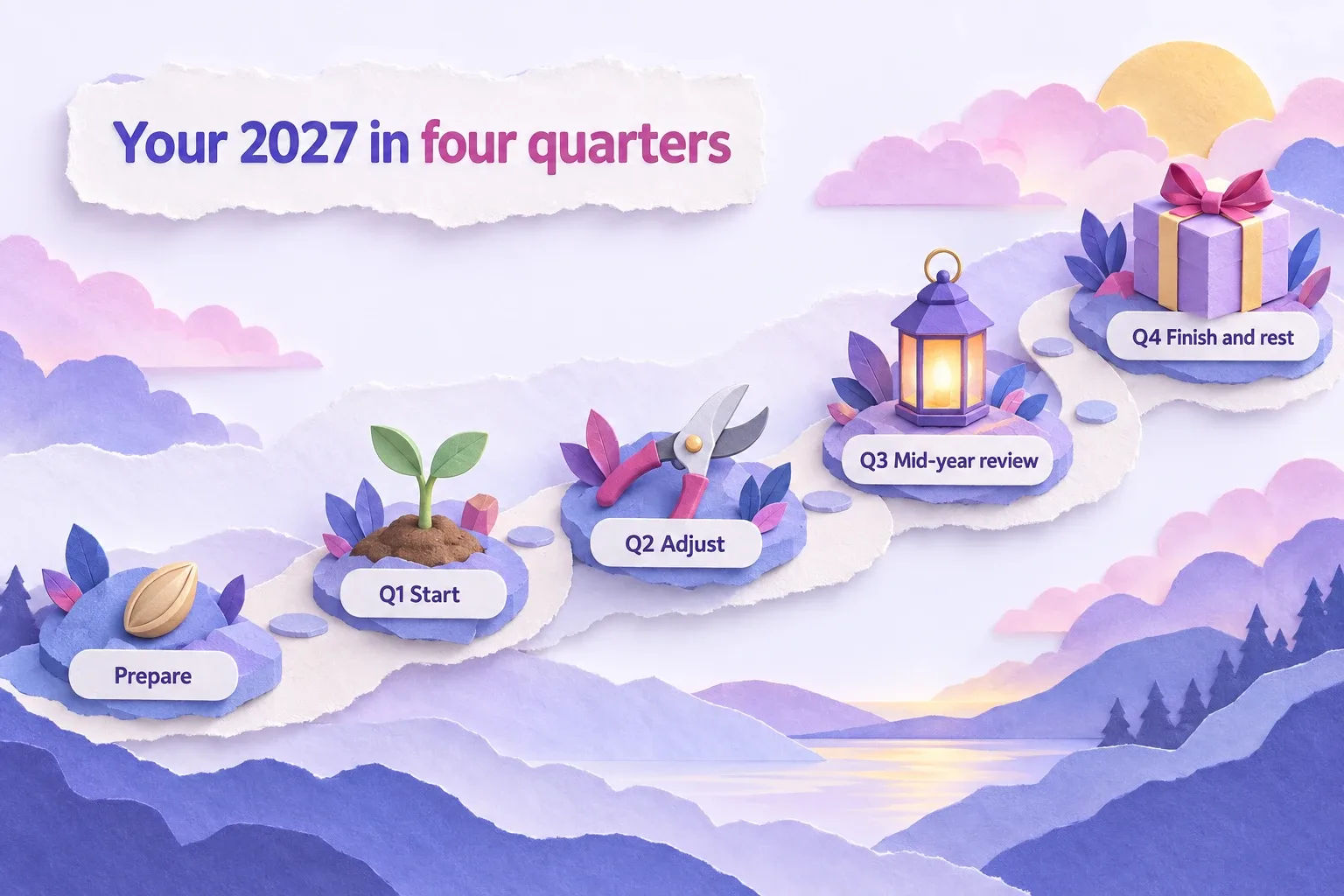
- October to December 2026: reflect, choose, prepare. October: look back at 2026. November: choose your areas and write your goals. December: add if-then plans, tell one person, and try each new habit in a tiny form.
- Q1, January to March: start. January 1, 2027 is a Friday. You can start that day or wait for Monday, January 4. Keep the first version small. Hold your first quarterly check-in at the end of March.
- Q2, April to June: adjust. Keep what works. Shrink or drop what doesn't. Changing a goal is not failing. It is editing.
- Q3, July to September: mid-year review. Ask what you would do differently. If you like a sky marker, the total solar eclipse on 2 August 2027 makes a memorable halfway checkpoint.
- Q4, October to December: finish, rest, review. Do the last push, celebrate what you did, and write next year's list.
January 1 is not your only fresh start. Dai, Milkman and Riis found in three archival studies that Google searches for "diet," gym visits and commitment-contract goal creation rose after temporal landmarks such as the start of a new week, month or year. Mondays and the first of each month are natural restart points. Your birthday is another.
What if you miss a week (or a month)?
If you miss a week or a month, shrink the goal, restore the if-then plan and restart at the next fresh landmark, such as Monday or the first of the month. One slip does not erase your progress. Skip the guilt and make the next action tiny.

Picture this. You planned to walk after lunch. Then you caught a cold in late January and missed ten days. It is now February 8, and you feel like you blew it. You didn't.
Here is a comeback protocol:
- Name what happened. "I was sick and busy" is a reason. "I'm a failure" is not.
- Shrink the goal. Walk five minutes, not 30. Make it too small to skip.
- Reset the if-then plan. "If I finish lunch, then I put on my shoes." Change the cue if the old one no longer fits your day.
- Pick the restart date. The next Monday or the first of the month works well.
- Get light support. Text your accountability person: "I'm restarting Monday." In the Swedish experiment, the group with some support beat the control group, and the extended-support group did not do better than that. Use this as a nudge to ask for a little help, not proof that more is better.
If a goal still feels wrong after a restart, change it. Goals should fit your life. Your life does not have to fit them.
Does 2027 being a Universal Year 2 (11) in numerology mean anything for your goals?
In numerology, 2027 adds up to 2 + 0 + 2 + 7 = 11, which reduces to 2, so practitioners call it a Universal Year 11/2. Numerology is a belief tradition, not evidence, and fact-checkers classify it as pseudoscience. It can still work as a journaling theme, nothing more.
In the tradition, 2026 was a Universal Year 1, linked with beginnings. Many practitioners describe a 2 as a theme of partnership, patience and cooperation, and the master number 11 as intuition and vision. You can read more in our guide to 2027 numerology. If you want to see your own numbers, try the numerology blueprint tool, or read what each life path number means. A life path 7, for example, tends to prefer quiet, reflective goals over loud ones.
Numerology can't predict your money, health or relationships, and it does not make your goals more or less likely to happen. If the theme is useful, use it as a question for your journal: What partnership or patience does my year need? Then turn the answer into a goal with a date and an if-then plan. The plan is where the evidence is.
Do written goals and letters to your future self actually help?
Writing goals down appears to help, and making your future self vivid is a promising idea, but neither is a guarantee. The best-known evidence is small: a 2015 conference study on written goals and a lab experiment on age-progressed photos. Both are useful nudges, not proof.
We covered Matthews's study in Step 7. It is real, but small, short and focused on work goals. It is not the same as the 1953 Yale story, which never happened.
The second piece of evidence is about the future self. In Hershfield and colleagues' 2011 experiment, working-age people who interacted with age-progressed images of themselves said they would put about 33% more of their pay into retirement accounts than a control group. That was a hypothetical allocation in a lab, not real savings over time, and it is not financial advice. It hints that a concrete picture of a future you can matter. If that is hard to picture, this guide to how to see your future self is a good place to start.
That is the idea behind Manifest Mosaic's "See yourself in 2027." You write what you want from 2027, add one selfie, and get photos of yourself already living it. Your first photo is free. The full vision board is $19, paid once, with no subscription. It includes nine photos of you (one per wish), a print-ready poster, phone wallpapers, three free swaps, and 30 morning letters from your future self, one a day for 30 days, each about a wish on your board. We can't promise results. Think of the photos as a keepsake and a prompt that sits beside your plan. To go deeper, read about the letter from your future self method and how to build a 2027 vision board.
If you want a person on your side, you can give someone their 2027 for Christmas, New Year's Eve or a birthday. They open an envelope on the day you choose and add their own selfie. It costs $19, and our New Year gift ideas have more ways to mark the turn of the year, and manifestation gifts collects 25 meaningful ideas. If you'd like a ritual for the night itself, see these New Year's Eve rituals.
Affirmations and vision boards are a mindset practice, not a substitute for medical, mental-health or financial advice.
See yourself living it in 2027 — make your first picture free →
Sources & Methodology
Oscarsson et al. (2020), "A large-scale experiment on New Year's resolutions: Approach-oriented goals are more successful than avoidance-oriented goals," PLOS ONE — supports the 58.9% vs 47.1% approach-goal finding, the 55% one-year figure and the Norcross & Vangarelli follow-up numbers.
Gollwitzer, "Implementation Intentions" chapter summary, US National Cancer Institute — reports the Gollwitzer & Sheeran (2006) meta-analysis of if-then plans across 94 studies.
University of Surrey (2026), "Does it really take 66 days to form a habit? We asked the expert, Dr Pippa Lally" — supports the 66-day average, the 18-254 day range and the quote on behaviour change.
Matthews (2015), "Goals Research Summary," Dominican University of California — supports the written-goals and weekly-update comparison, with the small-study caveats.
Dai, Milkman & Riis (2014), "The Fresh Start Effect: Temporal Landmarks Motivate Aspirational Behavior," Management Science — supports the idea that new weeks, months and years work as restart points.
Methodology: We used the primary studies and summaries linked above and quote percentages as reported. Several results rely on self-report, effect sizes are not percentages, and numerology is described as a belief tradition. Written on 29 September 2026.

 Manifest Mosaic