Which Life Path Numbers Are Compatible?
Numerology has no single compatibility chart. Many online charts pair 1 with 5, or 2 with 6, and describe some pairs as easy and others as challenging, but the pairings change from site to site. No study has shown that any pairing predicts whether a relationship, friendship or business partnership will last.
Numerologist.com frames compatibility around what each number asks of you, not as a verdict. That's the helpful version: a conversation starter, not a test your relationship can pass or fail.
Try this with a partner or friend:
- Read each other's section out loud, and each name one line that fits and one that doesn't.
- Ask: "Where do our growth edges bump into each other?" A 1's impatience and a 2's indecision can make a simple choice feel like a standoff.
- Agree on one small thing that would help, like the 2 naming a preference first and the 1 waiting a beat.
Scenario: you're a life path 8 and your partner is a 6. A chart calls the pair "challenging." Read both sections instead and you'll notice the 8's growth edge is overwork and the 6's is over-giving. That's a useful talk about who carries what at home, and it has nothing to do with fate.
Affirmations and vision boards are a mindset practice, not a substitute for medical, mental-health or financial advice. The same goes for numerology, and for any decision about a relationship.
Where Does the Life Path Number Come From?
The life path number comes from an early-1900s American system, built on much older number symbolism. Many sites say Pythagoras invented it, but no authentic writings of Pythagoras survive. Today's birth-date method was shaped by writers such as L. Dow Balliett of Atlantic City, New Jersey, over 2,000 years later.
Here's the history in order:
- Names as numbers (ancient). In the 8th century BCE, the Assyrian king Sargon II built the wall of Khorsabad 16,283 cubits long to match the numerical value of his name. The Greeks practised isopsephy, adding up letter values, a practice related to Hebrew gematria (Wikipedia: Gematria).
- The Pythagoreans (from about 500 BCE). Pythagoras's followers held that numbers were the elements of all things. But almost nothing is known for certain about Pythagoras himself. Scholars such as Walter Burkert credit the number philosophy to a later Pythagorean, Philolaus of Croton, whose fragments are the earliest texts describing it (Wikipedia: Pythagoras). The Skeptic's Dictionary adds that "there is no evidence that Pythagoras thought he could analyze his disciples' personalities by assigning numbers to the letters of their names and their birth dates."
- The modern system (early 1900s). Mrs. L. Dow Balliett, born Sarah Joanna Dennis in 1847, is credited with creating the modern style of numerology. Her first book, How to Attain Success Through the Strength of Vibration: A System of Numbers as Taught by Pythagoras, came out in 1904, followed by The Philosophy of Numbers in 1908 (Wikipedia: Mrs. L. Dow Balliett). Numerologist.com also credits her with the A=1 to I=9 letter chart and with keeping 11 and 22 unreduced.
- Her students. Juno Jordan studied with Balliett as a teenager and later founded the California Institute of Numerical Research, which formalised more of the system, according to Numerologist.com.
The word "numerology" itself only came into use in the early 1900s. "Pythagorean numerology" is an ancient name on a modern American system.
Is Life Path Numerology Real?
No, not in any scientific sense. There is no controlled evidence that your birth date shapes your personality, your career or your relationships. Wikipedia's numerology entry describes it as a pseudoscience. Numerology is best understood as a belief tradition: meaningful to many people, useful for reflection, but not a way to predict anything.
Why do readings feel so accurate? Psychologists call it the Barnum, or Forer, effect: people rate vague, general personality descriptions as highly accurate for themselves. In psychologist Bertram Forer's classic classroom test, 39 students each got the identical 13-item profile, taken from an astrology book, and rated it about 4.3 out of 5 for accuracy (Wikipedia: Barnum effect).
Try it: read the sections for 2, 6 and 9 above. Most kind people will see themselves in all three.
The fair take: if your number hands you a useful question, such as "Where am I being too rigid?" for a 4 or "What have I been avoiding saying?" for a 2, answer it. The value comes from the attention you give it. Don't make a big decision, such as a job, a move or a breakup, because of a number.
How Can You Use Your Life Path Number in 2027?
Use your life path number as a theme for choosing what you want in 2027. Pair it with your 2027 personal year, then write three to nine wishes that fit you. The number decides nothing. It gives you a starting question: what would a good year look like for someone like me?

In numerology, 2027 is a Universal Year 11/2, because 2 + 0 + 2 + 7 = 11 (our 2027 numerology guide explains the themes). Your personal year is your reduced birth month + reduced birth day + 11, reduced again. For July 6, 1989, that's 7 + 6 + 11 = 24, then 2 + 4 = 6. So a life path 22/4 walks into 2027 in a personal year 6: a builder in a year the tradition ties to home and care.
Now turn your number into wishes. A 4 or 22 might wish for a home or a steady side business, a 5 for travel or a move, an 11 for creative work, a 6 or 33 for family time. The comparison table above has an idea for every number.
Scenario: say you were born April 2, 1988. That's 4 + 2 + 8 = 14, then 1 + 4 = 5: a life path 5, the freedom seeker. Your 2027 personal year is 4 + 2 + 11 = 17, then 8, a year the tradition ties to achievement. So your wishes might pair freedom with a clear target. Write them in the first person and present tense: "I'm working from Lisbon for a month in spring 2027, with my savings goal already met."
Then make them visible. A 2027 vision board keeps your wishes in view every day. With Manifest Mosaic, you write what you want from 2027, add one selfie, and get photos of yourself already living it. Your first picture is free. The full board is $19, paid once, no subscription: nine photos of you (one per wish), a print-ready poster, phone wallpapers, three free swaps, and 30 morning letters from your future self, one a day, each about a wish on your board. You can also write one yourself with our guide to a letter from your future self.
Know a friend's number? You can give someone their 2027 for Christmas, New Year's Eve or a birthday; they add their own selfie when they open it.
Writing wishes down may help. In a small 2015 study by Gail Matthews, people who wrote goals down achieved more, and those who also sent weekly progress updates to a friend did best: 76% reached their goals or got more than halfway, versus 43% of those who didn't write them down. It was presented at a conference, not peer-reviewed, so treat it as encouraging, not proof (Matthews research summary).
To go deeper into one number, see our guide to life path 7, or read about angel numbers if repeating numbers catch your eye. If a number keeps showing up on clocks and receipts, what 333 means is a good place to start, and once you know your number you can turn it into a plan with New Year's resolutions for 2027.
More numerology and 2027 planning guides:
See yourself living it in 2027 — make your first picture free →
Sources & Methodology
Numerologist.com (accessed 2026), "Life Path Numbers, All 12 Meanings + the Correct Calculation," Numerologist.com — the reduce-each-part method, the warning about the add-every-digit shortcut, and the "what each number asks of you" framing for compatibility.
Numerologist.com (accessed 2026), "Master Numbers 11, 22, 33," Numerologist.com — classical traditions recognise only 11 and 22; 33 is newer and sometimes read as 6.
Wikipedia (accessed 2026), "Mrs. L. Dow Balliett," Wikipedia — Balliett's life, her role in modern numerology and her book dates.
Wikipedia (accessed 2026), "Pythagoras," Wikipedia — no authentic writings survive; Burkert's attribution of the number philosophy to Philolaus.
Wikipedia (accessed 2026), "Barnum effect," Wikipedia — Forer's classroom test (39 students, about 4.3 out of 5) and why general readings feel personal.
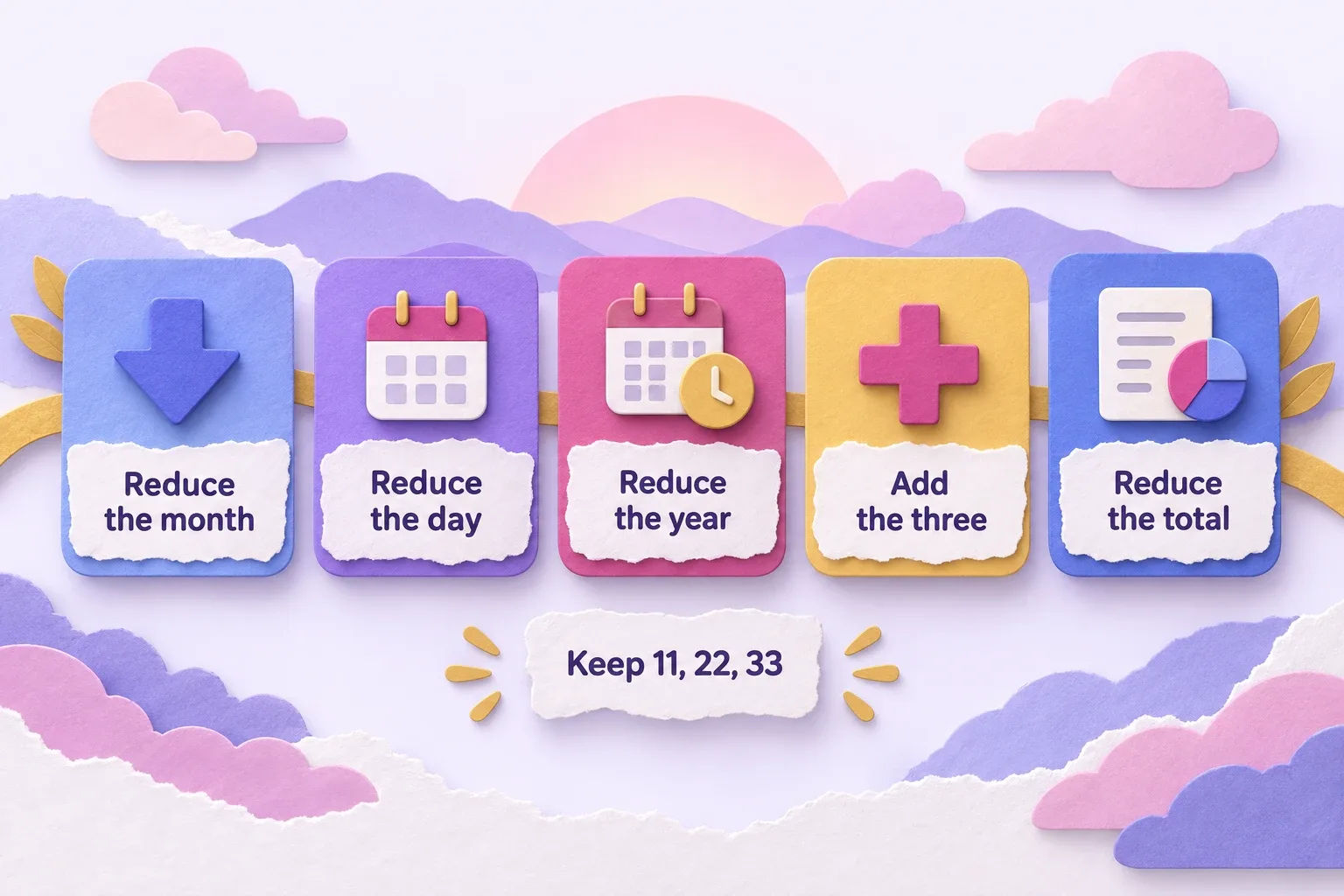
Methodology: All life path numbers in this article use the standard method: reduce month, day and year separately (keeping 11 and 22 in the parts), add, and reduce, stopping at 11, 22 or 33. The disagreement rates (14.1% and 9.1%) and the rarity figures are our own counts across all 29,585 calendar dates from 1930 to 2010, checked in code; they are not a published statistic. Meanings summarise common numerology sources and are presented as a tradition, not a prediction.

 Manifest Mosaic