

2027 Numerology: Universal Year 11/2

Numerology 2027 explained: why 2027 is a Universal Year 11/2, how it differs from 2026, how to find your personal year, the real history and how to use it.

2027 Numerology: Universal Year 11/2
In this guide 11 sections
  1. 01How Do You Calculate the Universal Year for 2027?
  2. 02What Does 11/2 Mean in Numerology?
  3. 03How Is 2027 Different From 2026 in Numerology?
  4. 04How Do You Find Your Personal Year Number for 2027?
  5. 05Will 2027 Be a Good Year According to Numerology?
  6. 06Is Numerology Real or Scientifically Proven?
  7. 07Where Does Numerology Come From? Did Pythagoras Invent It?
  8. 08Is 2027 an Angel Number?
  9. 09How Can You Use 2027's Themes Without Leaning on Predictions?
  10. 10Final Thoughts: A Year for Listening
  11. 11Sources & Methodology

In numerology, 2027 is a Universal Year 11/2. Add its digits (2 + 0 + 2 + 7) and you get 11, a "master number" that numerologists keep whole, then reduce once more to 2 (1 + 1). The tradition links 2027 with intuition, partnership and patience. It is a belief system for reflection, not a forecast.

Key Takeaways
  • 2027 adds up to 11, a master number, which reduces to 2. That is why it is called a Universal Year 11/2.
  • 2026 was a Universal Year 1 (it adds up to 10, then 1), the start of a new nine-year cycle. 2027 is year two.
  • In the tradition, 1 is about starting and acting alone; 2 and 11 are about partnership, patience and intuition.
  • Numerologists split on the personal-year formula (add 11 or add 2). Both give the same final digit.
  • 2027 is not the first 11/2 year: 2009 and 2018 were too. You can check the themes against your own memory.
  • Numerology predicts nothing. Its best use is as a prompt to decide what you want and write it down.

How Do You Calculate the Universal Year for 2027?

To calculate the universal year, add the four digits of the year together. For 2027 that is 2 + 0 + 2 + 7 = 11. Most numerologists stop there, because modern schools don't reduce the master numbers 11 and 22. They then note the reduced base, 1 + 1 = 2. So 2027 is written as Universal Year 11/2.

Compare it with 2026: 2 + 0 + 2 + 6 = 10, and 1 + 0 = 1. Ten is not a master number, so 2026 is a plain Universal Year 1 (numerologycalc.org).

One thing most 2027 pages skip: this sum is not rare. 2009 (2 + 0 + 0 + 9), 2018 (2 + 0 + 1 + 8) and 2036 (2 + 0 + 3 + 6) all add up to 11 as well. 2027 is the third 11/2 year this century, which means you can test the themes against your own past.

What Does 11/2 Mean in Numerology?

In numerology, 11/2 means a year that carries the traits of the master number 11 on top of the base number 2. Practitioners describe 2 as the number of partnership, cooperation, diplomacy and patience. They describe 11 as a sharper, more sensitive version of 2, linked to intuition, insight and inspiration.

The number 2 in the tradition

Two is the number of the pair. Numerologists tie it to teamwork, listening, tact, timing and quiet support. Where 1 pushes forward alone, 2 waits, weighs things up and works with others. Its common "shadow" traits are indecision, people-pleasing and over-sensitivity.

Master number 11 in the tradition

Numerologists treat 11 as the first master number, a doubled 1 that reduces to 2, linked to intuition, insight and high ideals. The downsides they list include nervous tension and a lack of grounding (numato.pl).

The master-number idea looks modern, not ancient. One numerology bibliographer credits L. Dow Balliett, an American writer of the early 1900s, as "the originator and popularizer of the Master Number system" (Yronwode).

Why sites use two different labels

Some numerologists call 2027 a "Universal Year 11/2." Others call it a "Universal Year 2 with an 11 undertone," treating 11 as a step on the way to 2 (numato.pl). Same sum, different emphasis. Numerology has no governing body, so neither label is official. This guide uses 11/2.

How Is 2027 Different From 2026 in Numerology?

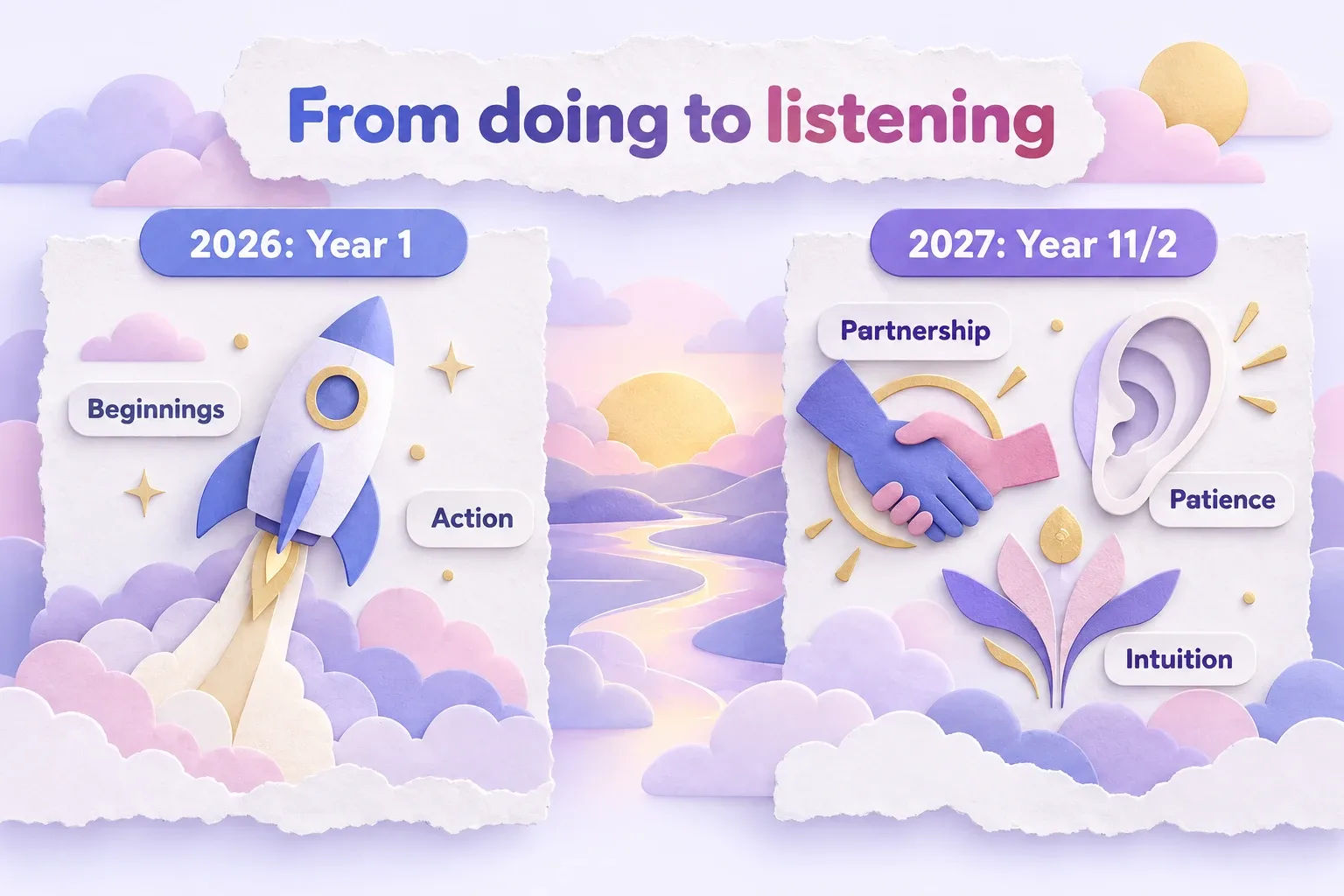
In numerology, 2026 is a Universal Year 1: the start of a new nine-year cycle, linked to fresh starts, bold action and independence. 2027 is a Universal Year 11/2: the second step, linked to partnership, patience and intuition. Practitioners often sum it up as moving from doing to listening.

2027 numerology: paper-craft comparison of 2026 Year 1 beginnings and 2027 Year 11/2 partnership and intuition

In the tradition, years run in nine-year cycles. The current cycle opened with 2026 (1) and closes with 2034 (2 + 0 + 3 + 4 = 9). 2027 is its second year.

2026 2027
The sum 2 + 0 + 2 + 6 = 10, then 1 + 0 = 1 2 + 0 + 2 + 7 = 11, then 1 + 1 = 2
Universal Year 1 11/2 (master number 11)
Place in the nine-year cycle Year 1 of 9 (opens the cycle) Year 2 of 9
Keywords in the tradition Beginnings, action, independence Partnership, patience, intuition
Posture the tradition suggests Start things, act, lead Listen, cooperate, refine
Common shadow side Impatience, going it alone Indecision, nervous tension
A useful question to ask What do I want to begin? Who do I want to build it with?
The last time this number came up 2017 2018

Read the table as a map of what numerologists say, not as a map of what will happen. "From doing to listening" is a framing the tradition uses, not a finding anyone has measured.

How Do You Find Your Personal Year Number for 2027?

To find your personal year number, reduce your birth month and birth day to single digits, then add the year's value and reduce the total. Numerologists disagree on the year's value: some add 11 for 2027, others add 2. Both give the same final digit; they differ only on master numbers.

2027 numerology: a mother and teen daughter carry a potted lemon tree onto a rooftop terrace at dusk

Here are the two conventions side by side, using a birthday of May 15:

  • Adding 11 (used by numerologycalc.org): May = 5. Day 15 = 1 + 5 = 6. Then 5 + 6 + 11 = 22, which that school keeps as a master number.
  • Adding 2 (used by Number Alchemy): 5 + 6 + 2 = 13, then 1 + 3 = 4.

So is it a 22 or a 4? Notice that 2 + 2 = 4. Both routes land on the same root number. The only question is whether you get to call it a master 22 year. That is true of every birthday, because 11 and 2 always reduce to the same thing.

Try a second birthday, July 14: 7 + (1 + 4) + 2 = 14, then 1 + 4 = 5. With 11 instead: 7 + 5 + 11 = 23, then 2 + 3 = 5. Same answer either way.

Pick one convention and stick with it. For the meaning of personal years 1 to 9, see our guide to your personal year number for 2027. For the numbers that stay with you for life, the free Numerology Blueprint calculator works out your Life Path, Expression, Soul Urge and Personality numbers, and our life path number guide explains them.

Will 2027 Be a Good Year According to Numerology?

Numerology cannot tell you whether 2027 will be a good year. The tradition offers themes, such as cooperation and intuition, not forecasts. Some pages state predictions about love, money and health as if they were facts. Nothing supports those claims, and broad themes tend to feel accurate for almost anyone.

Most 2027 pages agree on the arithmetic and the stock themes. Some go much further. One site calls 2027 "one of the most favourable Universal Years for romance and commitment," gives money guidance and recommends gemstones and mantras as "remedies" (Tisya Setu). Another promises 2027 energy "unlike anything we've experienced since 2018," which is hard to test (Ann Perry). This guide won't repeat forecasts about marriage, markets, jobs or health, and won't suggest timing big decisions by a number.

Why year themes feel so accurate

Psychologists call it the Barnum effect, or Forer effect. People rate vague, general descriptions as highly accurate when they believe the description is about them. In Forer's 1949 classroom demonstration, 39 students each got the same text, assembled from a newsstand astrology book, and rated its accuracy 4.30 out of 5 on average (Barnum effect). "A year to slow down, trust your gut and value your relationships" fits most years for most people.

A fair test: look back at 2018

2018 was also an 11/2 year. Take five minutes and write down what your 2018 held. Did it feel like a year of partnership, patience and intuition, more than 2017 or 2019 did? Our end-of-year reflection questions can help you remember. Either way, you'll have tested the idea against your own life instead of taking anyone's word for it, including ours.

Is Numerology Real or Scientifically Proven?

No. Numerology is not scientifically proven, and there is no evidence that the number of a year or a birthday shapes events. Wikipedia describes it as "the belief in an occult, divine or mystical relationship between a number and metaphysical phenomena or ideas," and notes scientists treat it as questionable science without empirical support.

Numerology 2027 history: an older woman studies an old book at a library table with a magnifying glass

Even some numerology sites say so. One puts it plainly: "Numerology is a reflective framework, not a scientific prediction or guarantee" (numerologycalc.org). That is the most honest way to hold it.

So why use it at all? For the same reason people use a journaling question or a word of the year. A theme like "partnership" points your attention at one part of your life. The question is useful. The number is only the reason you asked it.

Affirmations and vision boards are a mindset practice, not a substitute for medical, mental-health or financial advice. The same goes for numerology.

Where Does Numerology Come From? Did Pythagoras Invent It?

Pythagoras did not invent numerology as people practise it today. No authentic writings of his survive, and scholars credit much of the number philosophy to later followers. Number symbolism is ancient, but the birth-date and name system behind 2027 readings was built in America in the early 1900s, and the word "numerology" itself dates to about 1907.

Here is the history in order:

  1. Letters as numbers (antiquity). The Greeks added up the number values of letters in a practice called isopsephy, a cousin of Hebrew gematria. Graffiti at Pompeii, from around 79 AD, reads "I love her whose number is 545" (Isopsephy).
  2. The Pythagoreans. "No authentic writings of Pythagoras have survived" (Pythagoras). His later biographies are full of legend. The scholar Walter Burkert argued the number philosophy credited to him was really the work of a later Pythagorean, Philolaus, whose writings treated numbers as the essence and source of all things (Philolaus).
  3. Late antiquity. Nicomachus of Gerasa (about 60–120 AD) wrote a Theology of Arithmetic that treated numbers as mystical (Nicomachus).
  4. A new word (about 1907). "Numerology" is not recorded in English before about 1907. The older word, "arithmancy," goes back to the 1570s (Numerology).
  5. The modern system (early 1900s). L. Dow Balliett, born Sarah Joanna Dennis in 1847, self-published from Atlantic City, New Jersey. Her book The Philosophy of Numbers: Their Tone and Colors is usually dated to 1908. Bibliographer Catherine Yronwode credits her with the English-alphabet system and master numbers (Yronwode).
  6. Her students. Juno Jordan (1884–1984) studied with Balliett, and Florence Campbell's Your Days Are Numbered (1931) became a bestselling textbook (Yronwode).

The honest verdict: "Pythagorean numerology" borrows an ancient name, but universal years, personal years and master numbers are largely an early-20th-century American system built on much older number symbolism.

Is 2027 an Angel Number?

2027 is not a classic angel number. In that belief, angel numbers are repeating sequences such as 111 or 222 that people read as messages. If you keep noticing 2027, followers of the idea usually read it through its digits (2, 0 and 7) or through its sum, 11/2, which brings you back to partnership and intuition.

The angel-number idea is modern. Wikipedia traces its popularity to a 2004 book by Doreen Virtue and Lynnette Brown (Numerology). Our angel numbers guide covers the common sequences, including what 1111 means and what 555 means, a number the tradition ties to change.

How Can You Use 2027's Themes Without Leaning on Predictions?

Use 2027's themes as questions, not answers. Turn "partnership, patience, intuition" into three planning prompts, answer them in writing, then choose one or two concrete goals for the year. The number decides nothing. It gives you a place to start.

Three questions for an 11/2 year

  1. Partnership: Who do I want to build with in 2027? Name the people, not just the idea.
  2. Intuition: What have I been noticing but ignoring? Write it down without judging it.
  3. Patience: What one thing will I do slowly and well? In the tradition, year two refines what year one started. Deepen one thing from 2026 instead of adding five new ones.

Scenario: a personal year 5 and a possible move

Say you were born on July 14, so 2027 is your personal year 5, a number the tradition ties to change and freedom. You're thinking about moving cities. The numbers don't say go or stay. They hand you two good questions: what change do you want, and who is it with or for? Write both answers, then weigh the move on its real costs.

Scenario: a freelancer weighing a partnership

Say you're a freelancer and a friend wants to go into business with you in 2027. A page calling 2027 "the year of partnership" might nudge you to say yes. Don't let a number sign a contract. Use the theme to ask better questions: what does each of you bring, how will you split the work, and what happens if it ends? For money and legal questions, talk to a qualified professional.

Then write it down

Whatever you choose, put it on paper. In a small 2015 study by psychologist Gail Matthews, people who wrote goals down achieved more, and those who also sent weekly progress updates to a friend did best: 76% reached their goals or got more than halfway, versus 43% of those who didn't write them down. It was presented at a conference, not peer-reviewed, so treat it as encouraging rather than proof (Matthews research summary). For an 11/2 year, pick a partner to report to.

🗺️Your 11/2 year, as a planning timeline (not a forecast)
1
🔍 Oct–Nov 2026Look back at 2018

2018 was also an 11/2 year in numerology. Write down what it held for you, and what 2026 started. Test the themes against your own memory.

2
✍️ December 2026Answer the three questions

Who do I want to build with? What have I been noticing but ignoring? What one thing will I do slowly and well? Write your answers by hand.

3
🎯 January 2027Choose and write your goals

Turn your answers into one or two specific goals for 2027. Pick one person to send a short progress update to each week.

If you are a seeker type, our life path 7 guide shows how one number can meet the year's themes. Our guide to goals for 2027 helps turn answers into goals you'll keep, our list of New Year's resolutions for 2027 gives you ideas to pick from, and a 2027 vision board keeps them in view. With Manifest Mosaic, you write what you want from 2027, add one selfie, and get photos of yourself already living it. The first photo is free. The full board is $19, paid once, no subscription: nine photos (one per wish), a print-ready poster, phone wallpapers, three free swaps and 30 morning letters from your future self, one a day. They suit a year the tradition calls reflective, though the number has nothing to do with them.

If 2027 is about partnership for you, you can also give someone their 2027 for Christmas, New Year's Eve or a birthday. They open an envelope on the day you choose and add their own selfie.

Final Thoughts: A Year for Listening

2027 adds up to 11, reduces to 2 and, in numerology, carries themes of partnership, patience and intuition after 2026's year of starting. The predictions and remedies are belief. Use the themes as questions, test them against 2018, and let your own written answers, not the number, shape your year.

See yourself living it in 2027 — make your first picture free →

Sources & Methodology

Methodology: We checked the 2027 arithmetic by hand, compared the leading 2027 numerology pages for where they agree and differ, and traced the history through encyclopedia entries and a numerology bibliography. Numerology is presented as a tradition and belief system, not as science; no predictions are made. Sources checked September 2026.

Questions

Frequently asked questions

In numerology, 2027 is a Universal Year 11/2. Its digits add up to 11 (2 + 0 + 2 + 7), which numerologists keep as a master number, and 11 reduces to 2 (1 + 1). The tradition links the year with intuition, partnership, patience and listening.

It is both, depending on how a numerologist labels it. The sum is 11, which reduces to 2. Some practitioners call it a Universal Year 11/2, others a Universal Year 2 with an 11 undertone. The arithmetic is identical; only the name changes.

Reduce your birth month and birth day to single digits, then add the year value. Some numerologists add 11 for 2027 and others add 2. Both routes reach the same final digit; they only disagree on whether an 11 or 22 counts as a master number.

In numerology, 2026 is a Universal Year 1, the start of a new nine-year cycle, tied to fresh starts and bold action. 2027 is a Universal Year 11/2, the second year, tied to partnership, patience and intuition. Practitioners often frame it as moving from doing to listening.

Numerology does not predict whether a year will be good or bad. The tradition offers themes for 2027, such as cooperation and intuition, that you can use as prompts for reflection. There is no evidence that a year's number causes events in your life.

No. No authentic writings of Pythagoras survive, and scholars think much of the number philosophy credited to him came from later followers. Number symbolism is ancient, but the birth-date system people use today was built in America in the early 1900s.

Your first picture is free

See yourself in 2027.

Write what you want from next year, add one selfie, and see a photo of you already living it. Then turn all nine wishes into your board.