What makes a resolution stick?
A resolution sticks when it is phrased as something you start, replaces an old habit instead of trying to erase it, begins tiny, and gets enough time to become automatic. In the 2020 Swedish study, "start" resolutions succeeded 58.9% of the time, compared with 47.1% for "stop" resolutions (Oscarsson et al., 2020).
Start, don't stop
Lead author Per Carlbring's advice is simple. "You cannot erase a behaviour, but you can replace it with something else," he writes. So "I will eat fruit several times a day" beats "I will stop eating sweets." Some rewrites:
- "Stop doomscrolling" becomes "My phone charges in the kitchen at 9pm."
- "Stop spending so much" becomes "I check my bank app every Sunday morning."
- "Stop eating junk at work" becomes "I pack fruit and nuts the night before."
Start tiny
Say your resolution is to read more. "Read 30 books" is a finish line. "Read 10 pages before bed, book on my pillow" is something you can do tonight. Once it runs by itself, grow it.
Give it real time
In a study of 96 volunteers, new daily habits took an average of 66 days to feel automatic, with a range of 18 to 254 days (Lally et al., 2010). Exercise habits took about one and a half times as long as eating or drinking habits. The popular "21 days" idea does not hold for most people. Plan to stay with a resolution until at least the end of March.
How do if-then plans help you keep a resolution?
An if-then plan, which psychologists call an implementation intention, links a specific moment to a specific action: "When situation X happens, I will do Y." It decides the when, where and how in advance, so you don't rely on memory or mood.

Peter Gollwitzer, who named the idea, reported striking results (Gollwitzer, 1999):
- Students asked to write a report about their Christmas Eve within 48 hours: three in four who wrote down exactly when and where they'd do it finished on time, versus one in three who didn't.
- In an exercise study, a motivation boost alone raised the share of people who exercised from 29% to 39%. Adding an if-then plan raised it to 91%.
A later review pooled 94 tests and found a medium-to-large effect on reaching goals (Gollwitzer & Sheeran, 2006). One caution: for people with strong perfectionist pressure, rigid plans can sometimes backfire. Keep yours kind, not strict.
Five if-then scripts you can copy
- "When I finish dinner, I will put on my shoes and walk for 20 minutes."
- "When I get into bed, I will read 10 pages before I touch my phone."
- "When my paycheck lands, I will move $25 into savings before I pay anything else."
- "When I pour my morning coffee, I will write one line in my journal."
- "When I feel the urge to open social media at work, I will stand up and refill my water."
What is the difference between a resolution, an intention and a vision?
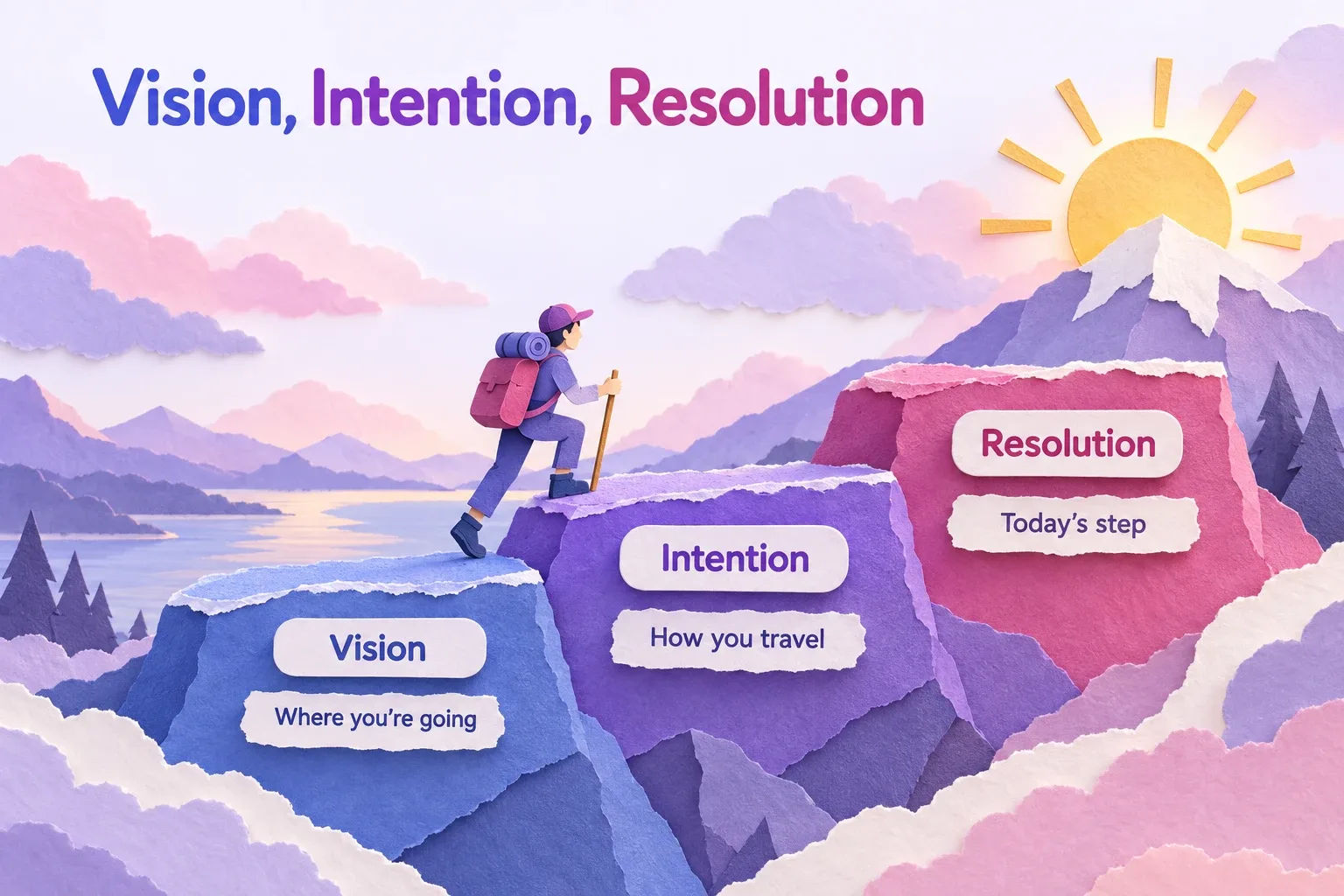
A resolution is a specific action you commit to. An intention is the direction or feeling you choose for the year. A vision is a picture of the life you want at the end of it. They work best together: the vision is where you are going, the intention is how you want to travel, and the resolution is today's step.
|
Resolution |
Intention |
Vision |
| What it is |
A specific action or rule |
A direction or quality you choose |
A picture of the life you want |
| Example |
"Walk 20 minutes after dinner" |
"Take care of my body" |
"Hiking the coast with friends in June 2027" |
| How it fails |
Too strict, dropped after one slip |
Too vague to act on |
Stays a daydream with no daily step |
| Best use |
Daily or weekly habits |
A filter for choices |
A reason that pulls you through hard weeks |
Most lists stop at the first column, which is why "exercise more" feels like homework by week three. For more on the middle column, see our guide to New Year intentions, and for turning a vision into steps, read goals for 2027.
One way to fill in the vision column: write your three resolutions as wishes for the year, then see them. With Manifest Mosaic, you write what you want from 2027, add one selfie, and get a photo of yourself already living it. Your first picture is free.
101 New Year's resolution ideas for 2027, by life area
Here are 101 New Year's resolution ideas for 2027, grouped into ten life areas. Each is phrased as something to start, and the words after the dash are a first step you can take in five minutes or less. Don't pick ten. Star the few that make you feel something, then use the checklist below to choose your three.
A note on health, money and big life changes: talk to a doctor before a major change to diet or exercise, and get professional support for quitting alcohol, smoking or other substances. Affirmations and vision boards are a mindset practice, not a substitute for medical, mental-health or financial advice.
Health and body
- Walk 20 minutes after dinner — put your shoes by the door tonight.
- Drink a glass of water with every meal — fill it before you sit down.
- Move your body three times a week — book Monday's session in your calendar.
- Eat a vegetable with lunch — add two to this week's shopping list.
- Stretch for five minutes each morning — leave a mat beside your bed.
- Cook dinner at home four nights a week — plan Monday's meal on Sunday.
- Book the checkups you've put off — call one office this week.
- Learn to swim, or swim better — look up adult lessons nearby.
- Train for a 5K or charity walk — sign up so there's a date.
- Take the stairs for two floors or fewer — skip the elevator today.
Mind and mental wellbeing
- Write three lines in a journal each night — pen and notebook on your pillow.
- Note three good things every evening — make a phone note called "Good things."
- Sit quietly for five minutes a day — do it after your first coffee.
- Start talking to a therapist or counselor — check what your insurance or workplace covers.
- Say no to one draining thing a week — pick this week's no.
- Take a real lunch break away from screens — set a 12:30 reminder.
- Spend 20 minutes outside every day — take tomorrow's phone call walking.
- Talk to yourself like a good friend would — rewrite one harsh thought a day.
- Ask for help sooner — name one person you can text on a hard day.
- Keep one evening a week completely unplanned — block it in your calendar.
Money
- Track every expense for one month — start a simple note or spreadsheet.
- Build a small emergency buffer — set an automatic payday transfer, any amount.
- Pay off your smallest debt first — list your debts, smallest to largest.
- Have one no-spend weekend a month — circle it on the calendar.
- Cut the monthly charges you don't use — scan last month's statement.
- Understand your retirement account — log in and find your balance and fees.
- Automate your regular bills — set up one autopay today.
- Wait 48 hours before any purchase over $50 — start a "wait list" note.
- Hold a monthly money check-in — book the first Sunday of each month.
- Ask for the raise or raise your rates — write down three wins from 2026.
Career and work
- Update your résumé or portfolio each quarter — add your best 2026 project.
- Learn one skill your next role needs — finish lesson one of a free course.
- Meet one new person in your field each month — send one message.
- Protect a two-hour focus block each week — block Tuesday morning.
- Finish the side project — write the next three steps on one card.
- Speak up once in every meeting — prepare one question beforehand.
- Find a mentor, or become one — ask someone for 20 minutes.
- Leave work on time three days a week — set a wrap-up alarm 15 minutes early.
- Keep a "wins" file — create the folder and add one win.
- Test your business idea small — ask three people if they'd pay for it.
Relationships and family
- Call a family member every Sunday — choose who gets the first call.
- Plan a monthly date night — book January's.
- Host a simple meal once a month — invite two people.
- Write one card or letter a month — buy a pack of cards.
- Keep phones off the dinner table — put a basket by the table.
- Reconnect with an old friend — send "I was thinking of you."
- Thank one person, specifically, each day — start with whoever you see next.
- Give each child one-on-one time weekly — 15 minutes, their choice of activity.
- Join a club, class or group — read one local listing.
- Learn to repair after arguments — practice saying "Can I try that again?"
Home and surroundings
- Make your bed each morning — tomorrow, before you check your phone.
- Declutter one drawer a week — the junk drawer, tonight.
- Reset the kitchen before bed — set a 10-minute timer after dinner.
- Grow something green — buy one herb plant for the windowsill.
- Carry a reusable bottle and bag — hang the bag on your door handle.
- Make a cozy reading corner — move one chair to the best light.
- Finish one home project each season — list them and pick the smallest.
- Donate what you haven't used in a year — put a box in your closet.
- Let in daylight first thing — open the curtains before the kettle.
- Learn one basic repair — watch one how-to video for the thing that's broken.
Learning and skills
- Read 12 books this year — 10 pages before bed tonight.
- Learn 500 words of a new language — five minutes during breakfast.
- Pick up an instrument — 10 minutes with a beginner video.
- Take one in-person class — look up a community course date.
- Write something every week — 200 words every Sunday.
- Cook five dishes without a recipe — choose the first dish.
- Earn a certificate that matters for your work — find the enrollment date.
- Swap one commute of scrolling for an audiobook — download one.
- Learn basic first aid — find a local course date.
- Teach someone what you know — offer a friend one lesson.
Fun and adventure
- Visit one new place a month within an hour of home — list six places.
- Take the trip you keep postponing — pick the dates. (Need more ideas? Browse the 2027 bucket list.)
- Try one new restaurant a month — save three to a list.
- Say yes to one invitation you'd usually skip — reply yes to the next one.
- Take one photo a day — set a daily 6pm reminder.
- See one live show a season — check what's on in January.
- Have one no-plans day a month — circle it and tell your household.
- Try a new hobby for 30 days — pick it and buy the basics.
- Spend a night under the stars — find a campsite or a dark field nearby.
- Host a monthly game night — pick the game and the date.
Spirit and purpose
- Volunteer once a month — email one local group.
- Write down your five core values — ask, "What do I want to be known for?"
- Choose a word for 2027 — browse word of the year ideas and shortlist three.
- Do one quiet kindness a week — pay for the next coffee in line.
- Keep a Sunday review — ask what went well, what didn't, what's next.
- Set a morning intention — finish "Today I want to feel…" before you get up.
- Spend time in nature every week — pick a park for Saturday.
- Practice your faith or tradition daily — choose a set time and place.
- Write a letter to yourself to open next December — date an envelope.
- Forgive someone, including yourself — write the letter you won't send.
Digital life and sleep
- Charge your phone outside the bedroom — move the charger to the kitchen.
- Go to bed at the same time on weeknights — set a bedtime alarm.
- Turn off non-essential notifications — silence three apps now.
- Move social apps off your home screen — put them in a folder on page two.
- Start the day with daylight, not a feed — phone stays face-down until after breakfast.
- Check email at set times — pick two times and put them in your calendar.
- Curate your feed — unfollow five accounts that leave you feeling worse.
- Keep a screen-free hour before bed — put a book where your phone usually goes.
- Delete one app you open on autopilot — check your screen-time report.
- Back up your photos — turn on automatic backup today.
- Take one phone-free walk a week — leave it at home this Saturday.
How many resolutions should you make?
Make one to three resolutions. Each new habit needs steady attention for weeks or months before it runs by itself, and it's hard to give that to many habits at once. If you want more change than three can hold, pick one big resolution and make the other two very small.
This is a recommendation, not a study result; no research has found a magic number. But if one habit takes around two months on average, stacking eight on January 1 is a lot. A simple shape: one for your body, one for your mind or relationships, one for money or work.

 Manifest Mosaic