 Manifest Mosaic
New Year's Eve rituals are small, symbolic acts that mark the end of one year and the start of the next. Some are old traditions, like Spain's twelve grapes or Japan's 108 bells. Others are personal habits you invent, like writing a letter to yourself. Both do the same job: they give the moment a shape.
You do not need candles, crystals or a party. You need about twenty minutes, a pen and a clear idea of what you want to leave behind and what you want to walk toward. Below you will find how real traditions work, which parts are someone's faith, a simple plan for the night, and the safety notes most lists skip.
- A ritual is a small symbolic act that marks a threshold. Old traditions and personal ones work the same way.
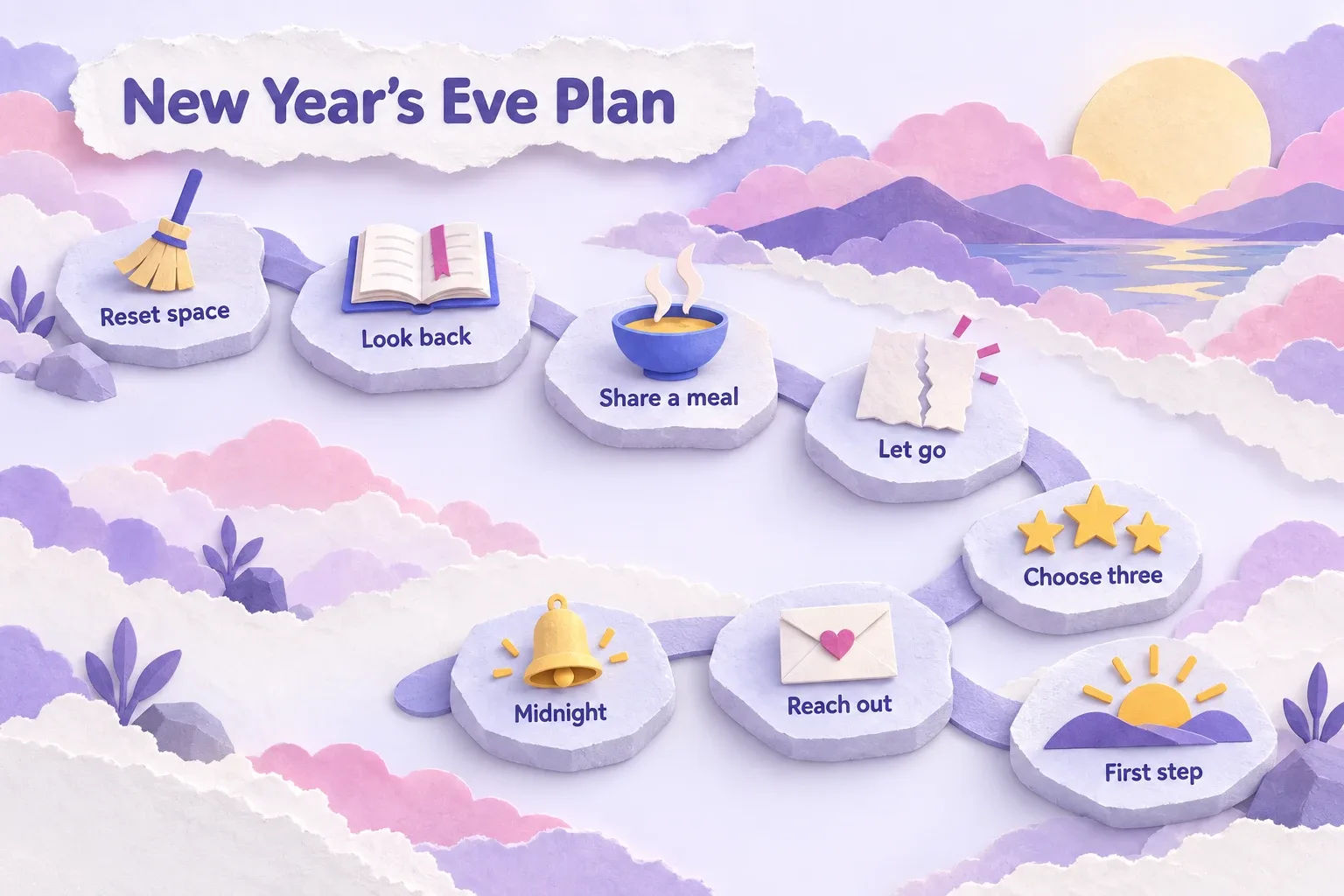
- Look back first (let go), then look forward (choose three intentions), then do one small thing on January 1.
- Word your intentions as what you are moving toward. In a large 2020 study, approach-framed resolutions did better than avoidance-framed ones.
- Some customs are religious practices. Learn from them respectfully instead of treating them as lucky charms.
- Skip the fire if you can. Never burn paper in a fireplace, keep candles 12 inches from anything that burns, and cut grapes for young children.
- A ritual marks a fresh start. Small steps in January are what make it last.
What Do People Do Around the World on New Year's Eve for Luck?
People around the world use food, sound, movement and fire to mark midnight. Spain eats grapes, Japan rings bells, Denmark jumps off chairs, Scotland visits neighbours and Brazil wades into the sea. The table below shows what each custom is, what it is said to mean and what to watch for.
| Where | What people do | What it is said to mean | Safety or respect note |
|---|---|---|---|
| Spain | Eat 12 grapes with the 12 chimes at midnight | One grape per month; luck for the year | Cut grapes lengthwise for children under 5 |
| Japan | Temples strike a bell 108 times; families eat toshikoshi soba | Clearing worldly desires; cutting off the year's hardships | The bell is a Buddhist practice |
| Denmark | Stand on a chair and "jump into" the new year at midnight | Leap into the year; skipping it is said to bring bad luck | Use a low, stable step |
| Scotland | First-footing: be the first to cross a neighbour's door after midnight | Sets the luck for the year; gifts like coal or shortbread | Community fire events are run by organisers |
| Ecuador and Colombia | Burn a life-size figure of the old year; walk around the block with a suitcase | Release the old year; invite travel | Street bonfires are not a home activity |
| Brazil | Wear white; some jump seven waves and make a wish | Peace, cleansing, luck | Iemanjá offerings belong to Candomblé and Umbanda |
| Greece | Cut a vasilopita cake with a hidden coin | Whoever finds the coin gets luck | Warn guests about the coin |
| Philippines | Wear round patterns and set out twelve round fruits | Circles are said to attract money | None |
Every one of these is a folk belief. Nobody has shown that a grape or a plate brings luck. What they do show is how people mark a threshold: with something you can taste, hear, wear or do together.
What Is the Story Behind the Best-Known Traditions?
Most traditions have a real history, and it is more interesting than the luck claim. The stories below are the ones people search for most, with the facts that are actually known.
The 12 grapes in Spain
At midnight, people in Spain try to eat one grape for each of the twelve chimes, one for each month of the year. The origin is debated. One story says grape growers in Alicante started the custom in the early 1900s to sell surplus fruit. Another says Madrid's middle class copied French habits, and used it to mock the French at Puerta del Sol. In Ecuador, people make a wish with each grape, which is a lovely twist to borrow (Laylita).
Safety first: doctors have documented deaths of children aged five and under from choking on whole grapes (report on the Scottish case series). Cut them lengthwise for young children, or leave them out.
108 bells in Japan
The custom is called Joya no Kane. Temples strike the bell 108 times as the year ends. The most common explanation is the 108 afflictions in Buddhism. Another counts 12 months, 24 solar terms and 72 microseasons, which add up to 108. It began in Song-dynasty China, reached Japan in the Kamakura period and became a New Year's Eve event in the Muromachi period (Wikipedia).
Families also eat toshikoshi soba on the night. Because soba noodles are easy to cut, the meal stands for cutting off the year's hardships. The long noodles also stand for a long life (Wikipedia).
First-footing in Scotland
At Hogmanay, the first person to cross your threshold after midnight is said to set your luck for the year. Visitors bring coal for warmth, shortbread, whisky or black bun. Homes are cleaned first, and "Auld Lang Syne" by Robert Burns is sung with arms crossed (Wikipedia). It is really a custom about welcoming people, which is why it travels well.
Burning the old year in Ecuador
In Ecuador, families and neighbours build life-size figures called Año Viejo, often made to look like public figures, and burn them at midnight. Each figure leaves a funny written "will" that jokes about the year. Some people jump the fire three times (Laylita). It is a big, shared street event. It is not a template for a bonfire in your yard.