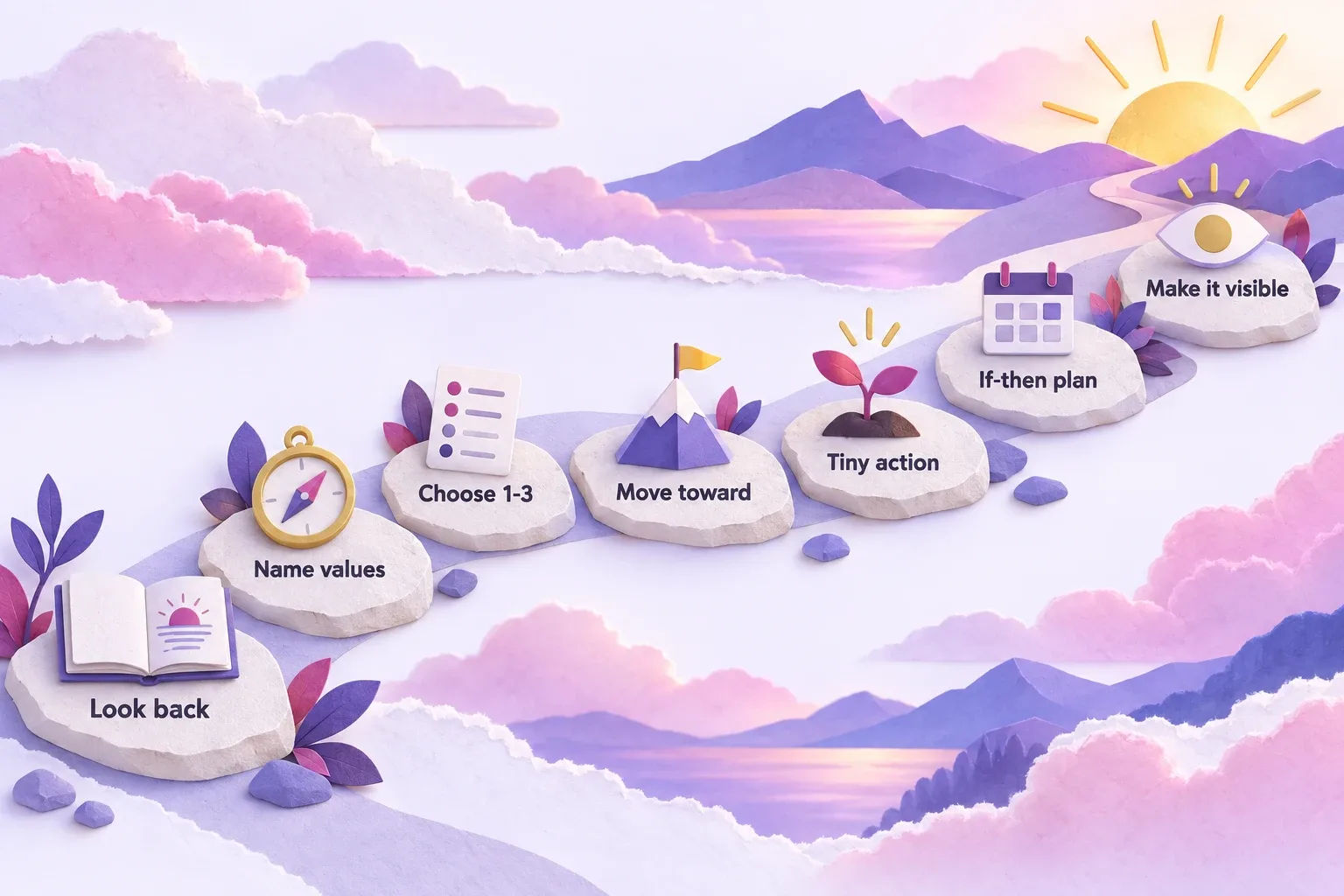
 Manifest Mosaic
New year intentions are short statements about how you want to live in the coming year. They point a direction instead of setting a pass-or-fail target. Rather than "lose 10 pounds," you might write "I intend to look after my body." You pick one to three, then attach one small action to each.
Most people know how to make a resolution. Fewer know how to make an intention that still matters in March. This guide gives you a seven-step method, 15 examples you can borrow, a 20-minute ritual and a reset plan for when the year gets messy. It is written for the turn from 2026 to 2027.
- An intention is a direction ("I intend to rest well"). A goal is a destination. A resolution is a pass-or-fail promise. You can use all three.
- Choose one to three intentions, not ten. Word each one as something you move toward, not something you avoid.
- An intention alone often fails to become action. Add one tiny first step and one if-then plan.
- A ritual is optional. Twenty quiet minutes with a pen is enough.
- Start between October and early January. 1 January 2027 falls on a Friday.
- Plan a February check-in now. Slipping is normal and fixable.
What Are New Year Intentions?
A new year intention is a sentence that names how you want to live, feel or act in the year ahead. It is broader than a goal and has no finish line. "I intend to be present with my kids" is an intention. It gives your choices a direction without turning your year into a scorecard.
The word "intention" has two meanings, and mixing them causes confusion. In psychology, a "goal intention" is a commitment to reach a specific result, such as "I intend to run a 10K." In wellness writing, an intention is a guiding quality, such as calm, courage or curiosity. This guide uses the second meaning, then shows you how to link it to the first.
Why does January feel like the right moment? Researchers have described a "fresh start effect": dates like a new year, a birthday or a new week work as temporal landmarks that can make people more willing to work on their aspirations. The date has no magic. It simply marks a clean page.
Setting an intention is not a forecast, and it is not a promise from the universe. It is a decision you make on purpose. What follows is the part that does the work.
What Is the Difference Between Intentions, Goals and Resolutions?
An intention is the direction you want to travel. A goal is a specific place you want to reach. A resolution is a firm promise to do or stop doing something. Intentions bend with your life. Goals and resolutions are easy to measure, which makes them useful and also easy to fail.
| Intention | Goal | Resolution | |
|---|---|---|---|
| What it is | A direction or way of living | A specific result | A firm promise |
| Example | "I intend to take care of my money." | "Save $1,500 by June." | "Never overspend again." |
| How you know it's working | You notice your choices lining up | You reach the number or date | Pass or fail, every day |
| Risk | Too vague to act on | Can feel like pressure | One slip feels like total failure |
| Best used | As your compass | As a milestone | Sparingly |
The research behind this article does not show that intentions beat goals. So don't choose a side. Use an intention as your compass, then add one small, measurable step so the compass turns into movement.
There is one useful finding about wording. In a large one-year experiment on New Year's resolutions, people with approach-framed goals (moving toward something) reported more success than people with avoidance-framed goals (moving away from something): 58.9% versus 47.1%. That is self-reported data, so treat it as a hint. It still gives you a good reason to write "I intend to..." and skip "I will stop...".