Word of the Year Ideas for 2027 (200+)

Word of the year ideas for 2027: 220 words in 10 themes, a 5-step way to choose yours, and low-guilt ways to keep it all year, even if you switch in spring.

Word of the Year Ideas for 2027 (200+)
In this guide 10 sections
  1. 01What is a word of the year, and where did the idea start?
  2. 02Is a word of the year better than a New Year's resolution?
  3. 03How do you choose your word of the year in 5 steps?
  4. 04What are good word of the year ideas for 2027?
  5. 05What is a good intention word for the year in your situation?
  6. 06Should your word be a noun, a verb, or a feeling?
  7. 07How do you stick with your word all year?
  8. 08What does 2027 mean in numerology, and should it shape your word?
  9. 09How can you see yourself living your word in 2027?
  10. 10Sources & Methodology

A word of the year is one word you choose to guide how you live the next twelve months. It works like a compass, not a to-do list. Below you'll find 220 word of the year ideas for 2027, sorted by theme, plus a simple way to choose one and keep it.

Most lists hand you a wall of words and stop. The hard part is not finding words. It is choosing one. So this guide gives you a short method first, then the words.

Key Takeaways
  • A word of the year is a theme for your choices. It is not a goal you pass or fail.
  • Ask "How do I want 2027 to feel?" before you scan any list.
  • Words that move toward something (like nourish) may serve you better than words that push away (like no more).
  • Test your word with one question: "What would I do differently on a Tuesday?"
  • Put the word where you'll see it, tell a friend, and check in for ten minutes a month.
  • You can pick in any month, and you can change your word by spring.

What is a word of the year, and where did the idea start?

A word of the year is a single word you pick as a theme for your next twelve months, such as ease, brave or build. You return to it when you make choices, big or small. It is a personal practice, not a dictionary award and not a goal you can pass or fail.

Ali Edwards began choosing one word each January in 2006. Her words have included play, peace, nurture, pause, joy and curious. She describes the idea as a word she could "focus on + get curious about as she went about her daily life over the course of a year." "One Little Word" is her registered brand, so this guide uses "word of the year" as the general term. Her workshop page shows her own version.

Other teachers have their own takes. Chris Brogan is often credited with My 3 Words, which uses three words instead of one. Susannah Conway teaches end-of-year workshops on finding your word.

If you searched "word of the year" and wanted the dictionary pick, that is a different thing, like Oxford's "rage bait" for 2025. This guide is about your own word. If you want a year-end ritual to help you choose it, try these New Year's Eve rituals.

Is a word of the year better than a New Year's resolution?

No study shows that one word beats resolutions, so nobody can honestly say yes. What research on resolutions does show is useful: goals framed as moving toward something did better than goals framed as avoiding something. A word can give you that framing and sit beside one small goal.

Here are the numbers we do have. In a large experiment on New Year's resolutions (Oscarsson et al., 2020), 1,066 people completed the first step. A year later, 55% of responders said they had been successful at sticking with their resolutions. That is self-reported. People with approach-oriented goals did better than people with avoidance-oriented goals: 58.9% vs 47.1%. Those who received some support did significantly better than the other groups.

The same paper cites an older study of 200 resolvers. In it, 77% were still keeping resolutions after one week, 43% after three months, and 19% after two years.

That research looked at resolutions, not one-word practices. So the next part is our suggestion, not a finding. Choose "begin" instead of "stop procrastinating." Add one small goal from goals for 2027. Tell a friend. If you'd like a longer menu of resolutions, see New Year's resolutions for 2027.

How do you choose your word of the year in 5 steps?

To choose your word of the year, look back at the last year, name how you want 2027 to feel, brainstorm five to ten words, test each one against an ordinary Tuesday, then pick one and put it where you will see it. The whole thing fits in one evening.
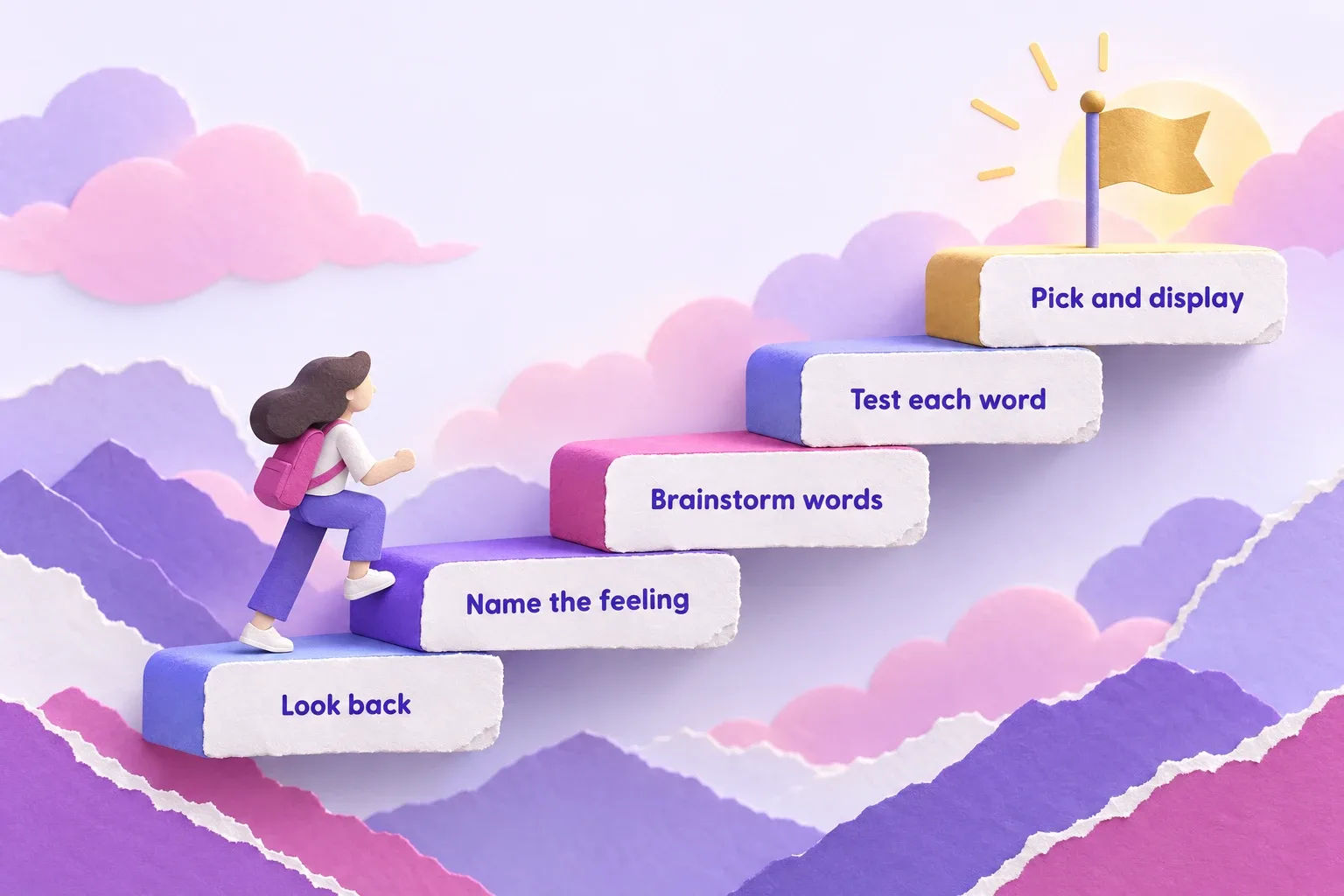
Word of the year: paper-craft staircase showing five steps from Look back to Pick and display

Here is how to choose your word of the year without overthinking it.

  1. Look back. Spend ten minutes on 2026. What gave you energy? What drained you? Our end-of-year reflection questions can help.
  2. Name the feeling. Finish this sentence: "In 2027, I want to feel ___." If you spent 2026 answering email at 10 p.m., you might write "unhurried."
  3. Brainstorm five to ten words. Use the lists below. Circle words that make you curious, not the ones that sound impressive.
  4. Test each word. Say it out loud. Then ask, "What would I do differently on a Tuesday?" If your word is ease, the answer might be "I stop booking back-to-back calls." If you can't picture a Tuesday change, the word may be too vague.
  5. Pick one and put it where you'll see it. Try your phone lock screen, the bathroom mirror or the first page of your planner.

There is no deadline. 2027 starts on a Friday, but a birthday, a September fresh start or your first day in a new job works just as well. Your word of the year 2027 can arrive in any month.

What are good word of the year ideas for 2027?

Good word of the year ideas are short, timeless words you can picture in daily life, such as ease, begin, nourish, connect or focus. Below are 220 words in ten themes, each with a note on when it fits. Skim for the words that make you exhale, then circle three.

Word of the year ideas: a bearded man in a greenhouse holds up two seedlings, choosing between them

Calm and Rest

Good for when you're tired, overbooked or coming off a hard year.

ease, rest, pause, restore, breathe, soften, slow, stillness, peace, calm, settle, unwind, gentle, quiet, recover, renew, refuge, balance, sanctuary, unhurried, exhale, steady

Courage and Change

Good for when you're standing at a door you keep walking past.

brave, begin, leap, bold, release, transform, choose, dare, pivot, unafraid, launch, cross, shift, unlearn, risk, embrace, evolve, fearless, become, reinvent, threshold, courage

Growth and Learning

Good for when you want to get better at something, or at everything.

grow, learn, curious, stretch, explore, practice, patience, wonder, study, deepen, expand, seek, build, progress, discipline, reflect, master, bloom, roots, adapt, question, humble

Love and Connection

Good for when your people need more of you, or you need more of them.

connect, love, kindness, belong, together, listen, generous, forgive, tender, welcome, gather, nurture, friendship, presence, family, compassion, honest, warmth, reach, community, devotion, cherish

Work and Purpose

Good for when you want your days to add up to something.

purpose, craft, serve, lead, ambition, momentum, finish, impact, vision, initiative, contribute, calling, standards, thrive, collaborate, steward, legacy, resourceful, persist, dedicate, prioritize, ownership

Health and Energy

Good for when you want to care for your body in a kind, steady way.

energy, strength, nourish, move, vitality, stamina, hydrate, wellbeing, sleep, fuel, walk, dance, outdoors, sunlight, nature, care, routine, resilience, grounded, tend, mobility, vigor

Creativity and Play

Good for when life feels too serious or too tidy.

create, play, make, imagine, wild, color, story, improvise, experiment, sketch, write, sing, invent, spark, whimsy, playful, design, dream, music, express, fresh, adventure

Joy and Gratitude

Good for when you want to notice more of what's already good.

joy, gratitude, delight, savor, appreciate, celebrate, laugh, sunshine, thankful, cheer, bright, lightness, contentment, enough, radiant, treasure, glad, hope, optimism, merry, fullness, grace

Simplicity and Focus

Good for when you're stretched thin and scattered.

simplify, focus, less, declutter, essential, clear, boundaries, minimal, priority, single, edit, tidy, streamline, deliberate, present, space, mindful, order, clarity, discern, spare, lighten

Spirit and Trust

Good for when you want to lean on something bigger than a plan.

trust, faith, surrender, intuition, wisdom, believe, sacred, flow, alignment, awaken, mystery, prayer, meaning, reverence, soul, allow, receive, unfold, guidance, ritual, spirit, openness

Some words sound alike but ask for different things. Rest means stopping. Pause is a short break inside your day. Restore means refilling what ran low. Brave means acting while you feel fear. Fearless says you won't feel any, which is a lot to ask of yourself. Trend slang ages fast, so this list sticks to words that will still make sense in 2030.

What is a good intention word for the year in your situation?

A good intention word for the year matches the season you are actually in, not the one you wish you were in. After burnout, try rest or boundaries. Starting something new, try begin or steady. In a season of loss, try tender or gentle. Choose the word your life is asking for.

  • After burnout: rest, boundaries, recover, enough
  • New job or business: begin, craft, momentum, ownership
  • New baby or a full house: tender, patience, gather, enough
  • Grief or healing: gentle, tender, soften, allow
  • A big move: threshold, welcome, roots, belong
  • Students and teens: curious, practice, discipline, brave
  • Retirement: explore, savor, legacy, unhurried

Say you had a baby in 2026 and are sleeping in pieces. Ambition would feel like a nag. Gentle might feel like relief. That is the test.

A word is a reflection tool, not a treatment. Affirmations and vision boards are a mindset practice, not a substitute for medical, mental-health or financial advice. If you're struggling or thinking about suicide, call or text 988 (US) or contact your local emergency number. The 988 Lifeline is there any hour. For a longer guide to setting intentions, see new year intentions.

Should your word be a noun, a verb, or a feeling?

Any of the three works, and the best choice depends on what you need. A verb pushes you to act, a noun gives you an identity to grow into, and a feeling word tells you how to weigh choices. If you stall often, pick a verb. If you feel scattered, pick a noun or feeling.

Type Examples Best for Watch out for
Verb begin, release, gather, finish Getting unstuck Can feel like pressure
Noun courage, home, craft Growing into an identity Can feel abstract
Feeling ease, joy, contentment Guiding everyday choices Hard to measure
Three words steady, kind, curious Juggling work, home and self Harder to remember

One word or three? Ali Edwards uses one. Chris Brogan is often credited with three. Both are valid. A short phrase is fine too. "A word" is a rule you can bend.


How do you stick with your word all year?

To stick with your word, make it visible, attach it to a small if-then cue, and check in once a month for ten minutes. Share it with one friend. Skip the guilt: if the word stops fitting, swap it. A light routine beats a perfect one.

  1. Make it visible. Use your phone lock screen, a sticky note or the top of your planner.
  2. Add an if-then cue. Write one sentence: "If I feel rushed, then I take one breath and ask what ease would look like." A 2006 meta-analysis of if-then planning (Gollwitzer & Sheeran) found it helped people reach their goals.
  3. Check in monthly. Ask three questions. Where did my word show up? Where did I forget it? What is one small thing for next month? Go easy on yourself. In a well-known habit study (Lally et al., 2010), a new behavior took 66 days on average to become automatic, and the range was 18 to 254 days.
  4. Tell one person. In the resolution study above, people with some support did better. That study wasn't about words, but sharing yours costs nothing.
  5. Let it change. If the word doesn't fit by March, swap it. No guilt. A word pairs well with an experience, so you might pick one thing from the 2027 bucket list that fits it.
✨One affirmation for 15 words
1 of 15 affirmations
Calm

“My word is ease. I can do this one thing at a time.”

1 / 15

Those are sample affirmations for fifteen of the words above. Borrow one, or write your own with the affirmation generator.

What does 2027 mean in numerology, and should it shape your word?

In numerology, 2027 adds up as 2 + 0 + 2 + 7 = 11, so it is often called a Universal Year 11/2. Some numerologists reduce it fully to a Universal Year 2. It is a belief system, not science, so treat it as optional symbolism for choosing a word.

Followers link the master number 11 with intuition and awakening, and 2 with partnership and patience. If that appeals, you could lean toward words like intuition, allow, unfold or together. Your own life path number can spark word ideas too, and a life path 7, for example, might lean toward words like depth or quiet. Wikipedia describes numerology as a belief in a mystical link between numbers and events. Watchdogs such as Africa Check call it a pseudoscience with no reliable predictive ability. Sources also disagree on whether 2027 is a 2, an 11 or an 11/2.

So there are no forecasts here about money, health or events. Let your word come from your life, not from a number. If you enjoy the tradition, read our 2027 numerology guide.

How can you see yourself living your word in 2027?

Picture one ordinary 2027 scene where your word is true, then make it concrete. Write two sentences about it: where you are, what you're doing, how it feels. Add a photo, a letter or a small ritual, so your word turns into something you can see. If you struggle to picture it, here is how to see your future self living it.

Word of the year ideas: a couple in their sixties smell peaches at a busy farmers market

Say your word is brave. Your scene might be: "It's a Tuesday in May. I'm standing up to share my idea at work, notes in hand, nervous and steady." That is far easier to hold than one word on a sticky note.

Here are three ways to use it:

  • Write a letter. Imagine it's December 2027. Write to yourself about who you became through your word. Our letter from your future self method shows how.
  • Build a board. Make your word the centerpiece of a 2027 vision board.
  • Get photos of yourself living it. Write what you want from 2027, add one selfie, and Manifest Mosaic turns your wishes into photos of you already living them. Your first photo is free. The full board is $19, paid once: nine photos, a print-ready poster, phone wallpapers, three free swaps and 30 morning letters from your future self, one a day for 30 days, each about a wish on your board. It's a keepsake and a nudge, not a promise of results.

Sharing helps, too. You can give a friend their 2027 as a gift. They open an envelope on the day you choose and add their own selfie. It costs $19. Our New Year gift ideas have more thoughtful options, manifestation gifts lists 25 more, and last-minute digital gifts work when time is short.

Pick your three words this week. Then choose one. You'll know it when it makes your Tuesday feel different.

See yourself living it in 2027 — make your first picture free →

Sources & Methodology

Ali Edwards Design Inc. (2026), "One Little Word® 2026 Workshop," aliedwards.com — supports the 2006 origin, her list of past words and the quoted description.

Oscarsson et al. (2020), "A large-scale experiment on New Year's resolutions: Approach-oriented goals are more successful than avoidance-oriented goals," PLOS ONE — supports the 58.9% vs 47.1% result, the 55% self-reported success, the benefit of support and the older 200-resolver figures.

Gollwitzer & Sheeran (2006), "Implementation Intentions and Goal Achievement: A Meta-Analysis of Effects and Processes" — supports the idea that if-then planning helps people follow through on goals.

Lally et al. (2010), "How are habits formed: Modelling habit formation in the real world," European Journal of Social Psychology — supports the 66-day average (range 18–254) for a behavior to become automatic.

Wikipedia, "Numerology" — describes numerology as a belief system rather than science.

Methodology: The word lists are original and grouped by theme. Research figures come from the sources above, and the resolution figures are self-reported. No study tested one-word practices, so our tips on approach words are suggestions. Numerology is presented as a tradition, not evidence.


Questions

Frequently asked questions

Yes. Ali Edwards picks one word a year. Chris Brogan is often credited with a three-word version called My 3 Words. Both work. Start with one if you want focus, or three if you want a small set of guide points for work, home and self.

Change it. A word is a tool, not a vow. Ask what the year has shown you, then swap in a word that fits better, or keep the old one and add a second. Renaming it in March or June is fine.

A resolution is a specific thing you plan to do, like walking three times a week. A word of the year is a theme that shapes many small choices. They work well together: pick one word, then attach one small goal to it.

Not quite. A mantra or affirmation is a phrase you repeat, like 'I move at a steady pace.' A word of the year is one word you return to when you make choices. You can turn your word into an affirmation if you like.

Write your top five on paper, then sleep on it. Cross out any word that feels like a should. Keep the one that makes your shoulders drop or your chest lift. If two still tie, pick the one that would change your Tuesday most.

Your first picture is free

See yourself in 2027.

Write what you want from next year, add one selfie, and see a photo of you already living it. Then turn all nine wishes into your board.