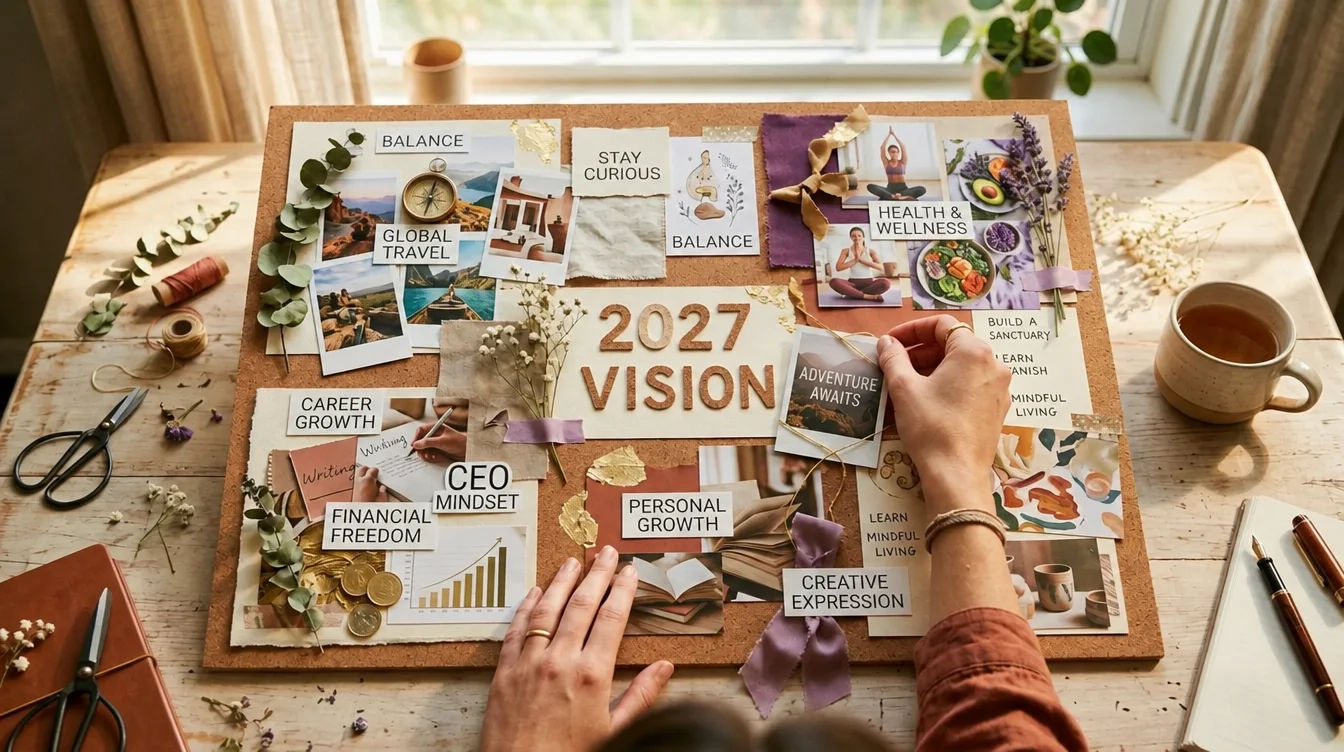
Do vision boards work? The honest answer is that no rigorous study has tested vision boards themselves. In related research, daydreaming only about a happy outcome left people with less energy to act, while vivid goals paired with specific plans, named obstacles and small steps helped. A board can be a useful start, not a shortcut.
This guide separates three things most articles blur together: what has been tested on boards (almost nothing), what nearby research on imagery and goals shows, and how to build a board that plays to that evidence.
Key Takeaways
- We found no controlled study of vision boards. A PubMed search on 29 September 2026 returned zero papers with "vision board" in the title or abstract.
- There is no real "vision board success rate." Numbers you see online come from other kinds of research.
- In several studies, rosy daydreams about the finish line went with less energy and weaker results than more realistic thinking.
- Picturing the process (the studying, the practice, the first call) beat picturing the prize in a classic exam study.
- Specific goals, named obstacles and if-then plans have the best evidence behind them.
- Build your board around what you will do, not only what you will have, and review it every week.
What is a vision board, and where did the idea come from?
A vision board is a collage of pictures, words and affirmations about your hopes, meant to inspire and motivate you. It became a mass trend after Rhonda Byrne's book The Secret (2006) popularized the law of attraction. It is a popular self-help practice, not a clinical tool, and its roots are in belief rather than lab research.
According to Wikipedia's entry on dream boards, celebrities such as Oprah Winfrey and Steve Harvey have promoted them, and some people see novelist Octavia E. Butler's handwritten notebook affirmations as an early version. The Secret taught that thoughts and images draw matching events toward you. Wikipedia describes that law of attraction idea as pseudoscientific.
You are free to hold that belief; our guide to how to manifest covers the tradition on its own terms. This article asks a different question: what does psychology research say a board can and can't do? If you're new to the basics, start with what a vision board is and what it's for.
Has any study actually tested vision boards?
Not that we could find. On 29 September 2026 we searched PubMed for "vision board" in titles and abstracts and got zero results. A second database, Europe PMC, returned three papers that mention boards in passing, none of them a test of whether boards help people reach goals. Confident claims either way borrow from nearby research.
That search has limits: it misses student theses, conference talks and unindexed work. Small projects on boards exist, but we couldn't check them, so we don't cite them.
The critics' case is thin too. Wikipedia says there is "some evidence" boards may backfire, but its sources are blog posts, not experiments. One, a 2012 Psychology Today post by Neil Farber, carries a much-quoted line: "Vision boards are for dreaming, action boards are for achieving." That's an opinion, not a finding.
The closest peer-reviewed evidence on the "why a picture might help" side is a 2024 paper in Current Psychology. In two experiments (128 and 323 people), vivid, image-rich "visions" stirred more positive feeling than a plainly listed goal. In the second study, visions predicted progress on goals through that positive feeling and stronger commitment. It tested workplace vision statements, not collages, so treat it as a hint, not proof.
What does research on positive fantasies show?
It shows that daydreaming about an ideal future, on its own, tends to go with less effort and weaker results. Psychologist Gabriele Oettingen's team found this across job hunters, students and patients, then tested it in the lab, where happy fantasies lowered people's energy. None of these studies used vision boards, and the lab tasks lasted minutes.

The real-world studies
Oettingen and Mayer (2002) drew a line between two things that sound alike:
- Positive expectations: judging that a good future is likely, based on your past.
- Positive fantasies: enjoying thoughts and images of that future.
Across four studies — graduates looking for jobs, students with a crush, undergraduates facing an exam, and hip-replacement patients — expectations predicted high effort and success weeks to two years later. Positive fantasies predicted the reverse. These studies measured what people already did, so they show a link, not a cause.
The lab experiments
Kappes and Oettingen (2011) then tested cause in four experiments with US undergraduates. In the first, 164 women either imagined a pair of high-heeled shoes in glowing terms or imagined it more doubtfully. The glowing-fantasy group showed less energy, measured partly by systolic blood pressure. Other studies used self-rated energy and effort on an essay. The authors' summary: "one reason positive fantasies predict poor achievement is because they do not generate energy to pursue the desired future."
Two fair caveats. First, this was energy in the moment, not long-term goal success. Second, the same authors note that positive fantasy can bring calm and contentment — "when relaxation is the aim, positive fantasy is beneficial." Dreaming isn't bad. Dreaming instead of planning is the risk.
Why can picturing the finish line backfire?
Picturing the finish line can give you the good feeling of success early, without the planning that gets you there. In a well-known exam study, students who pictured their top grade felt motivated but studied no more. Students who pictured how they would study did better. What you imagine matters more than whether you imagine.
In Pham and Taylor (1999), college freshmen spent 5–7 minutes a day for 5–7 days before a midterm doing one of these:
- Process: picturing themselves studying well — where, when, how.
- Outcome: picturing seeing a high grade posted and beaming with joy.
- Both, or simply tracking their studying (the control group).
Process simulation improved studying and grades, helped by better planning and less anxiety. The outcome group studied no more and did worse than the process group. In a second study, Shelley Taylor's review notes, they did worse than the control group, too. Her verdict: "the outcome simulation got them cranked up, but they failed to translate that feeling into effective action."
Taylor adds nuance: for simple goals, picturing the outcome may work fine, and process thinking can get in the way in some hard, high-stakes decisions.
Scenario: you want a promotion by next summer. (A career vision board built this way is the same idea.) An outcome board shows a champagne toast and a corner office. A process board shows you rehearsing a pitch on a Tuesday night, and making the first three client calls on Monday morning. Both feel inspiring. Only the second gives you a plan to run. For pictures of the process in action, browse these vision board examples.
These shifts are practical suggestions drawn from the studies above, not a tested program. Try one on your own board this week.
Does visualization work at all?
Yes, in specific ways. Imagery is a real mental process that shares brain activity with seeing, and mentally rehearsing a specific movement has improved strength in a controlled study. What the research does not show is that looking at a picture of a result makes that result arrive. Rehearsing a skill and admiring a prize are different things.
Pearson and colleagues (2015) describe mental imagery as working like a weak form of perception. Brain scans show that imagined and seen pictures produce similar patterns, as early as the first visual area of the brain. That's one reason imagery is used in therapy and sport.
Ranganathan and colleagues (2004) trained 30 healthy volunteers for 12 weeks, 15 minutes a day, five days a week. People who only imagined contracting a muscle gained 35% in finger strength and 13.5% in elbow strength. Physical training raised finger strength 53%. The control group didn't change significantly. That's rehearsal of a process, down to the muscle — the opposite of gazing at a trophy.
You'll often read that "the brain can't tell imagined from real" or that a "reticular activating system" filters the world for your goals. The research we reviewed doesn't support either as a proven way vision boards work. "Weak perception" is not "can't tell the difference."
What does goal-setting research say about vision boards?
Goal-setting research says specific, challenging goals beat vague "do your best" goals, as long as you're committed and get feedback. A board of loose, pretty pictures is closer to "do your best." It starts to match the evidence once each picture carries a clear target, a date and a way to track progress.
Edwin Locke and Gary Latham built goal-setting theory from roughly 400 lab and field studies. Specific, hard goals led to better performance than easy or vague ones when people were committed, had the ability and didn't face conflicting goals. Feedback mattered. One exception they note: on new, complex tasks, a learning goal ("find three ways to…") can beat a hard number.
Writing goals down and sharing progress may help too. In a small 2015 study by Gail Matthews at Dominican University, people who wrote goals down achieved more, and those who also sent weekly progress updates to a friend did best: 76% reached their goals or got more than halfway, versus 43% of those who didn't write them down (Matthews research summary). It was presented at a conference, not peer-reviewed, so treat it as encouraging, not proof. Our guide to setting goals for 2027 you'll keep walks through the writing side.
What is WOOP, and is it better than a vision board?
WOOP stands for Wish, Outcome, Obstacle, Plan. You name a wish, picture its best outcome, then picture the main obstacle inside you and write an if-then plan to handle it. It has more evidence than vision boards, which have none. It doesn't replace dreaming; it adds a second step after the dream.

The method comes from Oettingen's research, where it's called mental contrasting with implementation intentions. A 2021 meta-analysis by Wang and colleagues pooled 21 studies and 15,907 people. It found a small-to-medium boost to reaching goals (an effect size of g = 0.34, where 0.2 counts as small and 0.5 as medium). Face-to-face teaching worked better than written instructions. The authors flag signs of publication bias, and their adjusted estimate is smaller, around 0.24. So: helpful on average, modest, and not magic.
Oettingen's WOOP site puts the core idea this way: "The obstacles that we think most impede us from fulfilling our wishes can actually help us to realize them."
Scenario: saving for a trip. Here's a worked WOOP for one board picture (short lines of text from vision board quotes can sit beside it as a reminder):
- Wish: Save $3,000 for two weeks in Lisbon by June 2027.
- Outcome: Walking up a tiled street at dusk, no money stress, trip fully paid.
- Obstacle: Friday nights. I'm tired and I order takeout on autopilot.
- Plan: "If it's Friday at 6 p.m. and I reach for the delivery app, then I'll heat the meal I froze on Sunday and move $15 into the trip fund."
The obstacle is inside you, not "the economy," so the plan is something you can act on.
How does the evidence stack up, study by study?
Side by side, the studies share one pattern: dreaming alone is weak, and dreaming plus specifics plus a plan is stronger. None of them tested a vision board, so each tells you something useful and something it can't. Here is the plain summary, limits included.
| Study |
What it tested |
What it found |
What it can't tell you |
| Oettingen & Mayer (2002) |
Self-rated fantasies vs expectations in four groups |
Expectations predicted effort and success; fantasies predicted the reverse |
Cause and effect (it's correlational) |
| Kappes & Oettingen (2011) |
Brief lab fantasies in US undergraduates |
Rosy fantasies lowered energy in the moment |
Long-term goal results, or boards |
| Pham & Taylor (1999) |
Picturing studying vs picturing the grade |
Process picturing improved studying and grades |
Whether it holds for every kind of goal |
| Ranganathan et al. (2004) |
12 weeks of imagined muscle training |
Strength rose without lifting anything |
Anything about picturing life goals |
| Locke & Latham (2006) |
About 400 goal-setting studies |
Specific, hard goals beat "do your best" |
Whether pictures add anything to goals |
| Wang et al. (2021) |
21 studies of WOOP-style planning |
Small-to-medium boost to reaching goals |
Effects free of publication bias |
| Current Psychology (2024) |
Image-rich visions vs plain goals at work |
More positive feeling and commitment |
Collage boards specifically |
| Matthews (2015) |
Writing goals and weekly updates |
Writers plus updaters did best |
Much at all with confidence (small, not peer-reviewed) |
How do you make a vision board that follows the evidence?
Make a board where every picture carries a specific goal, a picture of the doing, one named obstacle, an if-then plan and a first step. Then review it weekly and tell one person how it's going. That turns a mood board into a working goal plan, and it matches what the research supports best.
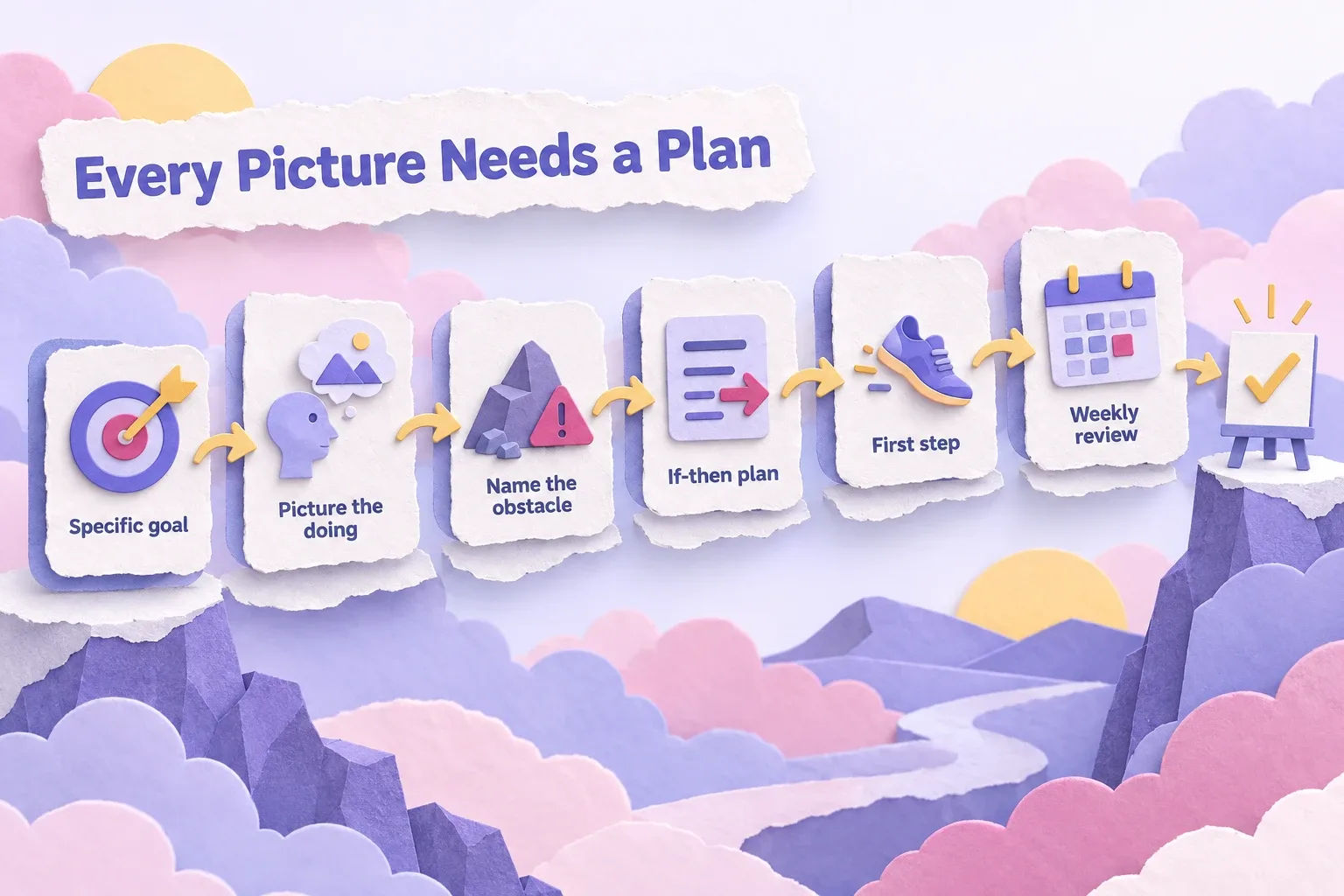
- Choose 6–9 wishes you truly want. Not what you "should" want. The 2024 study linked progress to commitment, and it's hard to commit to someone else's dream.
- Make each one specific. "Get fit" becomes "Run a 10K in May 2027." Add a number or a date.
- Picture the doing, not only the having. Choose images of the practice: running shoes by the door at 7 a.m., a laptop open to your pitch deck. If you use Manifest Mosaic to see yourself in 2027, write your wishes as actions ("Teaching my first pottery class in March") so the photo shows you doing it.
- Name the obstacle. Under each picture, write the thing inside you most likely to get in the way.
- Add an if-then plan. "If ___ happens, then I will ___."
- Write one first step for this week. Small enough to do in under 30 minutes. A vision board app or a vision board wallpaper keeps the board in front of you if a paper one fades into the wall.
- Review weekly for five minutes. Which steps did you take? What got in the way? Swap pictures that no longer fit. Habits take time — in one study, an average of 66 days, with a range of 18 to 254 (Lally et al., 2010).
- Tell one person. Send a short weekly update, the part of the Matthews study that did best. If pictures are not your thing, a letter to your future self is a words-first way to set the same direction.
A two-minute morning script: Look at one picture. Say, "Today I'm working toward ___. The step is ___. If ___ gets in the way, I'll ___." Then look away and do the step.
For the craft side (supplies, layouts, where to hang it), see our full guide on how to make a vision board. If you'd rather build around who you're becoming than what you'll own, read becoming board vs vision board.
What are the most common vision board mistakes?
The biggest mistakes are filling the board only with finish-line images, keeping wishes vague, skipping obstacles and next steps, and never looking at it again. Each one moves the board away from what research supports. The fix is usually one extra line of writing under each picture, not a new board.
- Only outcome pictures. Trophies, beaches and bank balances with no sign of the work. Add at least one "doing" image per goal.
- Vague wishes. "Abundance" and "happiness" can't be tracked. Add a number, a date or a behavior.
- No obstacles. A board that is all sunshine is the pure positive fantasy the lab studies warn about.
- No next step. Every picture needs one action you can take this week.
- Too many goals, or someone else's. Twenty goals compete for the same hours, and goals borrowed from Pinterest are hard to commit to.
- Make it and forget it. A board you never review turns into wallpaper.
- Using it instead of help. Affirmations and vision boards are a mindset practice, not a substitute for medical, mental-health or financial advice.
Should you make a vision board for 2027?
Yes, if you treat it as step one. Pair the board with your new year's resolutions for 2027 so each picture has a plan behind it. A board is a good way to get clear on what you want and to keep it in view. The evidence says the work happens after that: specific goals, named obstacles, if-then plans and weekly reviews. Make the board, then put a plan under every picture.
Scenario: you want to feel healthier in 2027. Your board can hold a photo of you finishing a trail run. Under it: "10K on May 16. Obstacle: I skip runs when it's dark. Plan: if it's dark at 6 a.m., I'll do the 25-minute treadmill session instead. This week: buy a headlamp." That one picture now does what the studies support.
If you want to see yourself in the picture (the idea behind seeing your future self), Manifest Mosaic turns your 2027 wishes into photos of you already living them. The full board ($19, paid once, no subscription) includes nine photos, a print-ready poster, phone wallpapers, three free swaps and 30 morning letters from your future self — one a day for 30 days, each about a wish on your board. Treat them as prompts to act, not as a promise of results. For the letter-writing idea itself, see a letter from your future self, and for a full planning walk-through, our 2027 vision board guide. Not sure whether pictures or words move you more? Try the free manifestation style quiz.
See yourself living it in 2027 — make your first picture free →
Sources & Methodology
- Kappes & Oettingen (2011), "Positive fantasies about idealized futures sap energy," Journal of Experimental Social Psychology — four lab experiments showing rosy fantasies lowered energy in the moment.
- Pham & Taylor (1999), "From thought to action," Personality and Social Psychology Bulletin — picturing the process of studying beat picturing the grade.
- Wang, Wang & Gai (2021), "A meta-analysis of the effects of mental contrasting with implementation intentions on goal attainment," Frontiers in Psychology — 21 studies, 15,907 people; small-to-medium effect of WOOP-style planning.
- Locke & Latham (2006), "New directions in goal-setting theory," Current Directions in Psychological Science — specific, hard goals beat vague ones across about 400 studies.
- Pearson et al. (2015), "Mental imagery: functional mechanisms and clinical applications," Trends in Cognitive Sciences — imagery works like a weak form of perception in the brain.
Methodology: We searched PubMed and Europe PMC for vision board studies on 29 September 2026 and found none that test boards directly, then read the main studies on positive fantasy, process vs outcome imagery, mental practice, goal setting and WOOP. Study sizes and limits are reported as the papers state them. The law of attraction is presented as a tradition, not a research finding.

 Manifest Mosaic