How to Make a Vision Board That Actually Works
Published: April 14, 2026 | Updated: April 14, 2026
Making a vision board that actually produces results requires more than gluing magazine cutouts to poster board. It requires clarity about your goals, intentional image selection that triggers an emotional response, structured layout by life category, and a daily engagement practice that reprograms your reticular activating system. This guide walks through the complete process — from choosing supplies to building a daily habit around your finished board.
Key Takeaways
- Clarify your goals in writing BEFORE touching any images or supplies
- Choose images that create a physical emotional reaction — not just ones that look nice
- Organize by 5-7 life categories for balanced manifestation across all areas
- The board itself is 20% of the work — the daily 2-5 minute viewing practice is the other 80%
- Digital and physical boards are equally effective when paired with consistent emotional engagement
Table of Contents
Preparation
Creation
Daily Practice
- Before You Start: The Clarity Step Most People Skip
- Step 1: Gather Your Supplies
- Step 2: Select Your Images
- Step 3: Organize by Category
- Step 4: Build Your Layout
- Step 5: Add Words and Affirmations
- Step 6: Place It Where You'll See It
- Step 7: Build Your Daily Practice
- Digital vs. Physical: Which Should You Choose?
- Common Mistakes That Kill Vision Board Results
- Sources & Methodology
What Should You Do Before Making a Vision Board?
The most critical step in making a vision board happens before you pick up scissors or open Canva. You need to get clear on what you actually want — in writing, with specifics — before you start collecting images. Skipping this step is the number one reason vision boards become decorative wall art instead of manifestation tools.
Grab a blank piece of paper or open your manifestation journal and answer these five questions:
Step 1: What does my ideal life look like one year from today? Write freely for 5 minutes. Don't edit. Let it pour out — the house, the job, the relationship, the health, the feelings, the morning routine, the bank account, all of it.
Step 2: What are my top 5-7 life categories? Common ones: career, finances, relationships, health, home, travel, personal growth, spirituality. Pick the ones that matter most to you right now.
Step 3: For each category, what is ONE specific goal? Not "better health" but "run a 5K in under 30 minutes by September." Not "more money" but "$8,000 per month in freelance income." Specificity is what gives your reticular activating system a target to lock onto.
Step 4: How will I FEEL when each goal is achieved? This is the most important question. The feeling is the fuel. Write the emotions: relieved, proud, free, giddy, powerful, peaceful, chosen.
Step 5: What am I willing to do daily to support these goals? A vision board without action is a poster. If you won't spend 5 minutes per morning looking at your board, be honest about that now.
Dr. Gail Matthews' research at Dominican University found that people who wrote their goals down and reviewed them weekly achieved 42% more than those who kept goals in their heads. Your pre-board clarity exercise IS the written component. The board turns those written goals into a daily visual review system.
✨ Key Insight: The five-question journaling exercise is not optional prep work — it IS the foundational manifestation work. Your board is simply a visual translation of what you write here.
What Supplies Do You Need to Make a Vision Board?
The supplies for a physical vision board are inexpensive and available at any craft store, dollar store, or online retailer. You don't need expensive materials — the quality of your intention matters infinitely more than the quality of your poster board.
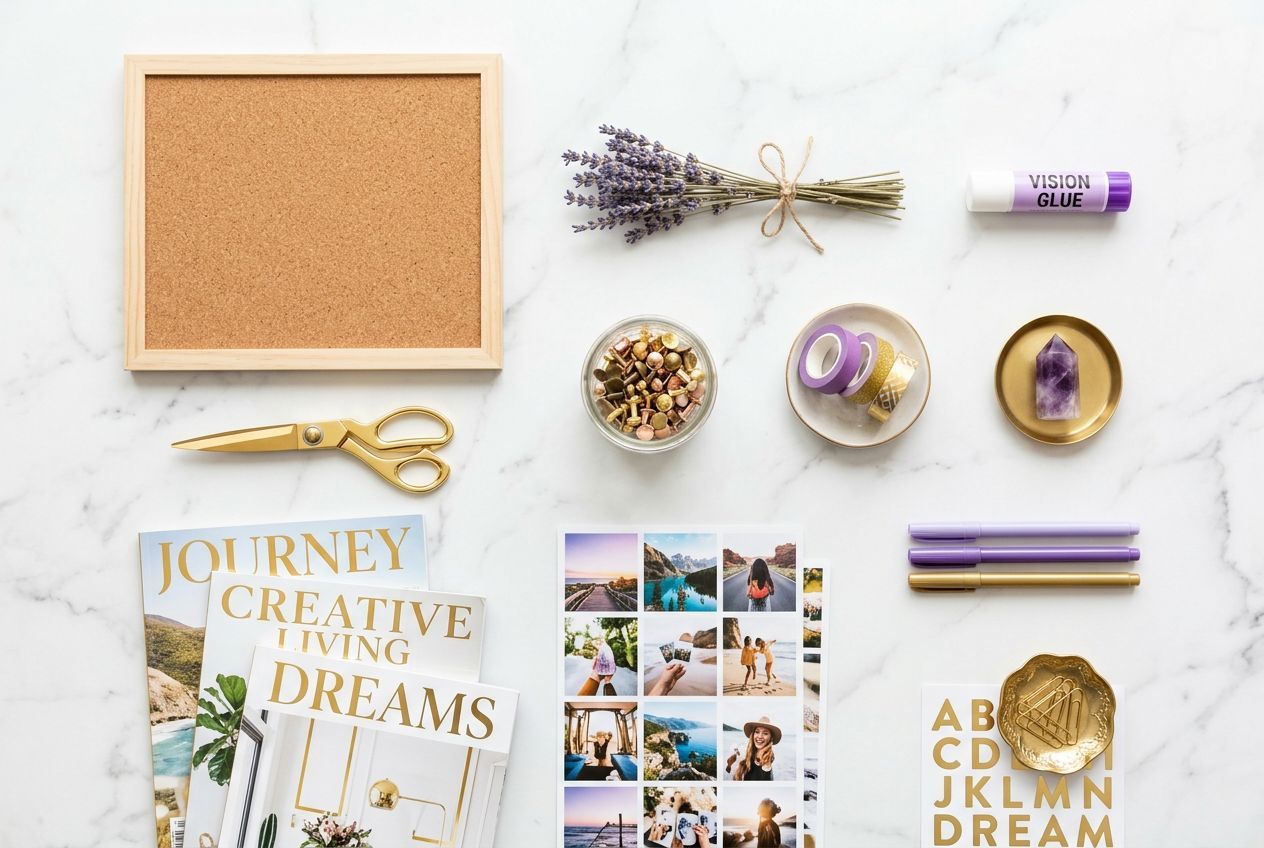
Essential supplies:
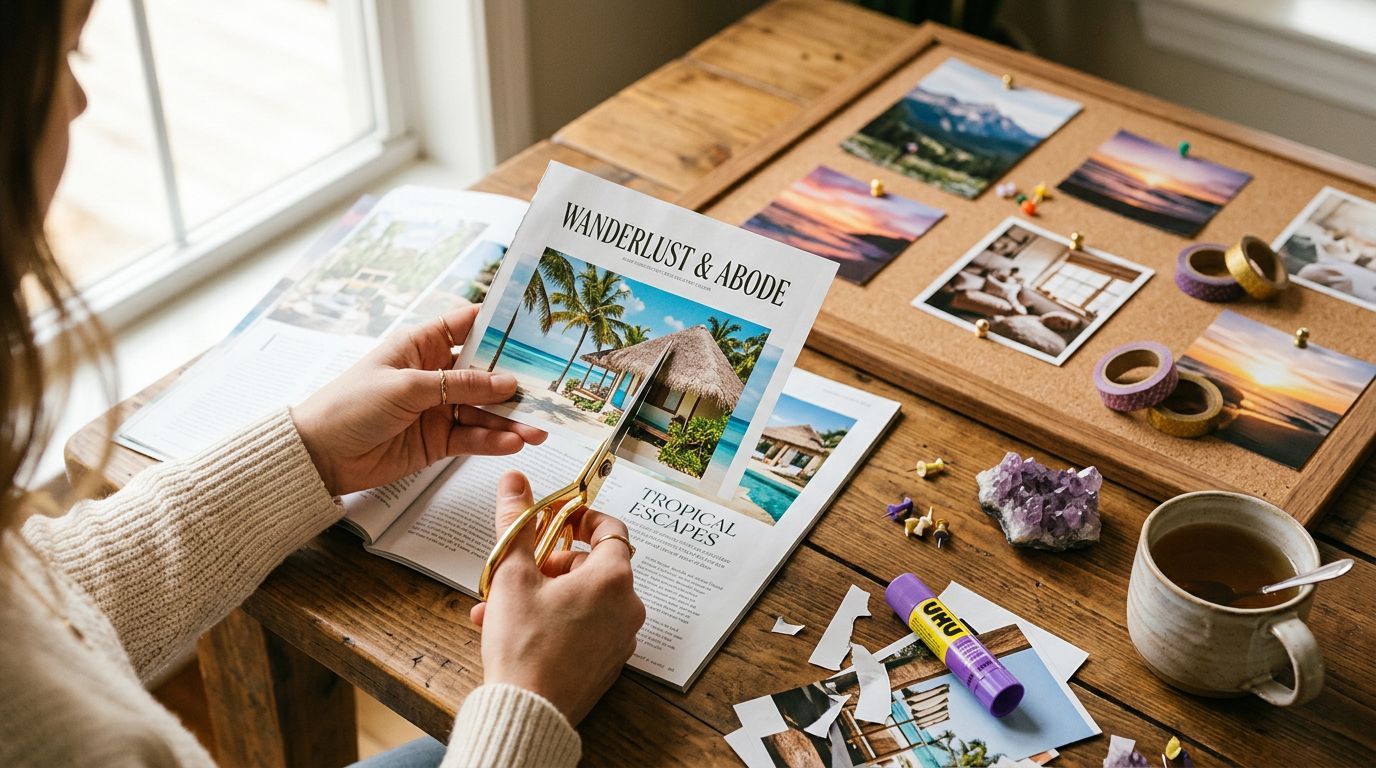
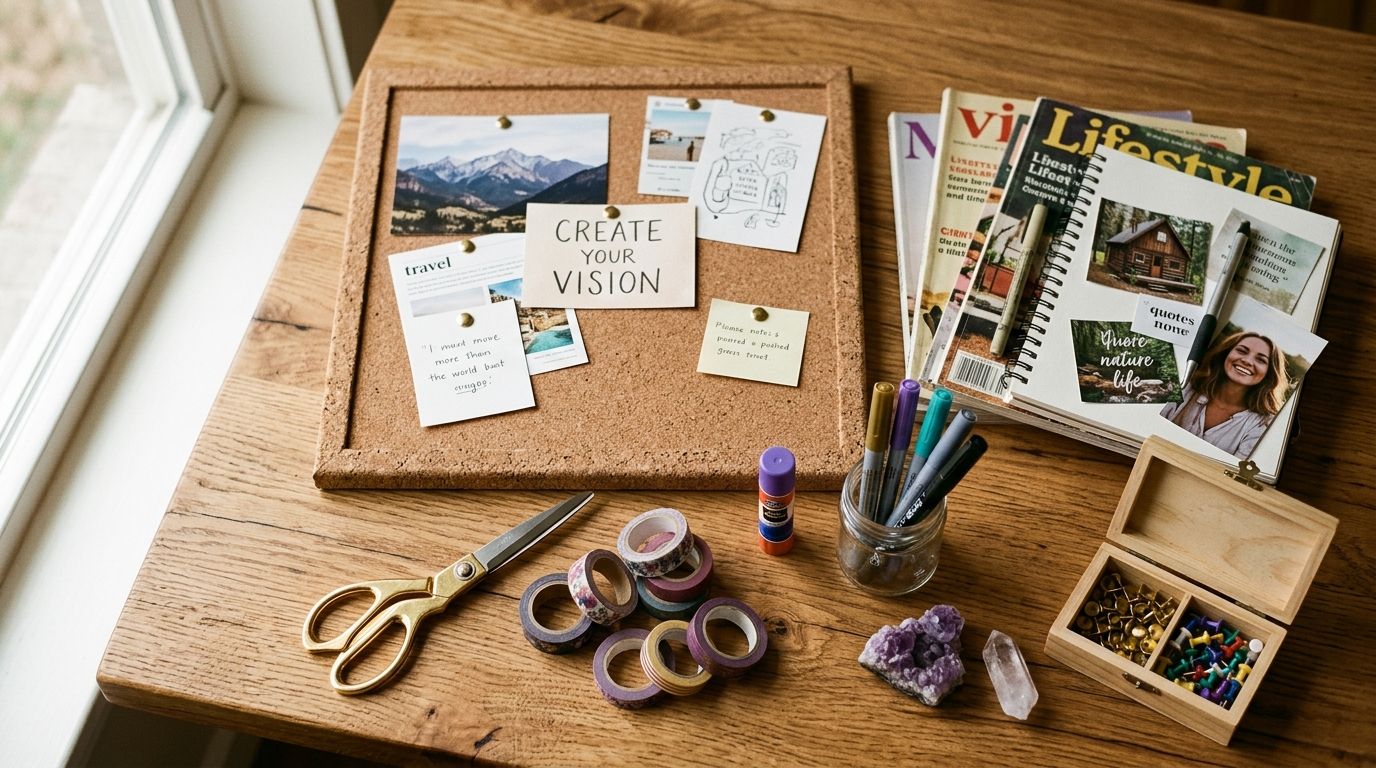
- A surface — cork board (reusable, easy to update), poster board (cheap, one-time), or foam board (sturdy, clean edges). Standard size is 20x30 or 24x36 inches.
- Scissors — sharp craft scissors for clean cuts
- Adhesive — glue stick for poster board, push pins for cork board, double-sided tape for foam board
- Image sources — magazines (Vogue, National Geographic, travel magazines, home design magazines), printed photos from Google, or screenshots from Pinterest
Optional upgrades:
- Washi tape for decorative borders between categories
- Markers or paint pens for handwritten affirmations
- Stickers, gems, or dried flowers for texture
- Printed vision board quotes from your favorite manifestation teachers
- A small photo of yourself to place at the center
For a complete list with specific product recommendations and price ranges, see the vision board supplies guide. If you prefer a ready-to-go option, several vision board kits include everything in one box.
📋 Pro Tip: Don't spend more than 20 minutes gathering supplies. Decision fatigue at the supply stage drains the creative energy you need for image selection. Set a budget of $10–$20 and move on.
How Do You Choose Images for a Vision Board?
The 3-Second Emotional Test
Choosing vision board images is not a casual browsing exercise — it's a deliberate curation process where you select only images that produce an involuntary emotional response. The neuroscience behind this is straightforward: emotional arousal increases activity in the amygdala, which signals the hippocampus to encode the associated information more deeply into long-term memory. Flat, generic images don't trigger this cascade. Emotionally charged ones do.
The 3-second test: Hold an image in front of you. Within 3 seconds, do you feel something physical — a tightening in your chest, a smile pulling at your face, goosebumps, a catch in your breath? If yes, it belongs on your board. If you feel nothing after 3 seconds, discard it no matter how pretty it is.
Where to Find High-Quality Images
Use these sources to build your initial image collection:
- Magazines — Flip through quickly. Rip out anything that hits you. Don't overthink it during the collection phase. You'll curate later.
- Pinterest — Search specifically: "dream kitchen modern farmhouse" not just "kitchen." Save to a private board. Print your top selections.
- Google Images — Search your specific goals. "Craftsman house red door Portland Oregon" not "nice house."
- Your own photos — Include real photos from your life that represent the feeling you want more of.
- AI-generated scenes — Platforms like Manifest Mosaic create photorealistic images of you living your dream life. Seeing your own face in the scene activates mirror neurons — the brain circuits responsible for empathy and self-modeling — which amplifies the visualization effect.
Browse the vision board pictures collection for 100+ curated images organized by category, or download free printable vision board images.
How Many Images to Use
Aim to collect 20–30 images in your initial gathering session, then narrow to 9 during the layout phase — one powerful image per life category. Why nine? Cognitive psychologist George Miller established that the brain holds 7±2 items in working memory at once. Nine sits at the top of that range, giving you enough variety to cover your key goals while keeping the entire board graspable as a single coherent vision.
During a 5-minute daily practice, 9 scenes gives you roughly 33 seconds of deep emotional engagement per scene — enough to actually feel it. A board with 25 images gives you 12 seconds each, which barely registers. There's a numerological layer too — 9 is the number of completion, the highest single digit, and the third number in Tesla's 3-6-9 sequence. Depth per scene beats quantity of scenes every time.
⚠️ Common Mistake: Collecting images that look aspirational rather than images that feel personally resonant. A luxury penthouse might look impressive, but if it doesn't make your chest tight with longing, it won't activate your RAS. Choose ruthlessly on feeling, not aesthetics.
How Should You Organize a Vision Board?
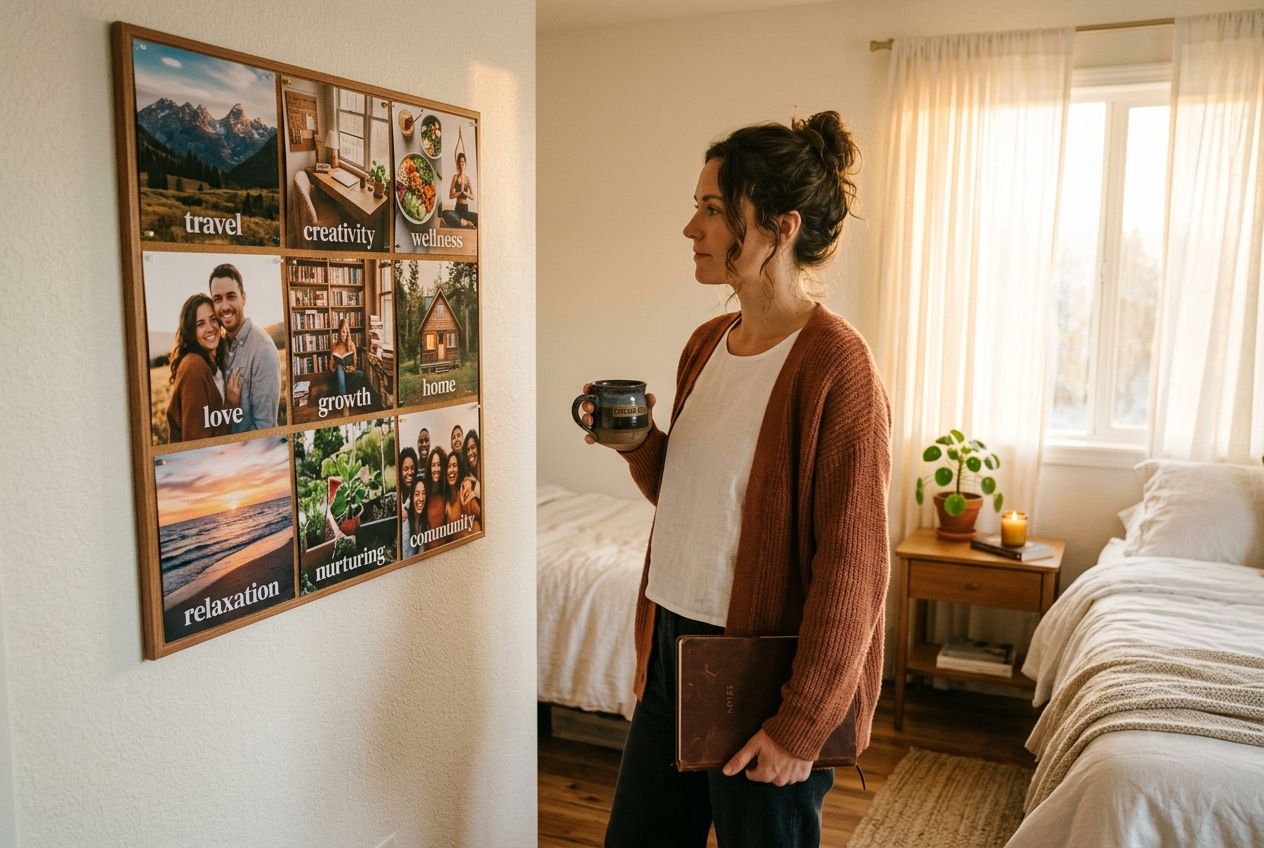
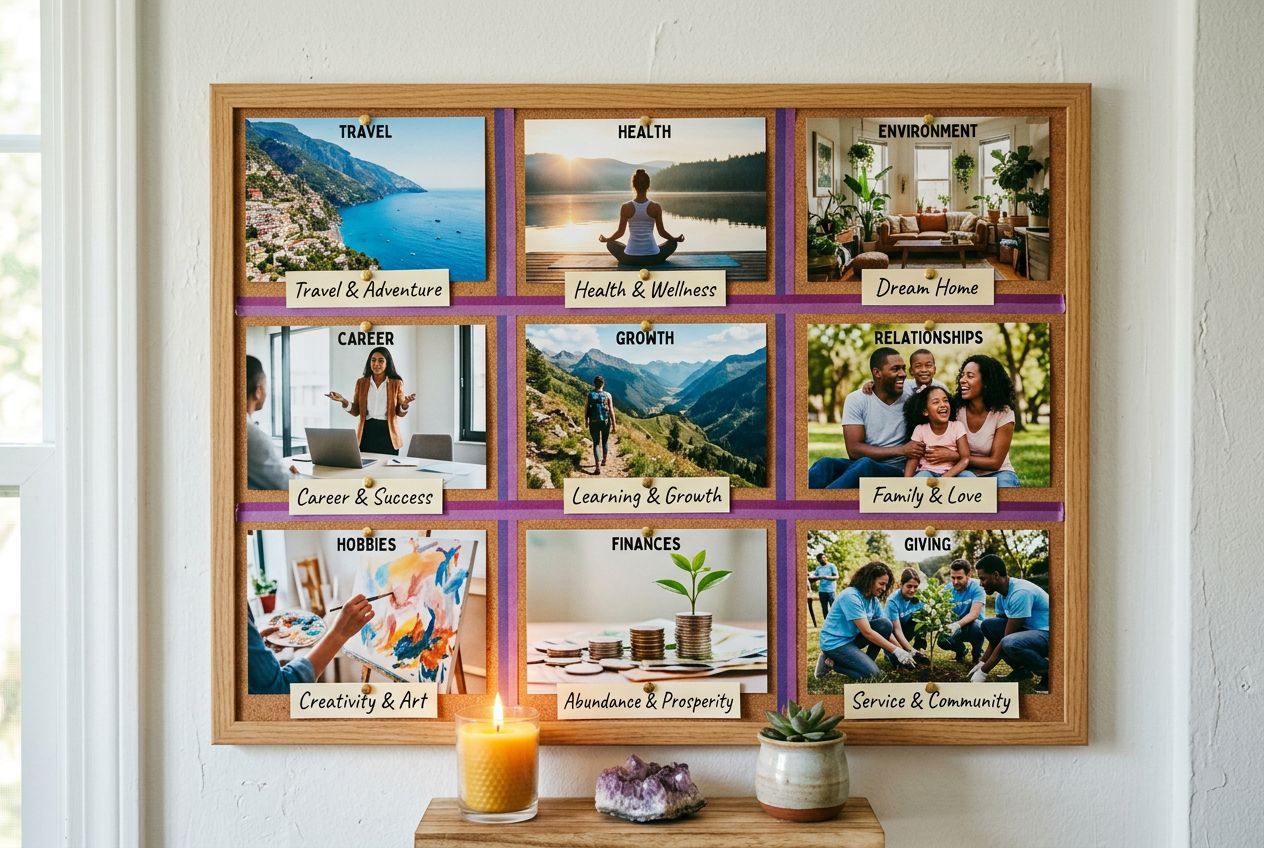
Organizing a vision board by life category creates visual structure that makes your board scannable and ensures balanced goal-setting across all areas of your life. An unorganized board with random image placement feels chaotic and makes daily practice less focused.
Recommended category structure (pick 5-7):
| Category | What to Include | Board Position | |---|---|---| | Career & Purpose | Job title, workspace, salary number, awards | Top left | | Financial Abundance | Bank balance, investments, debt-free imagery | Top center | | Love & Relationships | Partnership scenes, family, friendship | Top right | | Health & Wellness | Fitness milestones, energy, healthy meals | Middle left | | Home & Living | Dream house, interior design, neighborhood | Middle right | | Travel & Adventure | Destinations, experiences, passport stamps | Bottom left | | Personal Growth | Books, skills, education, spiritual practice | Bottom right |
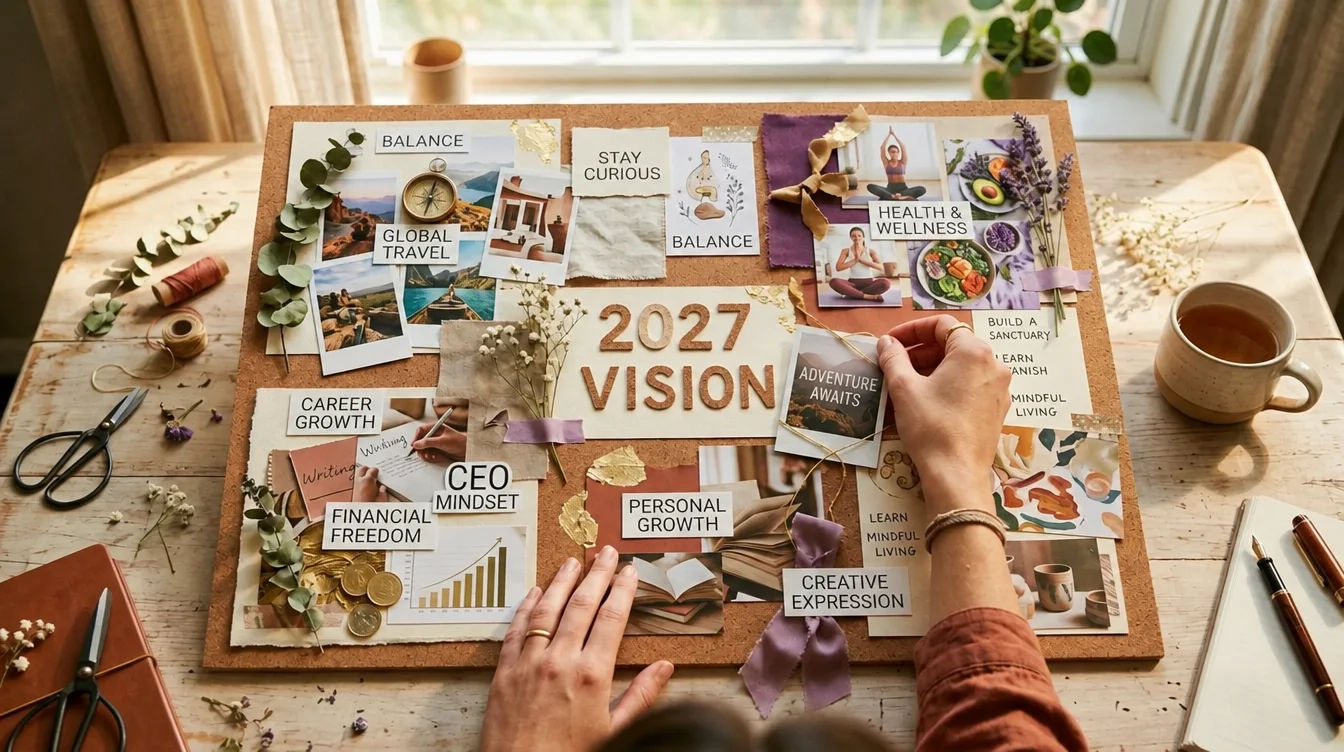
Center of the board: Place your most emotionally powerful image or a photo of yourself here. Your eye naturally gravitates to the center. Some people put a powerful affirmation or their single most important goal in this spot.
This grid structure isn't rigid — it's a starting framework. If your board ends up as a more organic collage with overlapping images and washi tape borders, that's fine. The purpose of categories is to make sure you don't accidentally create a board that's 90% travel photos and 10% everything else (unless travel truly is your dominant focus).
For layout inspiration, browse 25 vision board examples across different styles and aesthetics.
✨ Key Insight: Balanced category coverage signals to your subconscious that you are manifesting a whole life — not just one dimension of it. A lopsided board produces lopsided results.
What Is the Best Layout for a Vision Board?
The best vision board layout is the one that feels both visually appealing and easy to scan in under 30 seconds. You'll be looking at this board daily, often in a half-awake morning state, so clarity beats artistic complexity.
Choose from these five proven layout options:
| Layout Style | Best For | Key Characteristic | |---|---|---| | Grid | Structured, list-oriented thinkers | Clean rows and columns; one image per cell | | Collage | Creative personalities | Overlapping images, angled cuts, layered textures | | Central Focus | People with one dominant intention | Large central image surrounded by supporting images | | Mind Map | Visual-spatial thinkers | Name or "My Dream Life" at center with category branches | | Timeline | Progress- and momentum-driven people | Left = now, right = future; images flow chronologically |
Choose the layout that matches your manifestation style. Visualizers tend to prefer grid or central focus. Scripting types prefer mind maps with words. Action-oriented types prefer timelines.
📋 Pro Tip: Sketch your chosen layout on paper before gluing anything down. Five minutes of planning saves you from peeling off images that were placed in the wrong spot.
Should You Add Words to Your Vision Board?
Adding affirmations, quotes, and specific words to your vision board activates language processing centers in the left hemisphere while the images activate visual processing in the right hemisphere. This bilateral activation creates stronger neural encoding than images alone. Research published in the Journal of Experimental Social Psychology confirms that written self-affirmations reduce stress responses and improve problem-solving under pressure.
What words to include:
- Power affirmations — Short, first-person, present-tense. "I am financially free." "I love my career." "My body is strong and healthy." Generate personalized affirmations with the AI Affirmation Generator.
- Specific numbers — "$150,000 salary." "Size 8." "3 international trips." "30 min 5K." Numbers give your RAS a measurable target.
- Feeling words — "FREEDOM." "JOY." "PEACE." "POWER." These anchor the emotional state you're manifesting.
- Timeline markers — "By December 2026." "This summer." "Before my birthday." Deadlines create urgency that vague intentions lack.
- Quotes from teachers — Neville Goddard, Abraham Hicks, Dr. Joe Dispenza, or any author whose words activate something in you. See 100+ vision board quotes for curated options.
Write words by hand with markers when possible. Handwriting activates motor cortex engagement that typed text doesn't, creating an additional neural encoding pathway. This is the same principle behind the 369 manifestation method — writing the same affirmation repeatedly embeds it deeper than reading it.
⚠️ Common Mistake: Using vague, generic affirmations like "I am happy" that don't connect to a specific goal. The more precise the language, the sharper the signal to your RAS. "I am celebrating my first $10K month" is exponentially more powerful than "I am successful."
Where Should You Put Your Vision Board?
You should place your vision board somewhere you'll see it within the first 10 minutes of waking up and the last 10 minutes before sleep. These two windows — the hypnagogic state (waking) and hypnopompic state (falling asleep) — are when your brain operates in theta frequency and your subconscious is most receptive to visual programming.
Best physical locations:
- Bedroom wall facing your bed — First thing you see when you open your eyes. This is the gold standard location.
- Bathroom mirror — You'll see it while brushing your teeth every morning and night.
- Home office wall — Behind your monitor or above your desk, visible during work hours.
- Closet door interior — Private but visible every morning when you get dressed.
Best digital locations:
- Phone lock screen — You unlock your phone an average of 96 times per day. That's 96 micro-exposures.
- Computer desktop wallpaper — Visible during work hours.
- Tablet screensaver — Set it to display your board when idle.
Do NOT put your board in a guest room, inside a drawer, or in a closet you open once a week. A hidden board is a forgotten board. If privacy is a concern, a digital vision board on your phone gives you constant private access.
🔮 Aura Says: "Location is everything. I send you a new affirmation card every morning specifically so it's the first thing you see when you check your phone. Timing the visual input to that theta state is what separates manifestation practice from poster decorating — and it's one of the first things I customize when building a personalized plan for you on ManifestMosaic.com."
How Do You Use a Vision Board Daily?
A vision board without a daily practice is wall decor. The board is the tool — the practice is the work. According to neuroplasticity research, it takes an average of 66 days of consistent repetition to form a new neural pathway, and daily vision board engagement provides exactly that kind of repetition.
Morning Practice (5 Minutes — Non-Negotiable)
Step 1: Stand or sit in front of your board. No phone. No distractions. Just you and the board.
Step 2: Scan slowly. Let your eyes move across every image for 60 seconds. Don't rush to a favorite — give each category attention.
Step 3: Pick one image. Whichever one pulls you hardest today. Close your eyes and step INTO the scene. What do you hear? Smell? Feel on your skin? Who's with you? Stay in that visualization for 60–90 seconds.
Step 4: Speak one affirmation. Open your eyes, look at that image, and say out loud: "I am [living the scene]." Your voice activates auditory processing — a third neural encoding channel alongside visual and emotional.
Step 5: Feel gratitude. Spend 15 seconds feeling grateful as if this goal has already manifested. Gratitude shifts your emotional baseline from wanting to having. This is the signal that tells your RAS to stop seeking and start receiving.
Ready to go deeper? Aura can create a personalized plan for this →
Evening Practice (2 Minutes — Optional but Powerful)
Before bed, glance at your board and close your eyes to replay your morning visualization as you fall asleep. Pick the same image from your morning practice or a different one. The last thought before sleep becomes the dominant instruction for your subconscious during the 7–8 hours of nighttime processing. This is the principle behind the pillow method — programming your subconscious at the theta-sleep boundary.
Weekly Check-In (10 Minutes Every Sunday)
Open your journal and answer three questions to close the loop between visualization and action:
- What moved this week?
- What signs or synchronicities appeared?
- What one action can I take next week to move closer to my board?
This written reflection is the missing piece that separates people who manifest results from people who just wish.
📋 Pro Tip: Set a recurring 5-minute calendar block every morning labeled "Board Practice." Treat it as non-negotiable as brushing your teeth. The neuroscience of habit formation requires consistency — not intensity.
Is a Digital Vision Board Better Than a Physical One?
A digital vision board is created using software, apps, or AI platforms and viewed on screens, while a physical vision board is a tangible surface created by hand with printed images, cutouts, and handwritten words. Neither format is inherently superior — effectiveness depends entirely on how consistently and emotionally you engage with the board.
When Physical Wins
Choose a physical board when:
- You enjoy hands-on creative projects and crafting
- You want the meditative ritual of cutting, arranging, and gluing
- You have a dedicated wall space where the board stays permanently visible
- You live alone or with people who support your practice
- You want to host a vision board party as a group creation event
When Digital Wins
Choose a digital board when:
- You want to look at your board on your phone throughout the day
- You travel frequently and can't carry a physical board
- You want to update images easily as goals evolve
- You want AI to generate photorealistic scenes with you in them
- Privacy matters — your board stays on your device
When Both Wins (The Best Approach)
Create a digital board on Canva or Manifest Mosaic for daily mobile access and 96+ daily micro-exposures, and a physical board for the meditative creation ritual and bedroom wall placement. Use the same images on both. They reinforce each other — the digital board provides frequency, the physical board provides depth.
| Format | Key Advantage | Best Placement | |---|---|---| | Physical | Meditative creation ritual; deep daily engagement | Bedroom wall facing your bed | | Digital | 96+ micro-exposures per day; easily updated | Phone lock screen + desktop wallpaper | | Both (recommended) | Frequency AND depth; full-spectrum reinforcement | Mobile + bedroom wall simultaneously |
For a breakdown of every digital platform option, see the best vision board apps comparison.
✨ Key Insight: The creation ritual of a physical board has psychological value that digital alone can't replicate. The tactile act of cutting, arranging, and gluing encodes your intentions through a fourth pathway — kinesthetic memory.
What Mistakes Ruin a Vision Board?
Even well-intentioned vision boards fail when specific errors undermine the neurological and psychological mechanisms that make them work. These are the most common mistakes and how to avoid each one.
-
Mistake 1: Skipping the clarity exercise. Jumping straight to image collection without written goal clarity produces a board that looks nice but lacks personal emotional charge. Always do the five-question journaling exercise first.
-
Mistake 2: Choosing images that look good instead of images that feel powerful. A generic sunset is beautiful but activates nothing in your RAS because it doesn't connect to a specific goal. A photo of the exact Santorini hotel where you'll celebrate your business hitting $10K/month — that activates something.
-
Mistake 3: Never looking at the finished board. Studies on the spacing effect in memory research show that distributed repetition (looking at your board for 5 minutes daily) produces dramatically stronger encoding than a single long session (spending 3 hours making the board then ignoring it). The creation is 20%. The daily practice is 80%.
-
Mistake 4: Putting someone else's goals on your board. If your board shows a sports car because your friend thinks that's success but you actually want a cozy cabin in the woods, your subconscious detects the misalignment. Inauthenticity creates cognitive dissonance that blocks manifestation. Only YOUR goals belong on YOUR board.
-
Mistake 5: No action bridge. A vision board activates your RAS to notice opportunities, but you still need to walk through the doors it opens. If your board shows a marathon finish line, you still need to start running. Pair board practice with one micro-action per day connected to your goals.
-
Mistake 6: Keeping a stale board. Goals change. You change. A board from January that still shows goals you achieved in March has lost its emotional pull. Refresh quarterly at minimum. The law of attraction responds to current emotional charge, not past intention setting — a stale board broadcasts "already done" instead of "actively creating." Your board is a living goal-setting tool, not a time capsule.
⚠️ Common Mistake: Treating the vision board creation day as the event, rather than the starting line. The board is a tool — the daily practice is the transformation. Don't let the fun of making it substitute for the discipline of using it.
Meet Aura — Your AI Manifestation Coach →
Sources & Methodology
Dr. Gail Matthews, Dominican University — Goals Research Summary — Longitudinal study showing 42% improvement in goal achievement when goals are written, visually reviewed, and shared with an accountability partner.
Cleveland Clinic — Guided Imagery and Visualization Benefits — Clinical research on mental rehearsal demonstrating measurable physiological changes from visualization practice, including strength gains from mental exercise alone.
NIH — Neural Correlates of Mental Imagery — Peer-reviewed neuroimaging study confirming that vivid mental visualization activates primary visual cortex, premotor cortex, and parietal regions — identical to actual perception.
Journal of Experimental Social Psychology — Self-Affirmation Research — Academic research on self-affirmation theory showing that written affirmations reduce cortisol response to stress and improve performance under pressure.
Methodology: This guide synthesizes peer-reviewed neuroscience on mental imagery and memory encoding, clinical visualization research, and practical frameworks from manifestation practitioners including Neville Goddard and Dr. Joe Dispenza. All source URLs verified as of April 2026. Word-of-mouth techniques (vision board parties, shared goal accountability) are supported by Dr. Matthews' research on social accountability in goal achievement.