What Makes a Vision Board Actually Work?
A vision board works by keeping clear goals in front of you every day, which makes you more likely to notice chances and act on them. It also gives your imagination something concrete to work with: imagining an action activates many of the same brain areas as doing it (Kosslyn et al., 2001; Pearson et al., 2015).
Athletes have used mental rehearsal for decades. In one small Cleveland Clinic study, people who spent 12 weeks only imagining flexing their elbow muscle increased its strength by 13.5%, while a group that did nothing showed no real change (Ranganathan et al., 2004).
Coaches often explain the next part with the reticular activating system, a brainstem network that helps control alertness. The simple version: when a goal is on your mind, you notice things related to it. Look at your dream home every morning and you may start spotting open house signs and neighborhood chats you used to tune out.
Writing goals down helps too. In a small 2015 study by Dominican University psychologist Gail Matthews, people who wrote their goals down achieved more than people who only thought about them — and those who also sent weekly progress updates to a friend did best (76% reached or were more than halfway to their goals, versus 43% of those who didn't write them down). It was presented at a conference rather than peer-reviewed, so treat it as encouraging, not proof (Matthews research summary). A vision board is a written goal you can see.
The key ingredient most people miss is emotion. A board full of magazine cutouts you feel nothing about won't hold your attention. You need images that produce a physical sensation — goosebumps, a tight chest, watery eyes, a rush of excitement. That feeling is what makes you want to keep looking. Law of attraction teachers go further: they teach that the emotion itself draws matching experiences to you (see our manifestation definition). Either way, a vision board combines written clarity, pictures and a daily moment of focus.
✨ Key Insight: Many people find a goal easier to picture when they can see themselves in it. Personal photos help. That's why Manifest Mosaic puts your face in every scene.
What Are the Best Vision Board Ideas by Category?
The best vision board ideas are specific images tied to one clear goal in each area of your life — career, money, love, health, travel, home, growth and spirit. Sorting goals by category keeps your board balanced. Below are 50+ ideas in 8 categories. Choose 5-7 that fit your current goals, then pick ONE strong image per category.
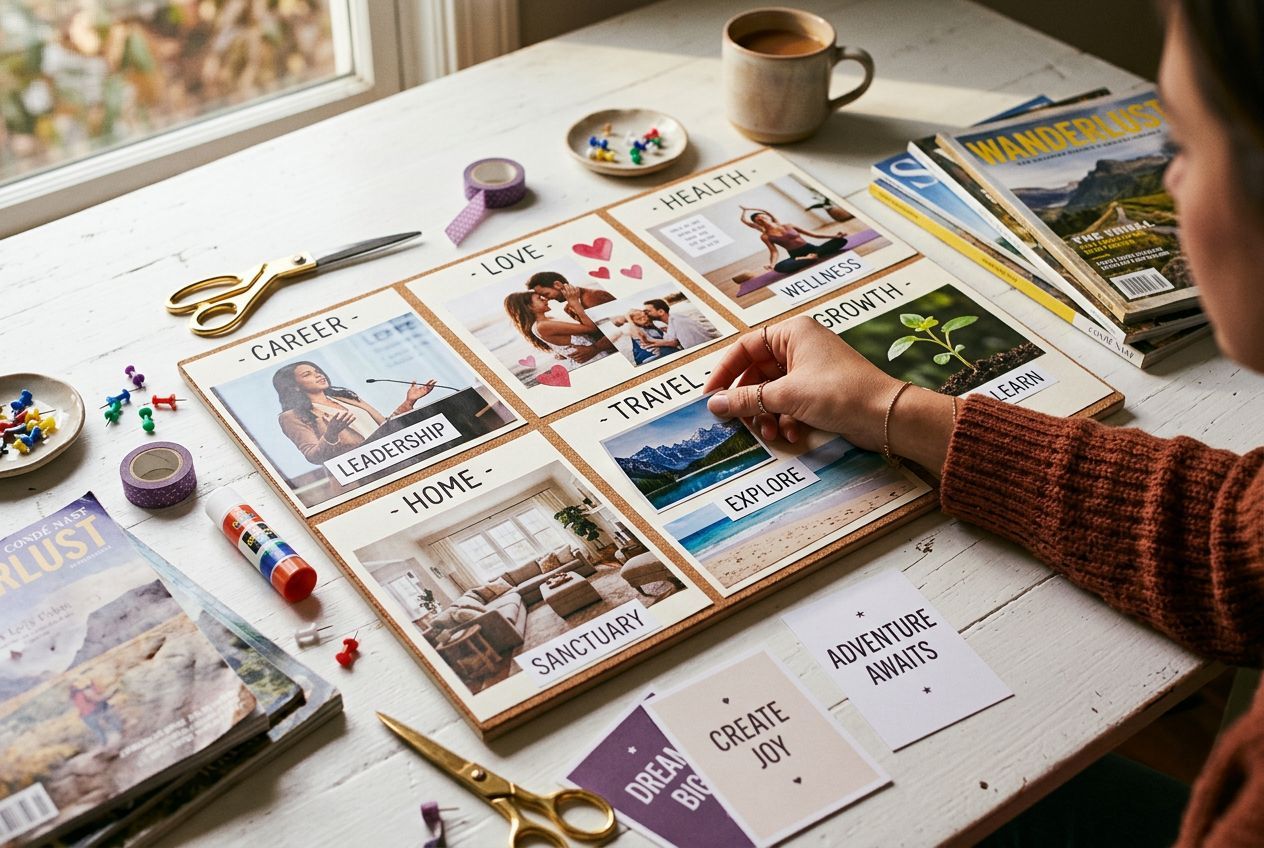
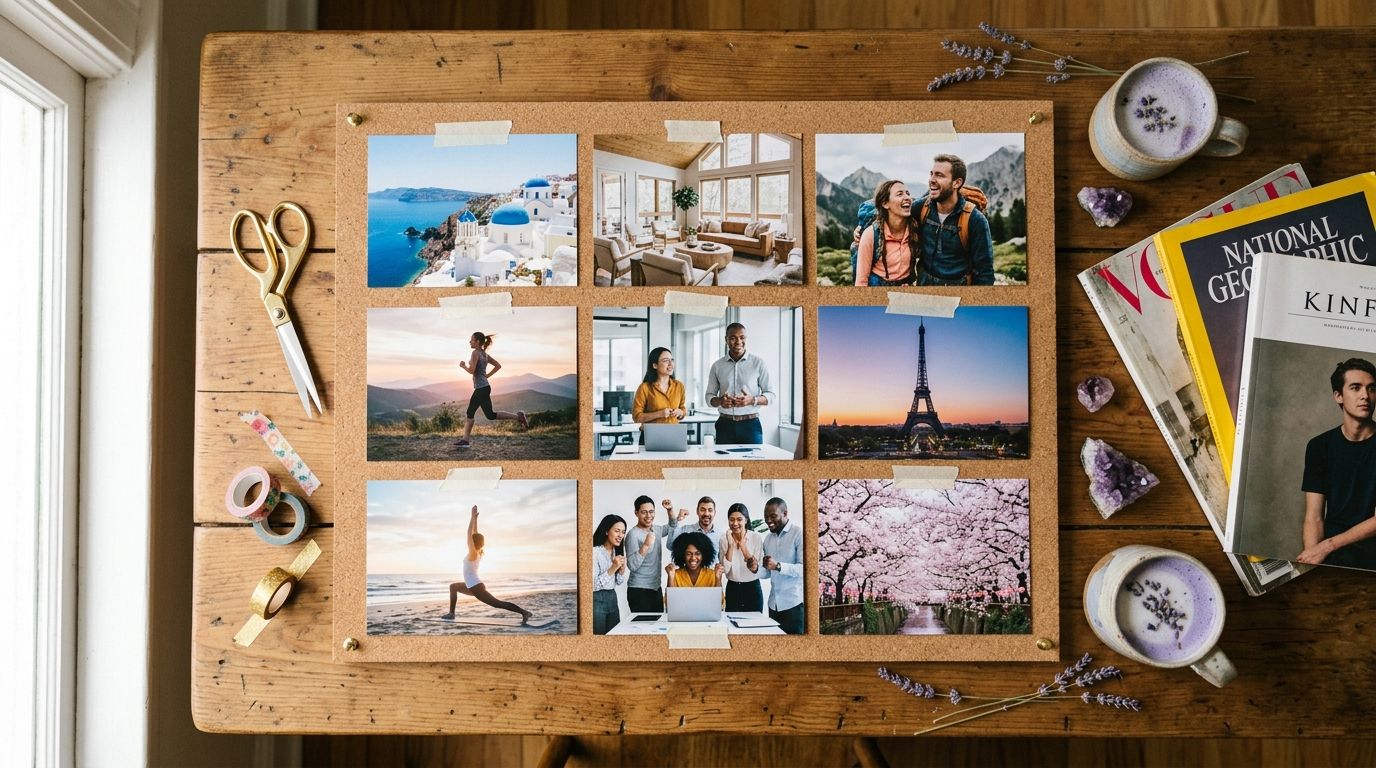
Why nine scenes is a sweet spot: Nine is enough variety to represent your full vision while keeping the board easy to take in at a glance. During a 5-minute daily practice, nine scenes gives you about 33 seconds with each image. A board with 25 images cuts that to 12 seconds each — easy to rush past. In numerology, 9 is also read as the number of completion. Quality per scene beats quantity of scenes.
Career and Professional Growth
Career vision board ideas ground your professional ambitions in specific, tangible images rather than vague aspirations like "success."
- Your dream office or workspace — the exact chair, desk setup, and view you want
- A specific job title on a nameplate or LinkedIn mockup — not "better job" but "Senior Creative Director"
- Your target salary written in large numbers — $150,000, $250,000, whatever your number is
- A photo of someone giving a keynote speech if public speaking is part of your vision
- Your dream company's logo or a photo of their headquarters
- A calendar showing your ideal work schedule — four-day weeks, remote Fridays, flexible hours
- An award or recognition you want to earn in your field
If you're manifesting a career change, pair these images with a written timeline. "Director of Marketing by December 2027" hits differently than a generic stock photo of someone in a suit.
Financial Abundance and Wealth
Financial vision board ideas work best when they combine specific numbers with the lifestyle those numbers create.
- Your target net worth written boldly — not hidden in a corner
- A screenshot of your dream bank balance (create a mockup)
- Images of what financial freedom looks like to you — maybe it's paying off your parents' mortgage, not a Lamborghini
- Your investment portfolio goals — rental properties, index fund balances, business revenue
- A debt-free celebration image — the moment you cut up that last credit card
- Passive income sources visualized — a book you'll write, a course you'll launch, dividend income
Your financial vision board should make you feel abundant, not anxious. If a $1 million number stresses you out, start with the next meaningful milestone — maybe that's your first $10,000 savings or paying off $30,000 in student loans. The goal should stretch you, not paralyze you.
Love and Relationships
Relationship vision board ideas focus on the feeling of the connection, not the physical appearance of a specific person.
- Scenes of partnership — cooking together, traveling together, laughing on a couch
- Your ideal date night — the restaurant, the conversation, the connection
- Words that describe how you want to feel in partnership: safe, chosen, adored, respected
- An engagement ring or wedding venue if that's your intention (be specific about the style)
- A family image if children are part of your vision — playground trips, bedtime stories, holiday chaos
- Friendship goals — a group trip, a dinner party, deep conversations by a fire
Don't put a specific person's photo on your board. Teachers from Neville Goddard to Abraham Hicks teach a similar idea: focus on the essence of what you want, not a specific person. "I attract a partner who makes me laugh until my stomach hurts and challenges me to grow" is more powerful than a photo of your ex.
Health and Wellness
Health vision board ideas should represent how you want to feel in your body, not just how you want to look.
- Your ideal morning routine visualized — yoga mat, green smoothie, sunrise walk
- A specific fitness milestone — running a half marathon, holding a handstand, touching your toes
- Energy and vitality images — dancing, hiking, playing with kids without running out of breath
- Healthy meal images that actually excite you (not sad salads)
- A meditation or breathwork practice — a quiet corner, cushion, candle
- Sleep quality goals — a cozy bed, a sleep tracker showing 8 hours, a "no phone in bedroom" sign
- Mental health wins — a therapy session, a journal entry, a calm mind visualization
Pair health goals with morning affirmations spoken while viewing your board. Seeing and saying your goal together makes the practice feel more complete.
Travel and Adventure
Travel vision board ideas are some of the most emotionally activating because they tap into desire for freedom and novelty.
- Specific destinations with your face in the scene — not just "Bali" but you standing on that cliff at sunset
- A world map with pins in every place you'll visit this year
- Business class or first class seat if upgrading your travel experience is a goal
- The Airbnb or hotel you want to stay in — screenshot the actual listing
- Adventure activities — scuba diving, hot air balloon, safari, northern lights
- A passport stamp collection image representing your travel volume goal
The most powerful travel board images are ones where you can almost feel the temperature. An image of Santorini at sunset hits harder than a generic "travel" text overlay.
Home and Living Space
- Your dream house exterior — the specific style, neighborhood, garden
- Interior design images matching your aesthetic — modern minimalist, cozy cottage, maximalist color
- A specific address or neighborhood you want to live in
- Home organization goals — the perfectly styled bookshelf, the walk-in closet, the chef's kitchen
- Entertaining spaces — the dinner party you'll host, the backyard BBQ, the holiday decorations
Personal Growth and Learning
- Books you want to read — stack them visually or list titles
- Skills to develop — a guitar, a coding screen, a language textbook
- A graduation cap or certificate for a course or degree you want to complete
- A journal and pen representing your commitment to daily writing
- A vision of your future self — who you're becoming, how you carry yourself
If that last idea appeals, how to see your future self shows how to picture it. And if you're building your board for a fresh year, pair it with your 2027 new year's resolutions.
Spiritual Growth and Manifestation Practice
- Your daily manifestation ritual visualized — crystals, candle, journal, quiet space
- A moon phase calendar for intention-setting and release ceremonies
- Affirmation cards with your most powerful personal affirmations
- A meditation retreat or spiritual workshop you want to attend
- Symbols of abundance — overflowing cups, blooming flowers, golden light
Explore which manifestation techniques align best with your energy. Some people manifest through visualization, others through writing, and others through physical action. Your board should reflect your natural style — the Manifestation Style Quiz can help you discover yours.
✨ Key Insight: The most useful vision boards focus on 5-9 goals. A board with 20 goals becomes visual noise. A board with 7 clear categories becomes a daily action plan you can actually take in.
What Are Vision Board Ideas Inspired by Joe Dispenza?
A Joe Dispenza-style vision board is built on a teaching from his books Becoming Supernatural and Breaking the Habit of Being Yourself: that you should feel the emotion of your future self now, before the goal arrives. In his approach, the images are scaffolding and the daily meditation is the real practice. Here's how to build one.
Dispenza's method asks you to do something most vision board guides skip: meditate in front of your board. Sit with it for 15-20 minutes each morning, eyes soft, and rehearse being the version of you who is already living each scene. These are his teachings rather than settled science, but mental rehearsal itself is a well-studied skill.
Vision board ideas in the Dispenza tradition:
- A photo of your future self at peace. Not posing, not striving — sitting calm and certain. The version of you who has already become.
- An image representing your "elevated emotion." Joy, gratitude, awe, freedom. Choose the feeling you want to anchor the entire board to.
- The unbecoming side. A small section showing what you're letting go of — the old identity, the survival emotions, the habit of being your past self. Some practitioners burn this part of the board ceremonially after 30 days.
- A morning meditation cue. A candle, a cushion, a chime — something that signals "I'm about to rehearse being the new me."
- One specific scene of the future "you" in action. Not the outcome (a check, a wedding ring, a new house) but you embodying the energy that produced it.
The Dispenza approach pairs naturally with the 369 method — write your affirmation in the morning, meditate on the board for 15 minutes, then move into your day from the elevated emotion you generated. Seeing, writing and feeling your goal together is the heart of his approach.
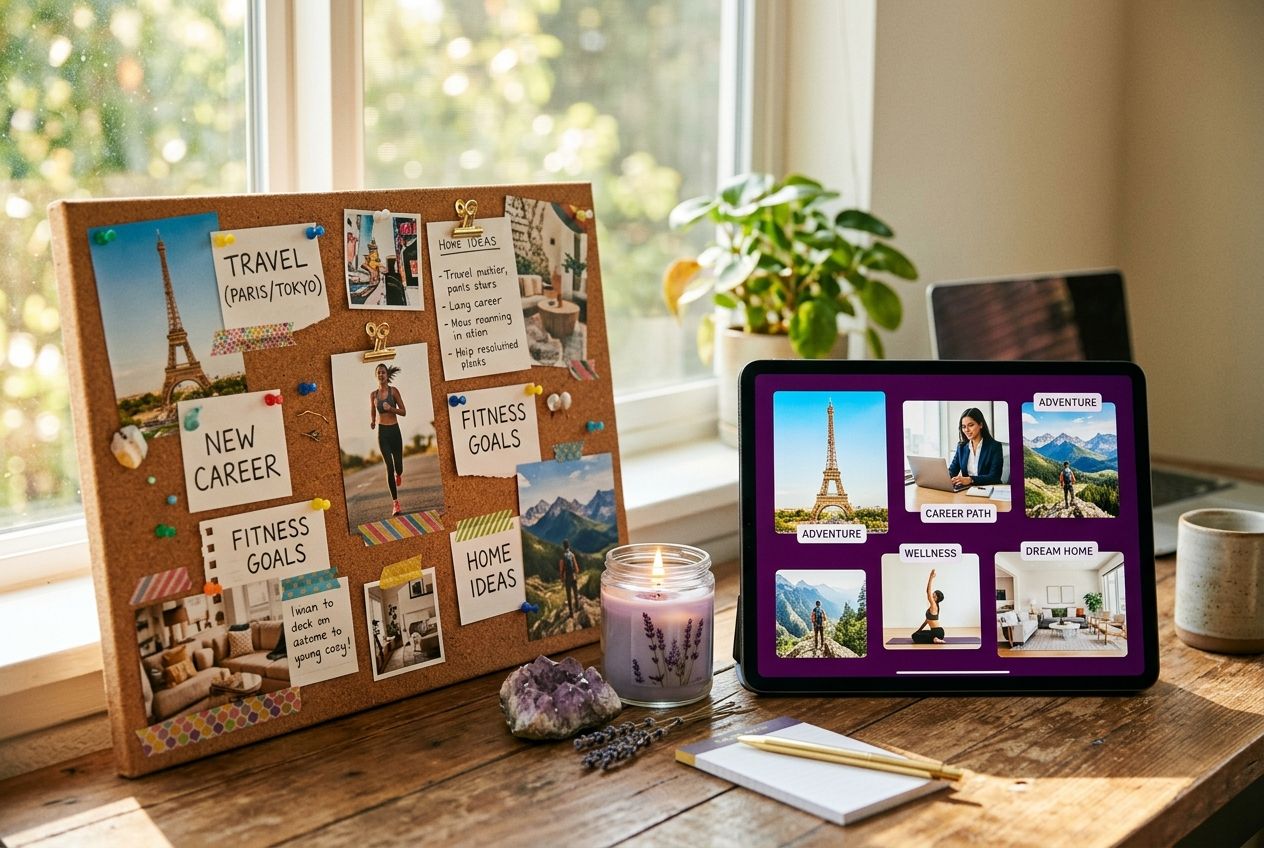
The best vision board formats are a cork board, poster board, Canva design, personal photo board or Pinterest board. Match the format to your lifestyle and how you'll use it daily. There's no single best format — the best one is the one you'll actually look at every morning.
| Format |
Best For |
Pros |
Cons |
| Cork board |
Tactile creators who enjoy crafting |
Easy to rearrange, physical ritual of pinning |
Takes wall space, not portable |
| Poster board |
One-time creation projects |
Cheap, available at any craft store |
Hard to update, gets damaged |
| Digital board (Canva) |
Tech-savvy creators |
Free, easy to update, phone wallpaper |
Less tactile, screen fatigue |
| Personal photo board (Manifest Mosaic) |
Maximum emotional impact |
Your face in every scene, photorealistic |
First photo free |
| Pinterest board |
Visual collectors who browse often |
Infinite images, always evolving |
Can become passive scrolling |
Additional creative formats to consider:
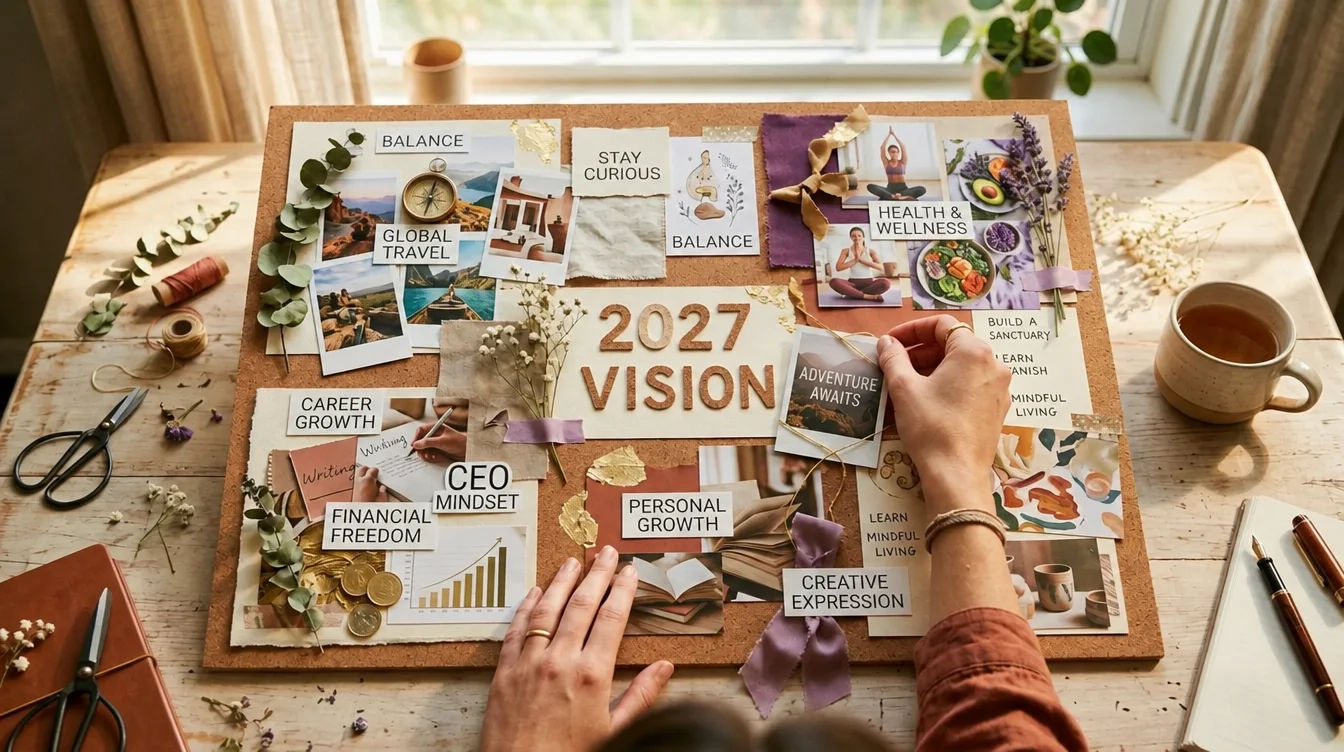
- Collage-style board — overlapping images, washi tape, handwritten notes
- Grid-style board — neat rows and columns, one image per goal
- Mind map board — central "dream life" image with branches to each category
- Vision book or binder — a portable vision board you flip through like a journal
- Phone wallpaper board — your 9 most powerful images as a rotating lock screen
- Google Slides vision board — collaborative, easy to share at vision board parties
Make your 2027 vision board — first picture free →
Who Are Vision Boards For?
Vision boards are for anyone with a goal — adults, teens, kids, couples and families. There's no age limit on visual goal-setting. What changes is the content: a student's board looks different from a parent's or a retiree's. Here's how to adapt the ideas above for different people and stages of life.
- For women: Focus on what YOU want, not what you think you should want. If your board has a dream kitchen but you hate cooking, that's someone else's goal on your board. Daily affirmations for women paired with a personal board create a powerful daily practice.
- For men: Drop the stigma. Goal-setting works the same way for everyone. Focus on career milestones, fitness achievements, adventure experiences, and the legacy you want to build.
- For students: Academic goals, dream universities, study abroad destinations, and career aspirations. A student vision board should include both the achievement and the celebration after — the graduation party, the first paycheck, the apartment in the city you love.
- For couples: Build a board together. Include shared goals alongside individual goals. A couples vision board night is one of the best relationship-building activities you can do.
- For kids: Make it fun. Use stickers, drawings, magazine cutouts, and positive affirmations for kids. Let them dream without filtering — if they want a pet dragon, put the dragon on the board. Imagination is the muscle we're training.
How Do You Choose the Right Images for Your Vision Board?
The right images produce an immediate emotional response — a flutter in your chest, a smile you can't control, or a sharp intake of breath. If you feel nothing when you look at an image, it doesn't belong on your board.
Three rules for selecting vision board images:
- Specificity beats aspiration. "A red front door on a craftsman house in Portland" manifests faster than "nice house." A clear, specific image is easier to picture and act on. Find the exact image that matches your vision — or have one made of you. That's why Manifest Mosaic puts your face in photorealistic scenes of your future.
- Include the feeling, not just the thing. A pile of cash is less powerful than an image of you paying for your parents' vacation with a huge smile. The image should capture the emotion of having the thing, not just the thing itself.
- Mix images with words. Words tell you exactly what each image stands for. Add powerful vision board quotes and specific affirmation phrases alongside your images.
For ready-made images organized by category, check out the vision board pictures collection or browse vision board templates for pre-designed layouts.

 Manifest Mosaic