What Does a Grid Vision Board Look Like?
A grid vision board arranges images in clean rows and columns — usually a 3×3 grid with nine squares, one goal per square. Each image gets its own space, so nothing competes for attention and you can take in every goal in a few seconds. It's the easiest layout to keep clear and the easiest to update.
Example 1: The Classic 3×3 Life Categories Board
A board divided into 9 equal squares: career (laptop in corner office), finances ($100K savings goal written in gold), love (couple cooking together), health (yoga mat at sunrise), home (craftsman house with red door), travel (Santorini sunset), growth (stack of books), spirituality (meditation space with candles), and center square — a selfie surrounded by the word "THIS IS MY LIFE."
Why it works: Every life area gets representation. The center selfie with the present-tense declaration creates identity-level association. The financial goal uses a specific number ($100K) rather than a vague "wealth" image.
Example 2: The Career-Focused Professional Board
A board with 9 squares all related to professional goals: a specific job title on a nameplate ("VP of Product"), a salary number ($185,000), a photo of a keynote stage, a screenshot of a LinkedIn post with 10K+ reactions, a team meeting with the creator at the head of the table, a published book cover mockup, his dream office setup, a Forbes 30 Under 30 logo, and center — a daily schedule showing 6am gym, 8am deep work, no meetings before 11am.
Why it works: Single-focus boards can be more powerful than multi-category boards when one area of life dominates your current intention. The daily schedule image is brilliant — it visualizes the process, not just the outcome.
Example 3: The Parent's Balanced Life Board
A parent's board showing: family vacation (Disney castle with kids), personal time (woman reading alone in a bathtub), business growth ($5K/month side income), health (completing a 5K run), home renovation (dream kitchen with white marble), date night (couple at a nice restaurant), kids' milestones (graduation cap, first day of school), daily peace (cup of tea on a rainy morning), and center — a handwritten affirmation: "I deserve ALL of this."
Why it works: The center affirmation addresses the guilt that many parents feel about wanting things for themselves. Each image balances family goals with personal goals — a deliberate structural choice.
For the complete guide on building your own grid board, see how to make a vision board.
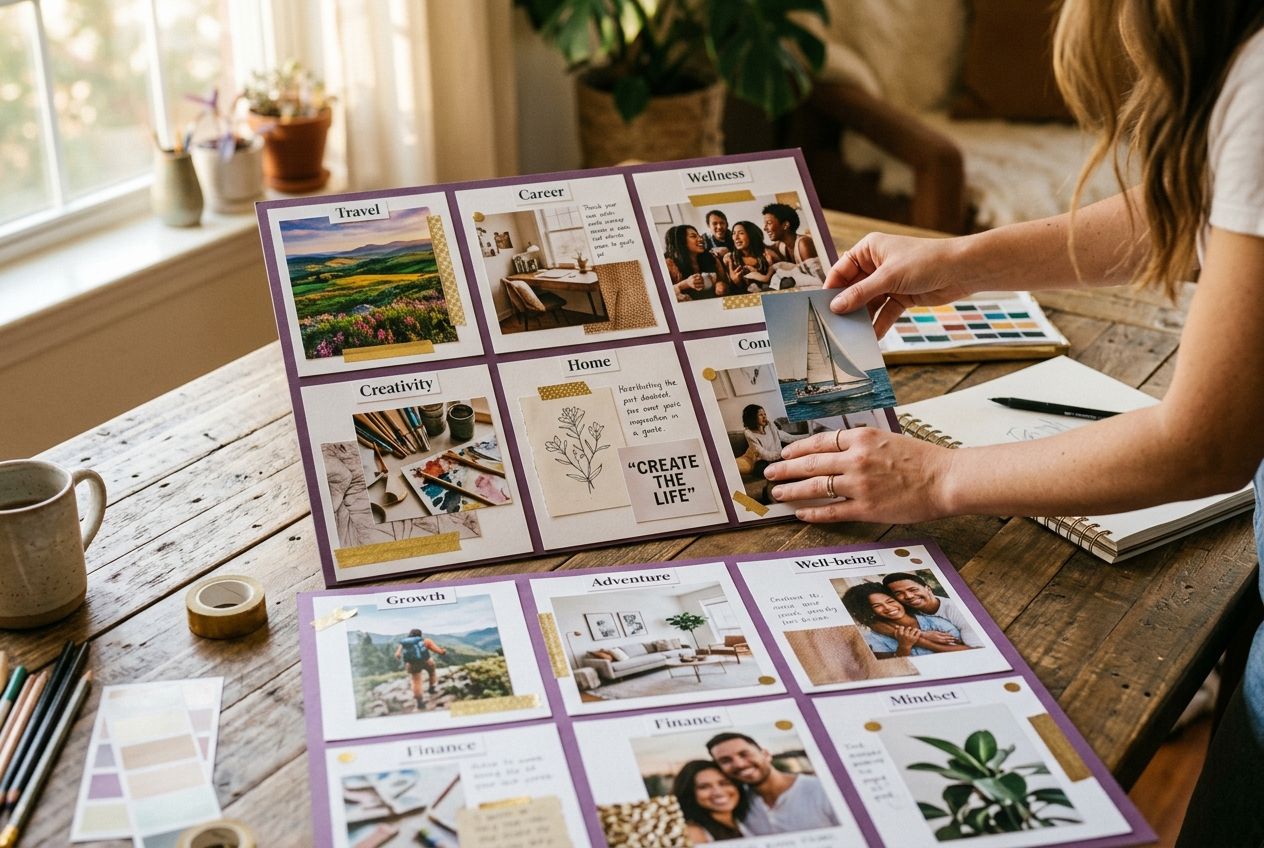
✨ Key Insight: Grids make each goal easy to spot because every section has one clear purpose. When you scan a 9-panel grid, you see 9 distinct goals. A busy collage can blur into "a bunch of pretty pictures" unless each image clearly stands for something.
What Does a Collage Vision Board Look Like?
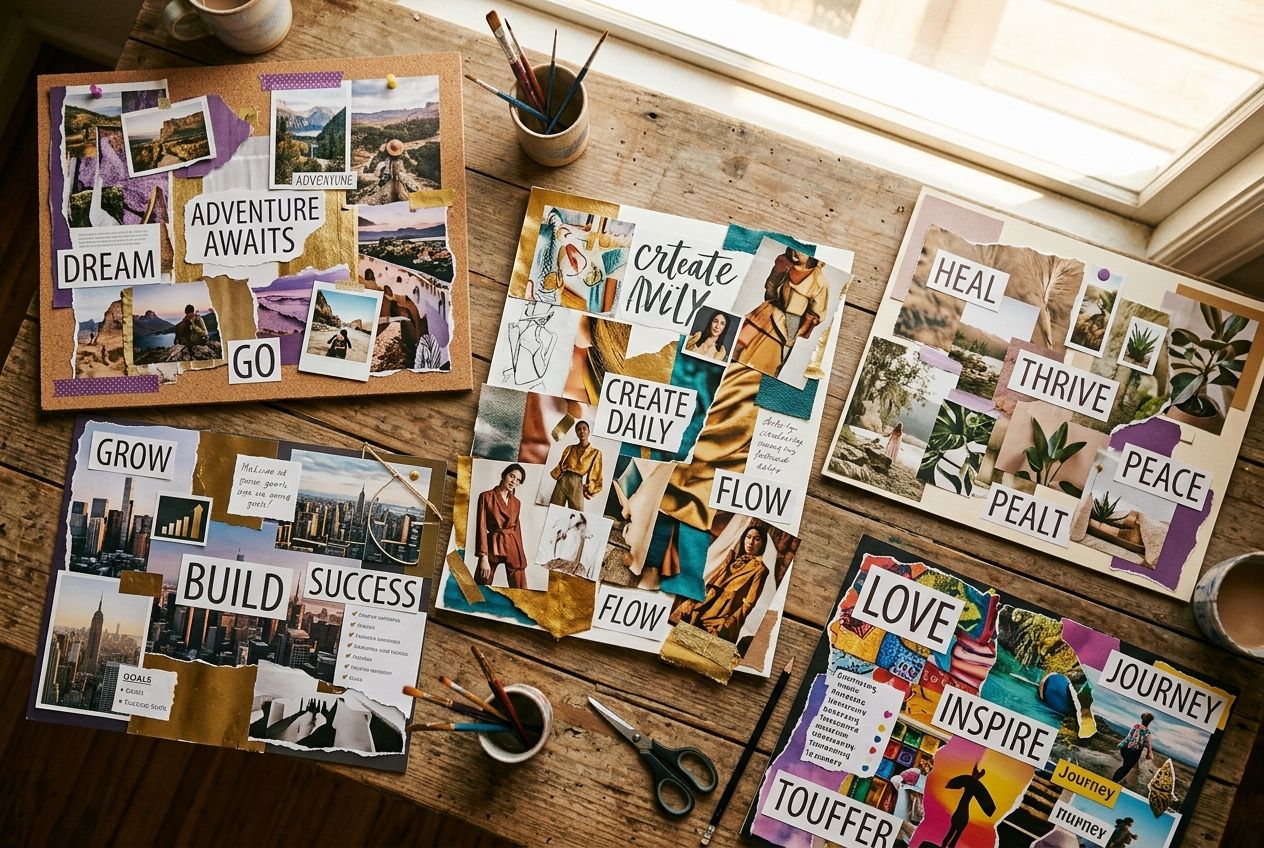
A collage vision board layers images, words and textures in an overlapping, free-form arrangement — closer to a mood board than a neat grid. It suits creative people who find grids too rigid. The trade-off is clarity: make sure each goal still has one image that clearly stands for it, so the board doesn't turn into noise.
Example 4: The Aesthetic Magazine Collage
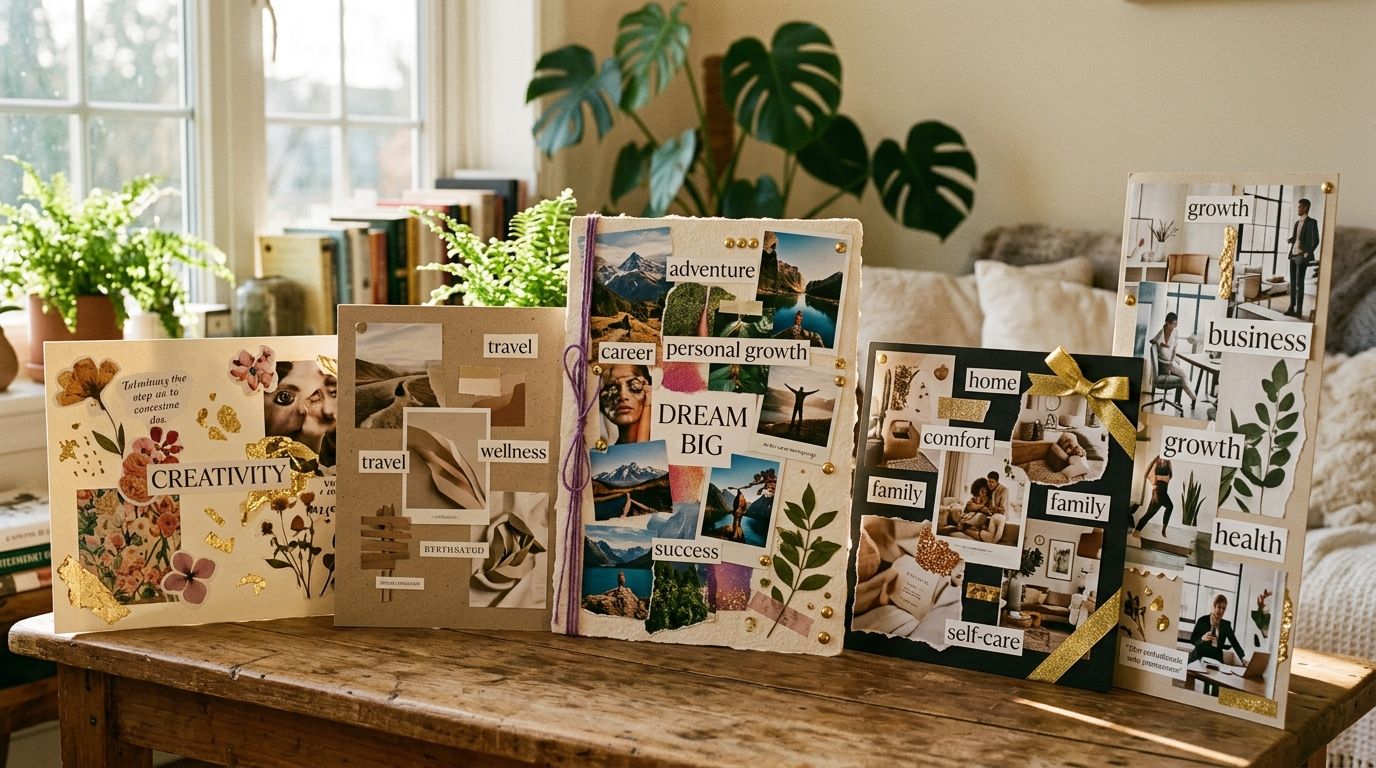
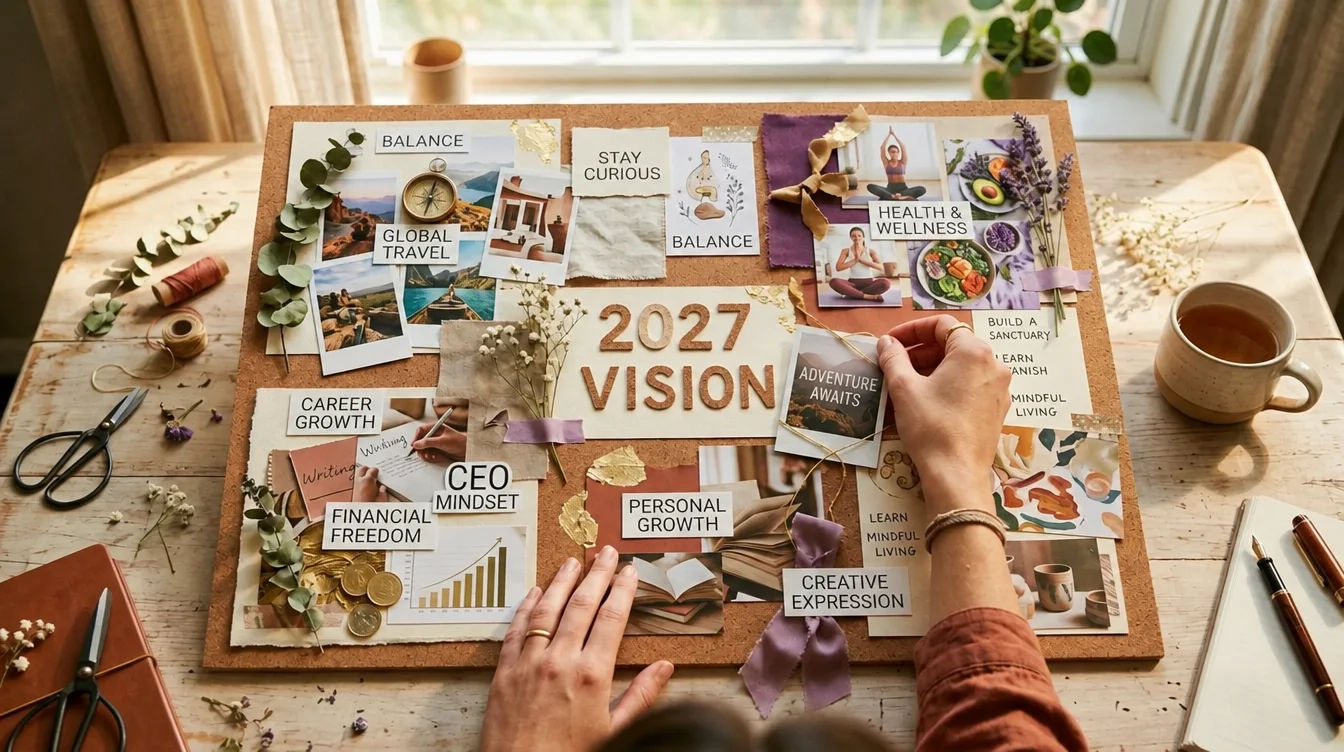
A board covered edge-to-edge with overlapping magazine cutouts — travel scenes, fashion images, food photography, and handwritten words scattered throughout. Washi tape in lavender and gold creates decorative borders between sections. Dried flowers pressed into the corners. No visible board surface — every inch covered.
Why it works: The creation process itself is a 3-hour meditative ritual. For tactile creators, the making is half the practice. A board this beautiful is one you genuinely want to look at every morning — which is the entire point.
Example 5: The Minimalist Words-Only Board
A board that contains ZERO images — only words. White poster board with large black text: "DEBT FREE BY DECEMBER," "150 POUNDS," "PROMOTED TO DIRECTOR," "DAILY MEDITATION," "CALL MOM EVERY SUNDAY." Simple, direct, no decoration.
Why it works: Proves vision boards don't require images. For analytical thinkers, specific written goals activate language processing without the distraction of image selection. The specificity (exact weight, exact month, exact title) makes each goal clear and measurable.
Example 6: The Travel Dream Board
An entire board dedicated to 9 travel destinations with printed photos, hand-drawn maps, pinned airline routes with string, and small envelopes containing saved money marked "$200 for Bali fund." A passport photo in the center with a stamp count goal: "25 countries by age 35."
Why it works: The physical envelopes with money inside create a tangible action bridge between visualization and behavior. The stamp count goal is specific and trackable.
What Are Some Digital Vision Board Examples?
Digital vision board examples include phone-wallpaper boards made in Canva, secret Pinterest boards, computer screensavers and boards of photos showing you in each scene. They're easy to update and easy to see all day, because they live on the screens you already check. The examples below show how each one works.
✨ Key Insight: Static boards show you images of someone else's dream life. The bigger leap is seeing your future self living it: your dream home, your business launch day, your finish line. For many people, seeing their own face makes a goal feel far more believable than a stock photo.
Digital boards are created using apps or software. They offer instant updating, phone wallpaper integration, and — in the case of Manifest Mosaic — photos of you in every scene.
Example 7: The Canva Phone Wallpaper Board
A 4-panel vertical layout designed for phone lock screen. Top: career goal image. Middle: relationship image + financial number overlay. Bottom: health image + daily affirmation text. Clean design, high contrast text readable at phone size.
Why it works: A phone wallpaper means you see your goals every time you pick up your phone, with zero effort. The simplified 4-panel layout accounts for the small screen — no tiny images that become unreadable. See how to create a vision board on Canva.
Example 8: The Personal Photo Board (Manifest Mosaic)
A 3×3 grid of 9 photorealistic scenes — each showing the creator's actual face in a different dream scenario: standing on a balcony overlooking the ocean, giving a keynote speech to a packed auditorium, cooking in a dream kitchen, sitting in first class on a plane, meditating on a mountaintop, laughing at a dinner party, signing a book deal, walking through a park with a partner, and standing in front of a "SOLD" sign on a house.
Why it works: Seeing your own face in the scene makes each goal personal in a way no magazine cutout can. Imagining yourself doing something is a real mental skill (Pearson et al., 2015), and a photo of you gives that imagination a head start. Make your own 2027 board →
Example 9: The Pinterest Secret Board
A Pinterest board with 50+ pinned images organized into sections using Pinterest's section feature: "Dream Home," "Career Goals," "Travel 2027," "Health & Body," "Relationship Vision." Constantly evolving — new pins added weekly.
Why it works: Pinterest boards are living documents that grow with you. The discovery process — searching and pinning — is itself a form of intention-setting. The weakness: Pinterest boards can become passive scrolling instead of active visualization.
What Do Vision Boards for Money, Love and Health Look Like?
Theme boards focus on one area of life. A money board pairs specific numbers with the lifestyle they pay for. A love board shows the feeling of a relationship, not a specific person. A health board shows how you want to feel in your body, not just how you want to look. Here are examples of each.
Example 10: The Financial Freedom Board
Images: debt payoff countdown tracker, investment portfolio screenshot mockup, dream house with price tag ($450,000), passive income sources visualized (rental property, online course, book royalties), a specific monthly savings goal ($3,000/month to emergency fund), and a "financial freedom date" circled on a calendar — July 2028.
Why it works: Financial boards succeed when they include BOTH the lifestyle the money creates AND the specific numbers behind it. A beach photo alone isn't a financial goal. A beach photo + "$8,000/month passive income" is. For a wider look at the practice, see how to manifest in 2027. For more on money goals, see how to manifest money.
Example 11: The Relationship Vision Board
Images: couple cooking together, morning coffee in bed scene, hiking together in nature, one image of the feeling word "SAFE" in large letters, a wedding venue photo, and a handwritten list of partner qualities: "makes me laugh until my stomach hurts, challenges me to grow, respects my independence."
Why it works: Notice the absence of a specific person's photo — the board focuses on the feeling and qualities of the relationship, not a particular human. This matches a teaching from Neville Goddard: focus on the essence of what you want, not a specific person.
Example 12: The Health Transformation Board
Before/after format: left side shows current state (tired, stressed, achy), right side shows the vision (running a half marathon, cooking healthy meals, sleeping 8 hours, energy to play with kids). Center: a specific number — "155 lbs by October, feeling strong and alive."
Why it works: The contrast format creates emotional tension between "where I am" and "where I'm going." This tension is motivational fuel. The emphasis on "feeling strong" alongside the weight number prevents the board from becoming purely aesthetic.
Example 13: The Student Vision Board
A college student's board: dream job title, graduation photo spot (cap and gown on campus), study abroad destination, first apartment, starting salary goal, mentor meeting scene, and a stack of books they want to read this year. Affirmation: "I am building the future I dreamed about in high school."
Why it works: Students benefit from boards because they're at a life stage where possibilities feel both exciting and overwhelming. The board narrows the field to specific, achievable images.
Example 14: The Career Change Board
A board for someone leaving one field for another: a course certificate, a portfolio website mockup, a first-day-at-the-new-job scene, a savings number marked "6 months of runway," and the line "I am a UX designer by fall 2027."
Why it works: It shows the steps as well as the finish line. Seeing the bridge — course, portfolio, savings — makes a big change feel doable.
Example 15: The Couples Board
Two people's board split down the middle, with a shared row across the center: a home they'll buy together, a trip for their tenth anniversary, and a weekly date night. Each side holds one personal goal the other supports.
Why it works: It balances "our" goals with "my" goals, so neither partner disappears into the other's plans.
Example 16: The Home Board
Nine images all about one future home: the front porch, a sunny kitchen, a reading nook, a garden bed, a dog on the rug, a dinner party at the table, and the down payment number written in the center.
Why it works: It turns "a house" into a place you can almost walk through — and the down payment number keeps it grounded.
Pro Tip: Place your vision board where you'll see it within the first 5 minutes of waking, before the day gets busy. A board on your bedroom wall or as your phone lock screen catches that quiet moment every day.

 Manifest Mosaic