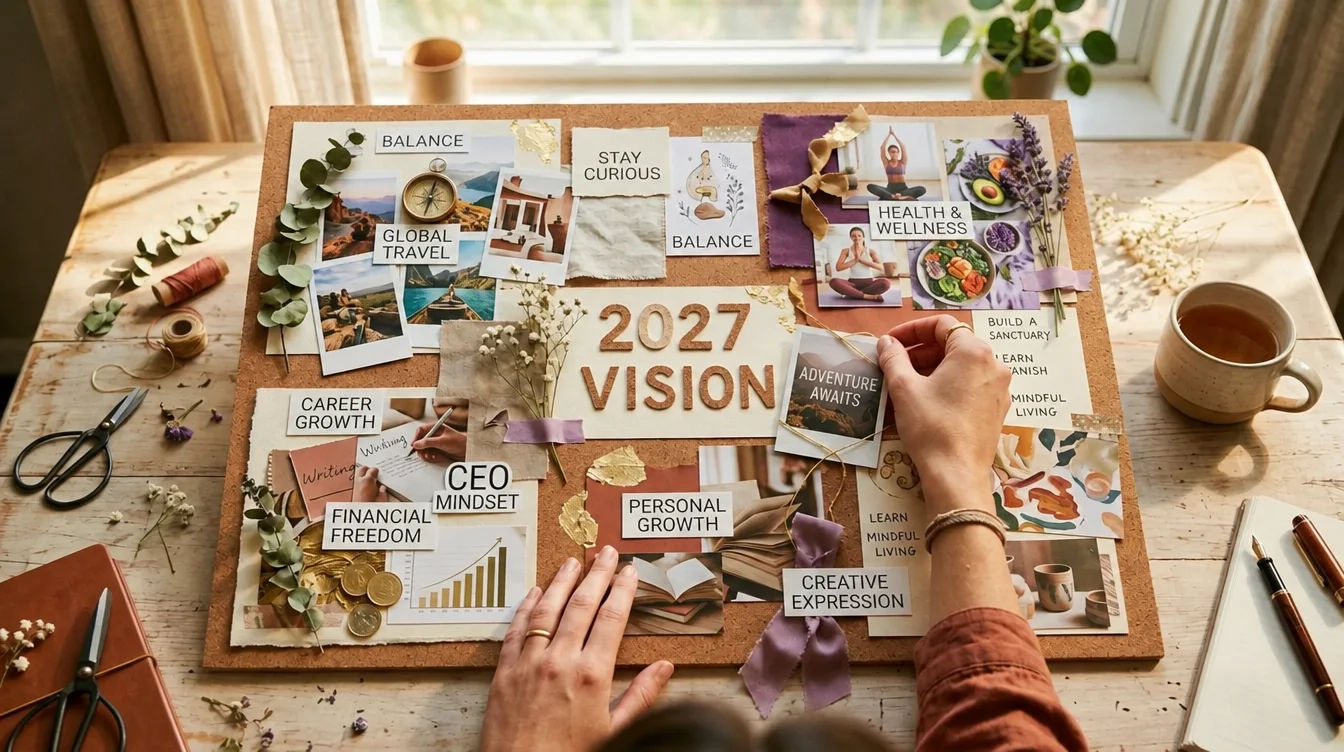

Becoming Board vs Vision Board

Becoming board vs vision board: one shows what you want, the other who you must become. See the differences, what research says and how to build both for 2027.

Becoming Board vs Vision Board
In this guide 11 sections
  1. 01What Is a Becoming Board?
  2. 02What Is a Vision Board?
  3. 03Becoming Board vs Vision Board: What Is the Real Difference?
  4. 04Vision Board vs Dream Board vs Goal Board: Are They Different?
  5. 05Do Vision Boards Actually Work?
  6. 06Why Does Focusing on Who You Become Help?
  7. 07What Is an Action Board, and How Is It Different?
  8. 08What Are the Best Vision Board Alternatives for 2027?
  9. 09How Do You Make a Becoming Board for 2027?
  10. 10Should You Use a Vision Board, a Becoming Board or Both?
  11. 11Sources & Methodology

The becoming board vs vision board question comes down to this: a vision board shows what you want to have, while a becoming board shows who you need to be and what that person does each day. Vision boards give you a target. Becoming boards give you a daily identity to practice.

You don't have to pick one. (If you want the belief side of it, see how to manifest in 2027.) The two answer different questions, and together they cover the gap that makes many boards fade by February.

Key Takeaways
  • A vision board shows the outcome; a becoming board shows the person and the daily behaviours behind it
  • "Becoming board" is a recent, informal coaching idea, not a researched method
  • Studies on positive fantasy and mental simulation suggest that picturing only the finish line can drain energy, while picturing the process helps
  • Terms like dream board, goal board and vision board have no official definitions
  • The simplest fix is a hybrid: keep your vision board, then add who, what and when to each image
  • Start in Q4 2026 so you walk into 2027 with both

What Is a Becoming Board?

A becoming board is a board, on paper or on a screen, that shows who you are turning into and what that person does on an ordinary day. Instead of a trophy or a dream house, it holds pictures and words about habits, choices and routines. It is a recent, informal idea, popularised online by coaches.

Here is a quick example. A vision board for a runner might show a marathon finish line. A becoming board for the same runner shows a pair of shoes by the door, a Sunday long-run route and the words "I'm someone who runs at 6:30 a.m. and rests on schedule."

The prompt often used is "[Your name] 2027 is…", followed by a few present-tense lines about how that person lives. It has been shared by coaches and creators on Substack, LinkedIn and Facebook. We can't say who coined it. What we can say is that nobody has tested it in a trial, so it is a practice, not a proven method.

What Is a Vision Board?

A vision board is a collage of images, pictures and affirmations of your hopes for the future, meant to inspire and motivate you, as Wikipedia describes it. It is a picture of the result: the trip, the job title, the home, the feeling of being healthy.

The idea has old roots. Some people see the notebook affirmations of novelist Octavia E. Butler as an early version of the modern board. Its popularity is often linked to 2006, when the book and film The Secret brought the law of attraction to a mass audience. That is a belief tradition, and it comes with no evidence that thoughts alone change outcomes.

A vision board still does real work. It helps you decide what you want, and it keeps it in front of you. Short lines of text help too; our vision board quotes are sorted by life area. If you're new to the format, start with what a vision board is or how to make a vision board, or see real layouts in these vision board examples.

Becoming Board vs Vision Board: What Is the Real Difference?

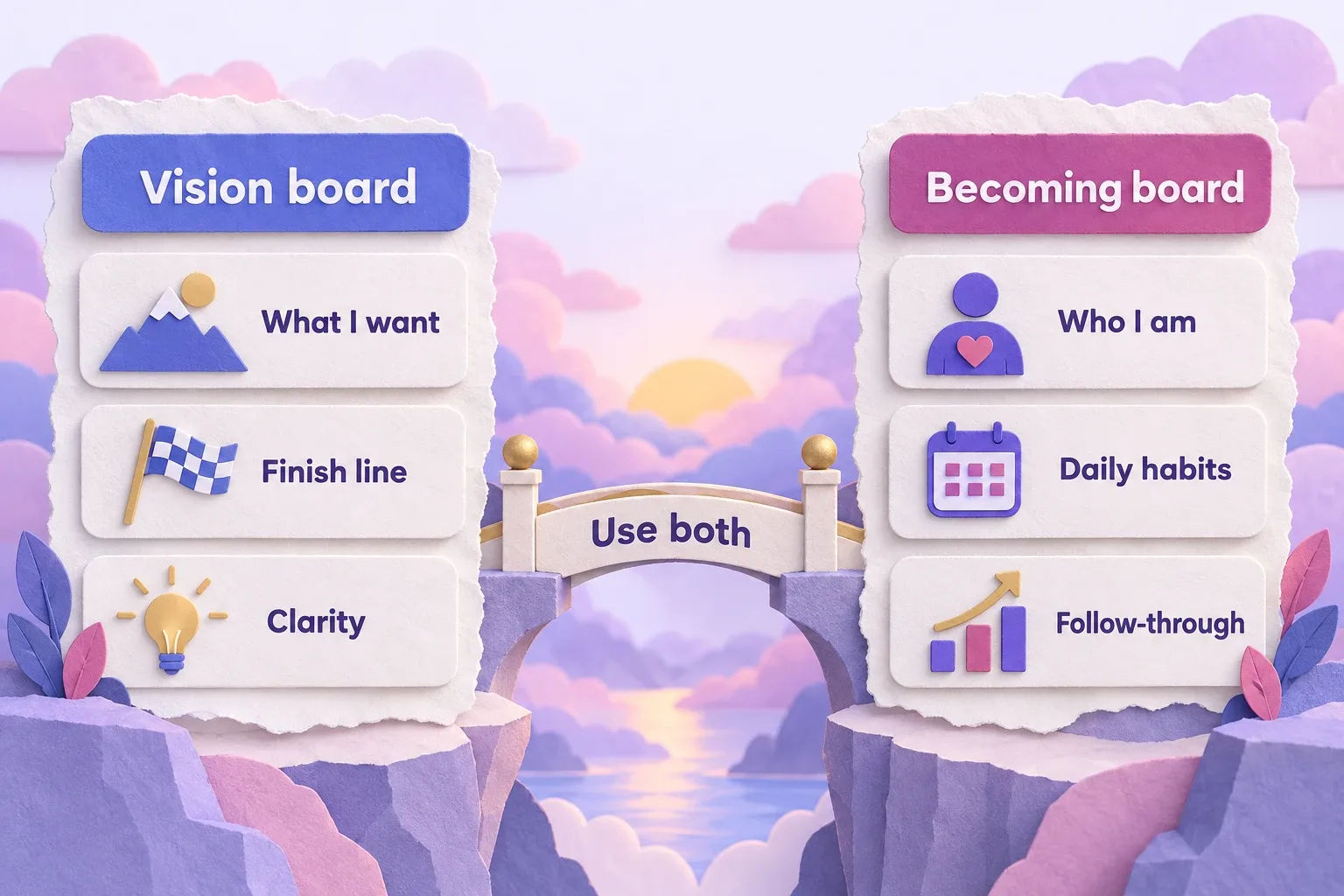
The real difference is the question each board answers. A vision board asks "What do I want?" A becoming board asks "Who do I have to be, and what do I do, for that to happen?" One shows an outcome. The other shows an identity and a routine.

Becoming board vs vision board comparison: outcome and clarity versus identity, daily habits and follow-through
Vision board Becoming board
Main question What do I want to have? Who am I, and what do I do daily?
What goes on it Results: trips, homes, titles, milestones Habits, routines, ordinary-day scenes, "I am someone who…" lines
Time focus Future finish line Every day between now and then
Main strength Clarity and motivation Follow-through and identity
Main risk A pleasant feeling with no plan Feeling like a chore list if it has no joy
Best for Choosing your direction Turning direction into behaviour
Research status Not tested as collages Not tested directly

Neither one is better in every case. If you don't know what you want, start with a vision board. If you know what you want and keep stalling, a becoming board is the missing piece.

Vision Board vs Dream Board vs Goal Board: Are They Different?

Not in any official way. Writers use the names inconsistently. Some call a dream board a long-term, bucket-list picture, and a vision board a dream board plus reminders of goals and actions. Others, including many coaching sites, treat vision, dream and goal boards as one thing.

Because nobody agrees, here is a simple set of working definitions. This is our convention, not a rule:

  • Vision board: pictures of the life you want to be living.
  • Dream board: the same, but looser and longer-term, with no deadline.
  • Goal board: pictures plus specific targets and dates.
  • Action board: each image paired with a next step.
  • Values board: pictures of the principles you want to live by.
  • Mood board: a collage of a style or feeling, often for design.
  • Becoming board: who you are and what you do each day.

Pick the terms that help you and ignore the rest. The label matters much less than what is on the board.

Do Vision Boards Actually Work?

Vision boards can help you get clear and stay motivated, but there is no good evidence that a collage alone makes goals happen. Research on related habits, such as writing goals down and planning specific steps, is more encouraging. For a longer look, read do vision boards work.

Here is what the research does and doesn't say:

  • Positive fantasy can sap energy. In four experiments, psychologists Kappes and Oettingen found that people who indulged in positive fantasies about a desired future showed less energy than people who imagined the future in a way that also questioned it (Kappes & Oettingen, 2011). That study did not test vision boards. It tested daydreaming about a perfect future.
  • Picturing the process beats picturing only the outcome. In a study of college freshmen, students who mentally rehearsed the process of studying did better on a midterm than the control group, and they planned better and felt less anxious (Pham & Taylor, 1999). It was one exam and one group of students, so it is a hint, not a law.
  • Writing goals down helps. A small 2015 study by Gail Matthews, presented at a conference and not peer-reviewed, found that people who wrote goals down achieved more, and those who also sent weekly updates to a friend did best: 76% reached or got more than halfway to their goals, against 43% of those who didn't write them down (Matthews summary).

The fair reading: a board that only shows the finish line may feel great and change little. A board that also shows the process, the person and the plan has better odds. Some articles claim vision boards "decrease your chances of success." That goes further than the evidence does.

Why Does Focusing on Who You Become Help?

Focusing on who you are becoming turns a distant result into something you can do today. "Run a marathon" is a finish line you can't touch this week. "I'm someone who runs on Saturdays" is a small action you can do in the next few days, and doing it makes the identity feel true.

That fits with the process-simulation finding above: rehearsing steps rather than the applause. It also fits with everyday habit science. New habits took an average of 66 days to feel automatic, with a range of 18 to 254 days (Lally et al., 2010). A becoming board is a reminder to keep showing up through that long middle.

One honest limit: none of these studies tested a becoming board. They support the thinking behind one. Treat the board as a tool for reflection, not a guarantee.

A useful way to feel the shift is to change a reward-based line into an identity-based line, as in the sliders below.

🔄From the finish line to the person: reword your board
Health
Before

Run a marathon

→
After

I'm someone who runs on Saturday mornings and rests on schedule

1 of 6 mindset shifts

What Is an Action Board, and How Is It Different?

An action board pairs each image with a concrete next step, a date and a first move. Wikipedia describes it as an alternative to, or partner for, a vision board. A becoming board covers identity and daily behaviour, while an action board covers the plan and the schedule. They work well together.

The bridge between them is an if-then plan. Instead of "I'll exercise more," write "If it's Tuesday at 6:30 a.m., then I put on my running shoes." This is called an implementation intention, and researchers Peter Gollwitzer and Paschal Sheeran have studied it for years as a way to turn goals into action.

A three-layer model works well:

  1. Vision (why): the life you want.
  2. Becoming (who): the person who lives it.
  3. Action (when and how): the if-then steps that person follows.

What Are the Best Vision Board Alternatives for 2027?

The best alternative depends on what you need. If you want clarity, keep a vision board. If you want follow-through, add a becoming or action board. If you feel overwhelmed by goals, try a values board. If pictures aren't your thing, write a letter to your future self.

  • Values board: shows the principles you want to guide your choices. Good if you're tired of chasing outcomes.
  • Gratitude board: shows what you already have. Good for a low-pressure reset.
  • Action board: pairs each wish with a next step. Good for people who like lists.
  • Becoming board: shows the daily you. Good for building habits.
  • Letters to your future self: words, not pictures. Read our guide to a letter from your future self, or try future self journaling for daily prompts.
  • Photos of yourself in the life you want: see what it looks like to see your future self.

How Do You Make a Becoming Board for 2027?

To make a becoming board, choose one to three areas of your life, write who you are in each one, turn every outcome into a daily or weekly behaviour, add an if-then plan, then gather pictures of ordinary days rather than trophies. Put it where you'll see it and review it monthly.

Becoming board vs vision board: a grandmother and granddaughter build a paper board in a bakery

Step by step

  1. Pick one to three areas. Health, work, money, home, relationships. Fewer is better.
  2. Write "[Your name] 2027 is…" lines. Use present tense and behaviours: "Maya 2027 is someone who cooks dinner at home on weeknights."
  3. Convert each outcome into a person and a habit. "Save $5,000" becomes "I'm someone who moves money to savings on payday."
  4. Add one if-then plan per habit. "If it's payday, then I transfer $100 before I spend anything."
  5. Collect ordinary-day images. A packed gym bag, a tidy desk, a kitchen with vegetables. Avoid trophies.
  6. Place it where you'll see it. A wall, a fridge, a phone wallpaper.
  7. Review monthly for ten minutes. Keep what fits. Change what doesn't.

Two real-world scenarios show how this plays out. Dana wants a promotion. Her vision board shows a corner office, but her becoming board shows "I'm someone who sends a weekly update to my manager" and "If it's Friday at 3, then I write it." Sam wants to get fit, and his vision board shows a beach. His becoming board shows shoes by the door and a Sunday meal-prep list.

If you'd like the picture layer done for you, Manifest Mosaic turns your wishes into photos of you already living them, which makes the "who" easy to see. Affirmations and vision boards are a mindset practice, not a substitute for medical, mental-health or financial advice.

Should You Use a Vision Board, a Becoming Board or Both?

Use both. Start with a vision board to decide what you want, then add a becoming board so you know who you're practising to be. If you're short on time, add one line to each vision-board picture: "I'm someone who…" and a small habit. That single step turns a wish into a routine.

Becoming board vs vision board: two friends compare two boards side by side at a harbour at sunset

A quick guide:

  • You're unsure what you want: vision board first.
  • You know what you want but stall: becoming board.
  • You're overwhelmed: values board, then one becoming line.
  • You like plans: action board plus a becoming line.

For 2027, some people also like a numerology anchor. In numerology, the year 2027 adds up to 2 + 0 + 2 + 7 = 11, a master number that is often reduced to 2 and linked with intuition and partnership. That is a tradition, not evidence, but it makes a nice theme for a ritual. See our 2027 numerology guide.

If you want the full path, read how to make a 2027 vision board, then choose your targets with goals for 2027. Our New Year's resolutions for 2027 guide covers the habit side.

See yourself living it in 2027 — make your first picture free →

Sources & Methodology

Kappes & Oettingen (2011), "Positive fantasies about idealized futures sap energy," Journal of Experimental Social Psychology — four experiments on positive fantasy and low energy.

Pham & Taylor (1999), "From Thought to Action," Personality and Social Psychology Bulletin — process-based mental simulation improved exam performance.

Matthews, Dominican University, goals research summary — small conference study on writing goals and sharing progress.

Lally et al. (2010), "How are habits formed," European Journal of Social Psychology — habits took 66 days on average, with a range of 18 to 254.

Wikipedia: Dream board — definition of vision and dream boards, and the action-board alternative.

Wikipedia: Implementation intention — background on if-then planning.

Methodology: We reviewed the abstracts of the studies above and the public descriptions of the becoming-board idea. None of the studies tested becoming boards or vision-board collages directly, and we've said so where it matters. Numerology and law-of-attraction ideas are described as traditions, not science.

Questions

Frequently asked questions

A vision board shows the life you want: the trip, the home, the result. A becoming board shows who you will be and what you will do on an ordinary day to get there. One is the destination, the other is the daily identity.

No. Keep your vision board for clarity and motivation. Add a becoming layer on top of it: for each picture, write who that person is and one small habit they repeat. Most people do best using both together.

Not directly. No trials have tested becoming boards. Related research on process-focused thinking and if-then planning supports the idea behind them, but that research is not about boards. Treat a becoming board as a helpful practice, not a proven method.

There is no official difference. Some writers say a dream board is a long-term wish list and a vision board adds goals and actions. Others use the two names for the same thing. Pick your own definition and stick with it.

Start in October, November or December 2026 so you enter January with a clear picture. You can also make one in January or any other month. Set a monthly ten-minute review so the board stays useful.

Your first picture is free

See yourself in 2027.

Write what you want from next year, add one selfie, and see a photo of you already living it. Then turn all nine wishes into your board.