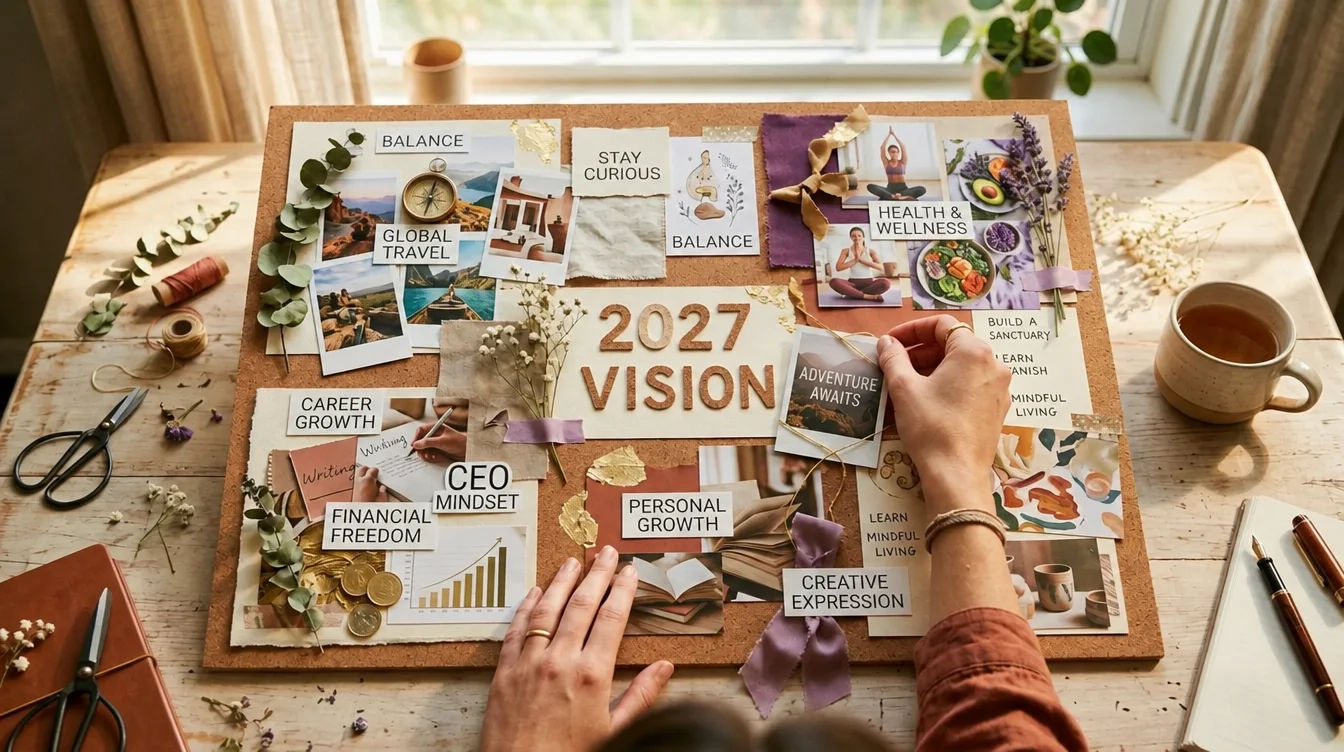

What Is a Vision Board? Meaning + Uses

What is a vision board? It's a collage of images and words for the future you want. Learn the meaning, what it's used for, and how it differs from a mood board.

What Is a Vision Board? Meaning + Uses
In this guide 10 sections
  1. 01What Is the Meaning of a Vision Board?
  2. 02What Is a Vision Board Used For?
  3. 03What Is the Difference Between a Vision Board, Mood Board, Goal Board and Becoming Board?
  4. 04Do Vision Boards Actually Work?
  5. 05Where Did Vision Boards Come From?
  6. 06What Is a Vision Board for Students?
  7. 07What Goes on a Vision Board?
  8. 08How Do You Make a Vision Board for 2027?
  9. 09What Are Common Vision Board Mistakes?
  10. 10Sources & Methodology

A vision board is a collage of images and words that shows the future you want. It can be a poster, a cork board, a page in a notebook or a phone screen. You look at it often, so your goals stay clear and you remember to act on them.

Some people call it a dream board, a goal board or a manifestation board. The name changes, but the idea stays the same. You turn a vague wish into something you can see. If you are building one for next year, our 2027 vision board guide is the place to start.

Key Takeaways
  • A vision board is a collage of pictures and words for the life you want, kept where you will see it
  • It is used for clarity, yearly planning, school and career direction, and daily focus
  • It is not the same as a mood board, which is about style, not life direction
  • Direct research on vision boards is thin, so treat a board as a planning tool, not magic
  • Boards that also show the steps (a "becoming board") fit the research better than boards of outcomes alone
  • If you are planning 2027, you can build yours between now and early January

What Is the Meaning of a Vision Board?

A vision board means a visual statement of where you want your life to go. The pictures stand in for goals, values and feelings. Instead of a to-do list, you get a scene you can look at and step into. Its meaning is personal: the board is only as useful as it is honest.

Merriam-Webster describes a vision board as a poster board or similar surface where people attach magazine clippings, photos, fabric swatches and notes to picture a hoped-for future. Wikipedia calls it a collage of images and affirmations of one's hopes and dreams, meant as inspiration and motivation.

Here is a plain way to read that. A vision board is a reminder with a mood. Each picture says, "This matters to me." Each phrase says what to do or how to feel.

You do not have to believe in the law of attraction to use one. That idea, the belief that positive thoughts bring positive events, is part of a spiritual tradition called New Thought. Wikipedia notes there is no empirical scientific evidence for it. A board can still work as a way to think, plan and remember, whatever you believe. If you are curious about the belief side, see how to manifest in 2027 for seven methods to try.

What Is a Vision Board Used For?

People use vision boards to get clear on what they want, to plan a year, to choose a direction in school or work, and to keep goals in sight every day. Some make one alone. Others make one with a partner, a class, a team or a friend group.

What is a vision board used for: a baker pinning shop photos to a cork board before opening

Here are the most common uses:

  • Get clear on your values. Psychology Today suggests starting with what motivates you and what you want to prioritize. The board comes second.
  • Plan a year. A board for 2027 helps you decide what deserves your time before the year fills up.
  • Choose a direction. Someone weighing a career change might collect images of the work, the place and the daily routine they want.
  • Stay focused. A board on your wall or phone brings your goals back to mind each morning.
  • Share a dream. Couples and families make boards to talk about what they want together.
  • Give a gift. A board, or a picture of someone living their goal, is a thoughtful present for a new chapter.

Two short scenarios show the range. Maya is 34 and thinking about leaving retail for nursing. She puts a photo of a hospital corridor, a course schedule and the words "first class: January" on her board. Dev and Priya are saving for a home. Their board has a street they love, a rough monthly savings number and a photo of a kitchen table. Neither board promises anything. Each one makes the next step easier to see.

What Is the Difference Between a Vision Board, Mood Board, Goal Board and Becoming Board?

A vision board shows the life you want. A mood board shows a look and feel, like the style of a room or a brand. A goal board lists targets and deadlines. A becoming board pairs each picture of your future with the habit or step that gets you there.

The confusion is common, and the words overlap. A 2019 Oprah Magazine piece, quoted by Merriam-Webster, put it simply: a vision board relates to life direction, while a mood board is a planning tool for aesthetics, such as decorating a room or planning a party.

The last type is newer. Wikipedia notes that an "action board" is sometimes seen as a better alternative to, or partner for, a vision board. We call the combined idea a becoming board: who you are becoming, plus what you will do this week. There is a full comparison in becoming board vs vision board.

Vision board vs mood board vs goal board vs becoming board

Board typeWhat it showsTime horizonBest forMain risk
Vision boardImages and words for the life you wantA year or moreClarity and daily focusShows the finish line but not the steps
Mood boardColors, textures and styleA single projectDesigning a room, party or brandSays nothing about life direction
Goal boardTargets, numbers and deadlinesWeeks to a yearTracking progressCan feel dry and hard to keep up
Becoming boardWho you are becoming, plus a weekly step for each wishA year, reviewed each quarterTurning a wish into habitsTakes a little more time to set up

The next section explains why the "steps" part matters so much.

Do Vision Boards Actually Work?

Nobody has tested vision boards directly, so no one can say for sure. Related research points two ways: imagining the steps toward a goal seems to help, while imagining only the happy result may drain energy. A board works best when it shows both the wish and the work.

Psychology Today says there is not a lot of research on vision boards, and that the studies it cites do not directly test making one. Its author also writes that "vision boards are not magic." We agree.

Two studies help explain why. In a 1999 study by Pham and Taylor, college freshmen spent 5 to 7 days before a midterm imagining either the outcome they wanted (a good grade) or the process (good study habits). The students who pictured the process studied more and earned better grades, partly through better planning and lower anxiety.

In 2011, Kappes and Oettingen ran four experiments and found that positive fantasies about the future produced lower energy than fantasies that also questioned the wished-for future. Their view is that this is one reason positive fantasy alone can predict weaker results.

Please read these carefully. Neither study tested a vision board. They do not prove boards work, and they do not prove boards harm. They are good reasons to put steps, obstacles and habits on your board, not just the finish line. For a longer look at the evidence, read do vision boards work.

Where Did Vision Boards Come From?

No one person invented the vision board, and its exact origin in self-help is not well documented. What can be traced is the language, the movement behind it, and a few dates. The idea is old. The phrase is fairly new.

Here is what is documented:

  • Early 1800s: The New Thought movement grows from the teachings of Phineas Quimby, according to Wikipedia. It stresses the power of belief and thought.
  • Around 1400: The word "board" in the sense of a bulletin board is recorded, per Merriam-Webster. Later terms like "mood board" and "vision board" build on it.
  • 1985 and 1995: Merriam-Webster finds "mood board" used in design.
  • 1999 and 2000: Its earliest found uses of "vision board" are a city-planning council in England and a business article in India. Neither is about self-help.
  • 2006: The film and book The Secret bring the law of attraction to a very wide audience, with a focus on feeling what you want.
  • 2010s onward: Social media and digital tools make boards easy to build and share.

You may read that vision boards began in cave paintings or with a famous person. We could not find reliable support for either claim, so we leave them out.

What Is a Vision Board for Students?

A vision board for students shows school and life goals in one place: a subject to master, a study routine, a program to apply to, or a career to explore. It works best when it shows weekly habits, not only the dream grade or the dream school.

That advice comes straight from the Pham and Taylor study above. Students who pictured the process did better than those who pictured only the result. So a strong student board might include:

  1. A photo of the place you want to study or work
  2. The habit, such as "Library, Tuesday and Thursday, 4 to 6"
  3. One outcome, such as the course, program or role you are aiming for
  4. One picture of a person or place that keeps you motivated
  5. A note for rest, because sleep and breaks are part of the plan

Teachers, parents and homeschool families can turn it into a short activity. Each student picks three goals, one image for each, and one action per week. A board cannot promise grades, and it should not add pressure. Keep it kind.

What Goes on a Vision Board?

Put on your board the few goals that matter most, one image for each, and a short phrase or action to go with it. Five to eight items is plenty. Too many, and the board becomes a pile of every hope you have ever had.

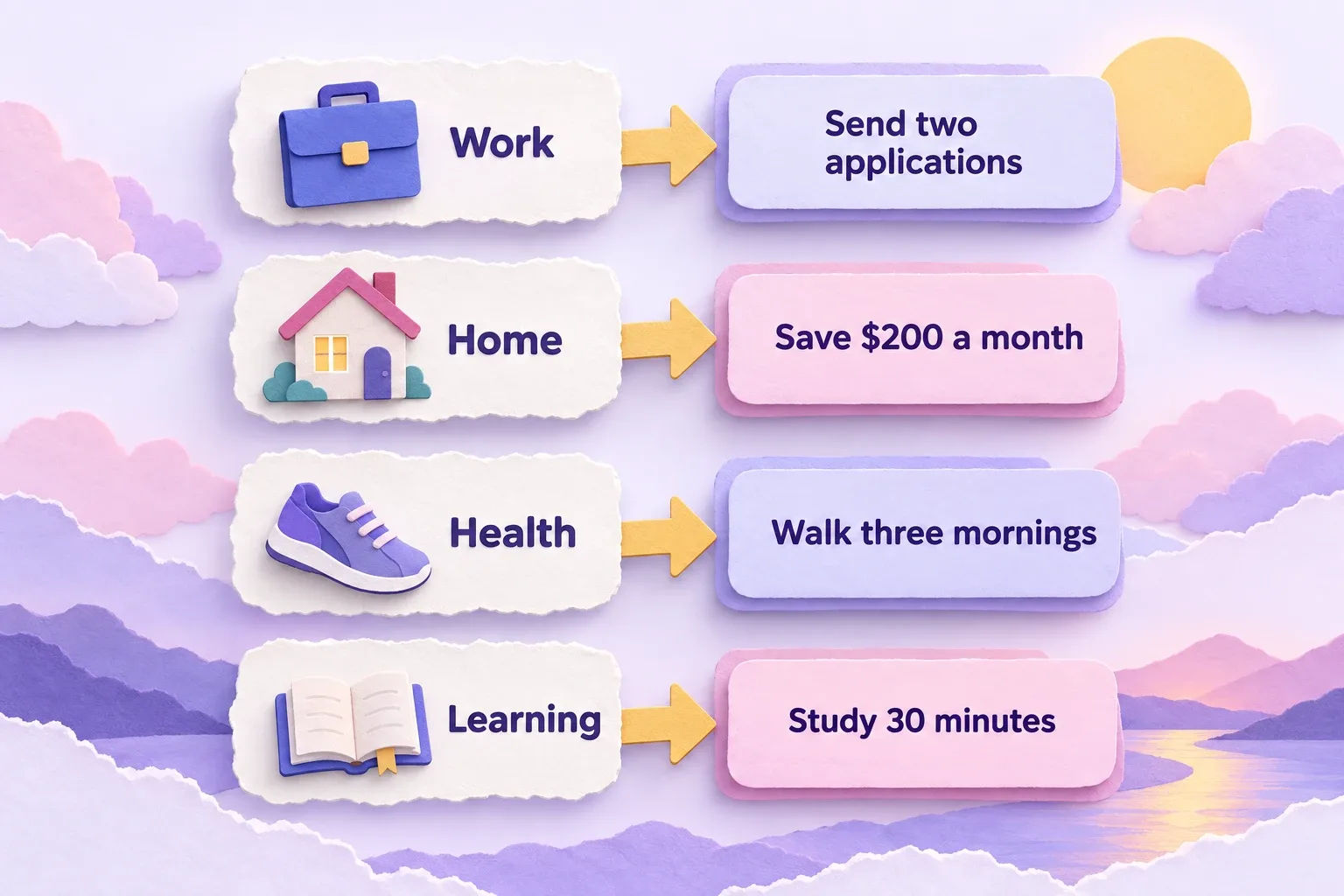
What goes on a vision board: paper-craft map pairing work, home, health and learning pictures with weekly steps

Psychology Today warns about that pile, and it suggests asking what you can reasonably do in a year. Here are some ideas by area, each paired with a first step:

Area Example image Pair it with
Work An office or workshop you would enjoy "Send two applications this month"
Home A room with morning light "Save $200 a month"
Health A trail or a finish line "Walk 20 minutes, three mornings a week"
Relationships A full dinner table "Call one friend every Sunday"
Learning A stack of books or a classroom "Study for 30 minutes after dinner"
Travel A street in a city you want to visit "Look up flights on the first of each month"
Inner life A quiet chair by a window "Ten minutes of quiet before checking my phone"

If you want more ideas, browse vision board examples, or pair your images with vision board quotes sorted by life area. Money, health and family goals need extra care. Affirmations and vision boards are a mindset practice, not a substitute for medical, mental-health or financial advice.

How Do You Make a Vision Board for 2027?

To make a vision board for 2027, reflect on 2026, pick five to eight priorities, choose one image for each, add one action beside it, and put the board where you will see it daily. Plan for about two hours, and review it every three months.

How to make a vision board for 2027: a woman fixing a sailboat photo onto a poster at a harbour

Step by step

  1. Look back at 2026. What gave you energy? What drained you? Write three lines for each.
  2. Pick your priorities. Choose five to eight areas from the table above. Fewer is better.
  3. Write each wish as a year-long target. "Run a 10K in May 2027" beats "get fit." The goals for 2027 guide can help, and new year's resolutions for 2027 has 101 ideas if you are stuck.
  4. Choose one image per wish. Pick pictures that make you feel something, not just pictures that look nice.
  5. Add one action. Write a small weekly step beside each image.
  6. Place it where you will see it. A bedroom wall, a mirror or a phone lock screen all work.
  7. Review it each quarter. Keep what still fits. Swap out what no longer does.

Physical or digital?

A hand-made board is a calm, hands-on ritual, and Merriam-Webster quotes neuroscientist Tara Swart as preferring a hand-made one. We know of no strong evidence that one format beats the other. A digital board is easy to update and can be your phone wallpaper. Our guide to a digital vision board covers the options, and how to make a vision board gives a longer walkthrough.

Seeing yourself in the picture

Most boards use pictures of strangers. Some people find it easier to picture a wish when they can see themselves in it, which is the idea behind seeing your future self. If that appeals to you, Manifest Mosaic turns what you write about 2027 into photos of you already living it. Your first photo is free.

What Are Common Vision Board Mistakes?

The most common mistakes are showing only outcomes, adding too many goals, copying other people's dreams, expecting the board to do the work, and feeling guilty when life shifts. Each one has an easy fix, and most come down to keeping the board honest and small.

  • Only the finish line. Add the habit or step to every image.
  • Too many goals. Cut to five to eight.
  • Comparison goals. If you would not want it in private, take it off.
  • Guarantees. No board can promise money, health or love. Aim for direction, not certainty.
  • Guilt. If a goal no longer fits, swap it. That is the board doing its job.

If you enjoy numerology, 2027 adds up to 2 + 0 + 2 + 7 = 11, a Universal Year 11 in that tradition, per numerology sources. Some people use that as a fun theme. It is a belief tradition, not a forecast. You can read more in 2027 numerology.

Ready to try it? A board is only a start. Some people also write a note to themselves in the future, and our guide to a letter from your future self shows how.

See yourself living it in 2027 — make your first picture free →

Sources & Methodology

Merriam-Webster, "Words We're Watching: 'Vision Board'" — supports the definition, the earliest found uses of the phrase (1999, 2000) and the vision board versus mood board distinction.

Wikipedia, "Dream board" — supports the definition, the note on possible counterproductive effects and the "action board" alternative.

Tchiki Davis (2021), "What Is a Vision Board and Why Make One?," Psychology Today — supports the point that direct research is limited and that boards should start from values and priorities.

Pham & Taylor (1999), "From Thought to Action," Personality and Social Psychology Bulletin — supports the finding that imagining the process helped student grades.

Kappes & Oettingen (2011), "Positive fantasies about idealized futures sap energy," Journal of Experimental Social Psychology — supports the finding that positive fantasy alone lowered energy.

Methodology: Definitions and dates come from the linked dictionary and encyclopedia pages. Study findings are summarized from the linked abstracts and papers. Neither study tested vision boards directly. Beliefs such as the law of attraction and numerology are described as traditions, not as science.

Questions

Frequently asked questions

A vision board is a page, poster or screen filled with pictures and short phrases that show the future you want. You look at it often, so your goals stay clear and you remember to take small steps toward them.

People use vision boards to get clear on what they want, plan a year, choose a direction in work or school, and keep goals in sight each day. Some also make them with a partner, a class or as a gift.

A vision board is about your life direction, such as your work, home and health. A mood board is about look and feel, such as the style of a room, a party or a brand. One shapes a future; the other shapes a design.

No single inventor is documented. Merriam-Webster's earliest found uses of the phrase, in 1999 and 2000, are in city planning and business. The self-help sense grew from there and was boosted by The Secret in 2006.

A student vision board shows school and life goals, such as a subject to master, a study routine, a program to apply to or a career to explore. It works best when it shows the weekly habits, not just the grade.

Your first picture is free

See yourself in 2027.

Write what you want from next year, add one selfie, and see a photo of you already living it. Then turn all nine wishes into your board.