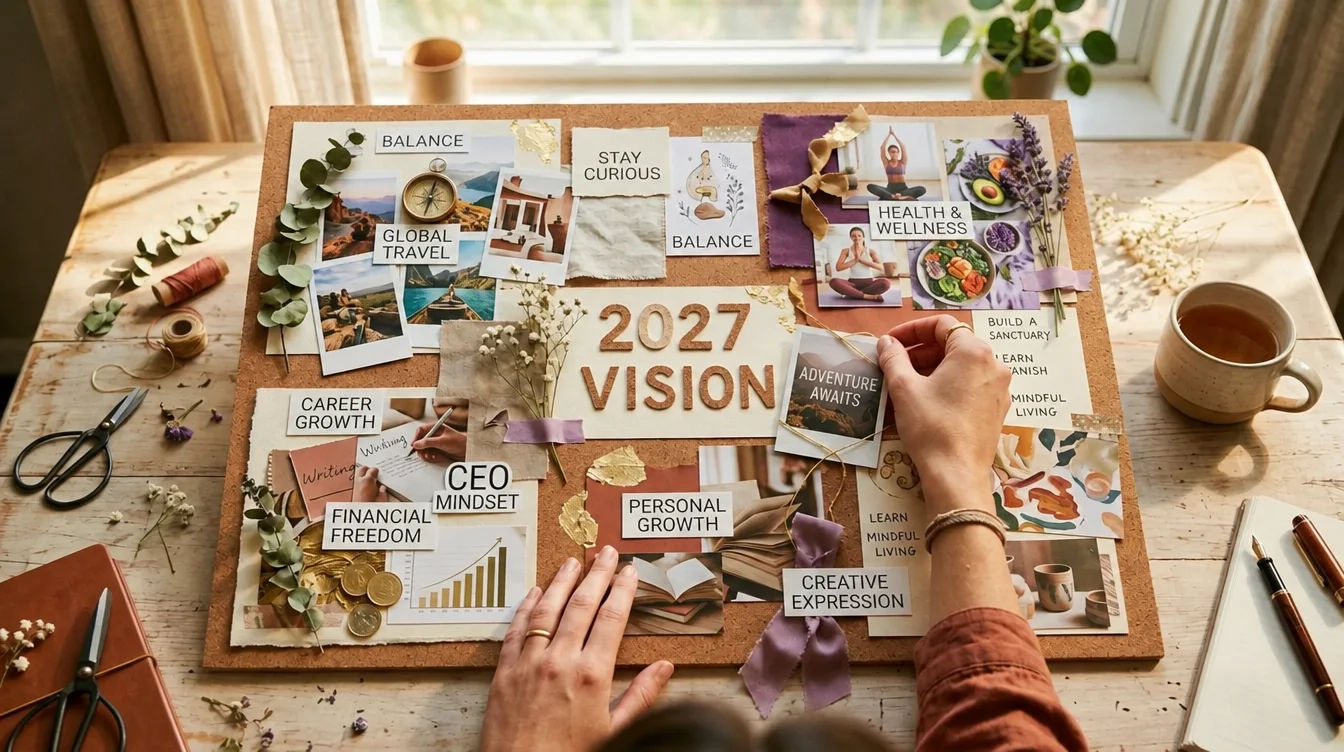
A money vision board is a page or screen of pictures, numbers and dates that shows what you want from your money in 2027, such as a savings cushion, a debt-free balance or a raise. It keeps your money goals in front of you, so you act on them.
Money is the area where a pretty board can mislead you. A pile of cash on a poster feels good and changes nothing. This guide shows how to build a board with a number, a date and a next step behind every picture. It also gives you ideas to copy and a plain look at what a board can and cannot do.
Key Takeaways
- A money vision board keeps your money goals visible. It does not create money, and it is not a plan on its own
- Give every picture a number, a date and one action you can take this week
- Small, believable targets, like a first $500, beat lottery-style wealth images
- Add the obstacle and an if-then plan to each goal, or dreaming alone can drain your energy
- Automatic saving and a weekly money check-in do the heavy lifting
- This is a mindset practice, not financial advice
Affirmations and vision boards are a mindset practice, not a substitute for medical, mental-health or financial advice. Nothing here promises income or results.
What Is a Money Vision Board?
A money vision board is a collage, poster or phone wallpaper that pulls your money goals into one glance. It mixes images (a home, a trip, a paid-off card) with hard details such as amounts and dates. Its job is focus. It reminds you what you decided, so daily choices line up with it.
You may also see it called a financial vision board, a wealth vision board or a debt-free vision board. They are the same idea with a different emphasis. A saver might build a board around a cushion and a first home. Someone paying off cards might build one around a balance falling to zero.
If you have never made a board before, start with our guide to how to make a vision board, then come back here to add the money layer. For boards in other areas, browse our vision board ideas.
Does a Money Vision Board Actually Work?
A money vision board can help you stay clear and consistent, but it works only when it leads to action. Research supports writing goals down and making specific if-then plans. It also warns that dreaming about a perfect outcome can lower your drive. So the board is a reminder, and your habits do the work.
Here is what the evidence does and does not show:
- Writing goals down helps. In a small 2015 study by psychologist Gail Matthews, people who wrote their goals down achieved more than people who only thought about them. Those who also sent weekly progress updates to a friend did best: 76% reached or got more than halfway to their goals, versus 43% of those who did not write them down. It was presented at a conference, not peer-reviewed, so treat it as encouraging, not proof (Matthews research summary).
- Dreaming alone can backfire. In four experiments, Kappes and Oettingen (2011) found that people who indulged in positive fantasies about an idealized future had less energy than people who also questioned the desired future. A board of only glowing outcomes is a risk. A board with obstacles and steps is not (Kappes & Oettingen, 2011).
- If-then plans help. A meta-analysis of 94 tests found that "if X happens, I will do Y" plans had a medium-to-large effect on reaching goals (Gollwitzer & Sheeran, 2006).
- Habits take time. New habits took 66 days on average to feel automatic, with a range of 18 to 254 days (Lally et al., 2010). Give a new money routine a full season.
What none of this shows is that a picture of money brings money. Some manifestation teachers do teach that feeling a goal as already real draws it to you. That is a belief, and this guide treats it as one. If you want that side, see how to manifest money and money manifestation methods. The steps below work whether or not you share it. For a fuller look at the evidence, read do vision boards work.
What Should You Put on a Money Vision Board?
Put one to four money goals on your board. For each goal, add a picture that shows the life the money is for, a specific number, a date, and the first action you will take. A goal with all four parts is a plan you can see. A goal with only a picture is a wish.
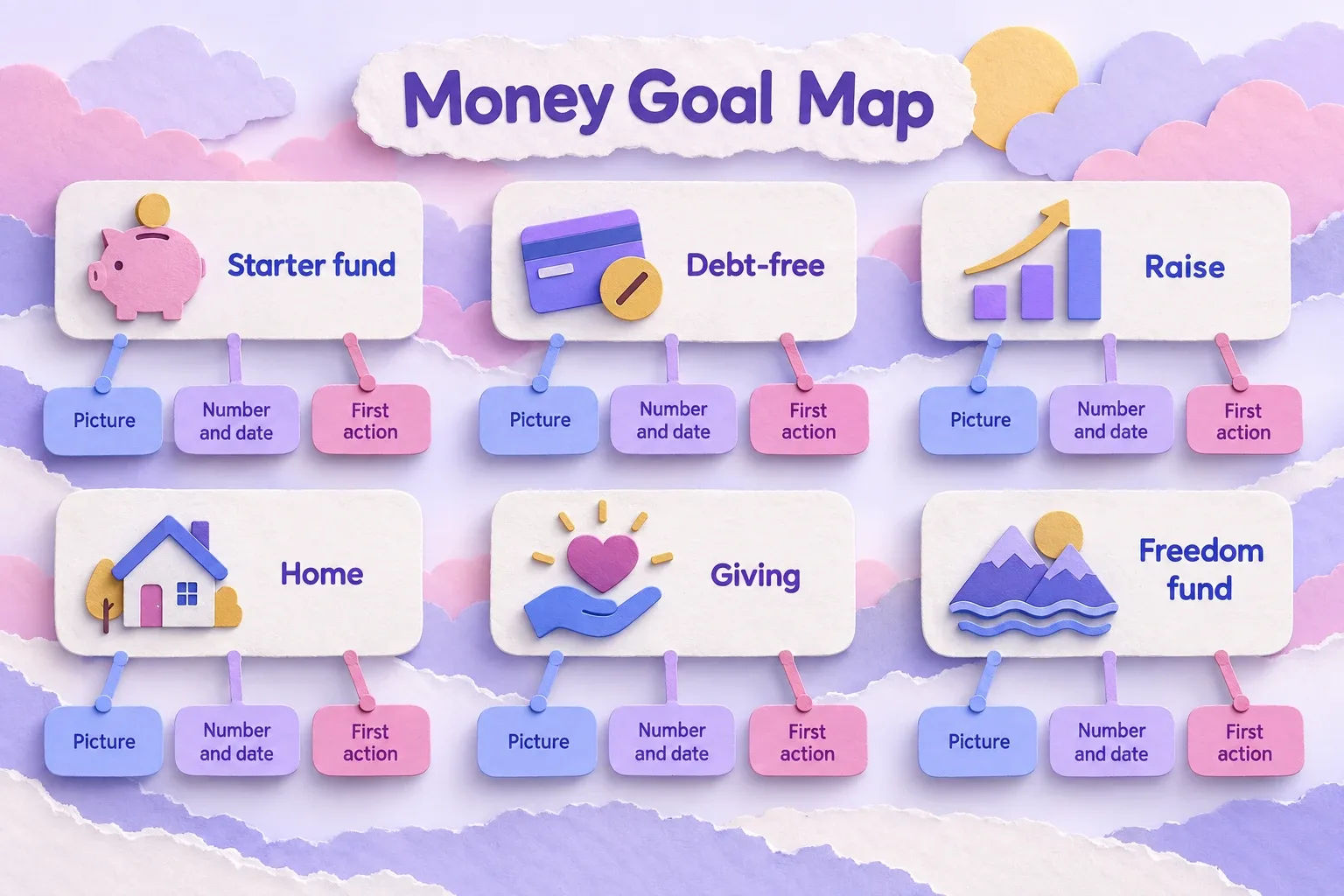
Here is a simple map you can copy:
| Money goal |
Picture |
Number and date |
First action |
| Starter emergency fund |
A calm morning at home, a full jar |
$500 by March 2027 |
Set up an automatic weekly transfer |
| Debt-free |
A card cut in half, a balance at zero |
Card balance to $0 by Dec 2027 |
Pay a fixed extra amount on payday |
| Raise or new income |
A desk, a team, a new role |
Target pay you have researched, by June 2027 |
Book the conversation with your manager |
| Home or big purchase |
The front door or the car you want |
Down payment amount by Sept 2027 |
Open a separate savings account |
| Giving or family |
A shared dinner, a gift |
A set monthly amount |
Add it to your budget on day one |
| Freedom fund |
A trip, a quiet weekday |
Three months of expenses |
Save one windfall a year |
Pick your own numbers from your real income and bills. Keep them honest. A target you believe is worth more than a bigger one you do not.
How Do You Make a Money Vision Board Step by Step?
To make a money vision board, start with your real numbers, choose one to four goals, attach a date and an action to each, then find one picture per goal. Arrange them on a page or phone screen and put it where you will see it daily. Plan for about two hours.
Step 1: Look at your real numbers (20 minutes)
Write down your monthly income, your bills and any debts with their balances. No judgment. This is the ground your board stands on. If looking feels heavy, do it with a friend or a nonprofit credit counselor.
Step 2: Choose one to four goals
Fewer goals get more attention. Start with what matters most this year: a cushion, a payoff, a raise, or a purchase.
Step 3: Write the number, the date and the first action
"Save $500 by March 1. Every Friday, $40 moves to savings on its own." This is the line that makes the picture matter.
Step 4: Find one picture per goal
Choose images that show life with the money, not just the money. See our vision board pictures for ideas by category. If you want to see yourself in that life, Manifest Mosaic can turn a wish into a photo of you living it, and your first picture is free.
Step 5: Add the obstacle and an if-then plan
Under each goal, write the thing most likely to derail you and your answer. Example: "If I get an unexpected bill, I pause extra debt payments for one week, then restart." This step turns dreaming into a plan.
Step 6: Hang it and set a weekly money date
Put the board where you will see it: your phone wallpaper, the fridge, the desk. Pick one 15-minute slot a week to update the numbers.
What Are Good Money Vision Board Ideas?
Good money vision board ideas match a picture to a small, believable goal. Think starter fund, debt payoff, income growth, a home, giving and freedom. Choose ideas that show the feeling you want, such as calm, safe or free, and pair each with a number you can track. Here are cards to spark yours.
For extra words on your board, try short lines from our money affirmations or morning affirmations to read at the same time, or build your own with the free affirmation generator. Pick sentences you can believe, like "I check my money every week," rather than claims that feel false.
A board for a first savings cushion
Imagine Maya, who has no savings and a car that is ten years old. Her board holds a jar photo, "$500 by March" and a note: "$40 every Friday, automatic." She does not picture a mansion. She pictures not panicking when the tire goes flat.
A board for a raise
Imagine Dev, who has not been paid more in three years. His board shows a desk and the words "Ask by June." Under it he writes three things he has done this year, and "Book the meeting Monday." The picture sets the goal. The list does the persuading. A career vision board goes deeper on this kind of goal.
How Do You Make a Debt-Free Vision Board?
To make a debt-free vision board, list each balance with a realistic payoff date, add a tracker you can color in or cross off, and show what your life looks like without those payments. Add one repeatable action, like a fixed extra payment on payday, so the picture connects to what you do.

A few extras help:
- Show the countdown. A bar you fill in or a list you cross off makes each payment feel like progress.
- Picture the freed-up month. Put an image of what you will do with the money once the payment ends.
- Know your rights. If a debt collector contacts you, you can ask them to verify the debt. Laws limit what collectors can say or do, and ignoring them will not make them stop (CFPB on debt collection).
- Be careful who you ask for help. The CFPB separates nonprofit credit counselors from debt settlement companies. Check who you are dealing with before you pay anyone.
If you are behind on bills, a board is not the first step. Call your lender, look for a nonprofit credit counselor, and get real advice.
Which Pictures Motivate Without Backfiring?
Pictures that motivate show a step you can take or a life you can enter, not a pile of cash. Process images, such as a budget on the table or a transfer notification, keep you moving. Outcome images, such as a mansion or stacks of money, can feel good while lowering your drive, as the research above suggests.
Use this quick test on every image: does this make me want to do something today? If the answer is a calm "yes," keep it. If it only makes you daydream, add a step beside it or swap it out.
Some ideas that pass the test:
- A grocery list with a number beside it
- A savings app screen at $500 (your own screenshot)
- A calendar page with payday circled
- A photo of you in the place the money will take you
- A door, a key or a keychain for the home you want
How Much Should You Aim For?
Aim for a number that fits your real life and grows in stages. The CFPB says the right emergency fund size depends on your situation and that even a small amount gives some security. Start with a first goal you can reach in a few months, then raise it. Saving automatically keeps it steady.
Some context may make you feel less alone. In the Federal Reserve's 2025 survey, 63% of adults said they would cover a $400 emergency using cash, savings or a credit card paid off at the next statement, and 55% said they had set aside three months of expenses (Federal Reserve, 2025 SHED). So a lot of people are still building. The CFPB adds that saving automatically is one of the easiest ways to make savings consistent (CFPB emergency fund guide).
A staged plan might look like this:
- A first $500 or one week of expenses
- One month of expenses
- Three months of expenses
- A goal for the life you want, such as a home or a trip
Put only the next stage on your board. Change it when you reach it.
How Can You See Your Future Self With Money?
You can make money goals feel real by picturing your future self in the life they pay for. In lab studies, people who interacted with age-progressed images of themselves were more willing to take later rewards over immediate ones (Hershfield et al., 2011). It suggests that meeting your future self can change today's choice.
That research used virtual reality in a controlled setting, so it does not promise the same result on your wall (Hershfield et al., 2011). But the idea is a good one to borrow. Instead of a photo of money, use a photo of you at a table in the home you want to buy.
That is what Manifest Mosaic does. You write your wishes, add one selfie, and get photos of you already living them. Your first picture is free, and the full board is $19, paid once. You can also try a written version: our guide to a letter from your future self walks through it, and seeing your future self explains why it can help.
How Often Should You Look at Your Money Vision Board?
Look at your board for a minute each day and hold a 15-minute money check-in each week. Daily glances keep your goals close. The weekly check-in is where you update numbers, cross off wins and pick one action for the next seven days. Review the whole board once a month.

A simple weekly script:
- Open your bank and debt balances
- Update the numbers on your board
- Cross off or color in one win
- Choose one action for this week
- Check your if-then plan for what might get in the way
Then stay with it. It takes about two months for a new routine to feel automatic, so give it time before judging it.
What Should Your Money Vision Board Include for 2027?
For 2027, pair your money goals with the rest of your year. Money is easier to move when it serves a bigger picture, so add one or two goals from other areas, such as a health vision board or a travel vision board. Pair it with a daily practice from how to manifest and your new year's resolutions for 2027. Start with goals for 2027 to decide, then fold the money pieces into a full 2027 vision board.
See yourself living it in 2027 — make your first picture free →
Sources & Methodology
Matthews (2015), "Goals Research Summary," Dominican University of California — small conference study on writing goals and progress updates.
Kappes & Oettingen (2011), "Positive fantasies about idealized futures sap energy," Journal of Experimental Social Psychology — why pictures of ideal outcomes alone can lower energy.
Gollwitzer & Sheeran (2006), "Implementation intentions and goal achievement," Advances in Experimental Social Psychology — the effect of if-then plans.
Federal Reserve (2026), "Economic Well-Being of U.S. Households in 2025: Savings and Investments" — share of adults with emergency savings.
Consumer Financial Protection Bureau, "An essential guide to building an emergency fund" — starting small and saving automatically.
Methodology: We used primary sources and official pages, cited each figure inline, and treated manifestation teachings as beliefs, not evidence. This article is general information, not financial advice.

 Manifest Mosaic