How to Manifest Weight Loss (Safely)

How to manifest weight loss safely: picture the walk, not the number, plan for obstacles, go at a safe pace, be kind to yourself, and know when to skip it.

How to Manifest Weight Loss (Safely)
In this guide 11 sections
  1. 01Can You Manifest Weight Loss?
  2. 02What Does the Evidence Say About Visualizing Weight Loss?
  3. 03How Do You Set a Health Goal That Isn't About a Number?
  4. 04How Much Weight Loss Is Safe per Week?
  5. 05How Do You Manifest Weight Loss Step by Step?
  6. 06Do Weight Loss Affirmations Work?
  7. 07Why Does Shame Make Weight Loss Harder?
  8. 08Can a Vision Board Help With Weight Loss?
  9. 09What Does a Kinder 12-Month Plan for 2027 Look Like?
  10. 10When Should You Skip Manifesting Weight Loss?
  11. 11Sources & Methodology

To manifest weight loss, use manifestation as a mindset tool, not a magic one: get clear on the healthier life you want, picture yourself doing the daily steps, plan for the hard moments, and act at a safe pace. Picturing a number on the scale tends to backfire. Picturing the walk, the meal and the plan helps.

Affirmations and vision boards are a mindset practice, not a substitute for medical, mental-health or financial advice. Talk to a doctor before you change how you eat or move, and read the last section first if food or weight thoughts already fill your day.

Key Takeaways
  • Manifesting can support the habits that change health. It can't change your body by itself.
  • Picture the process (the walk, the meal, the plan for a bad day), not a goal weight or an "after" body. Evidence favours process imagery.
  • Use if-then plans: "If it's 6 p.m. and I'm tired, then I put on my shoes and walk to the corner."
  • A safe pace is about 1 to 2 pounds (0.5 to 1 kg) a week, per the CDC and NHS.
  • Kindness beats shame. Early research links self-criticism to harder eating patterns.
  • Skip this if you have signs of an eating disorder. Free help is listed at the end.

Can You Manifest Weight Loss?

You can't manifest weight loss by thought alone, but you can use manifesting to support the habits that change your health. In this guide, "manifest" means four things: get clear on what you want, imagine yourself doing the daily steps, plan for obstacles, and act. Food, movement, sleep, stress and medical care do the physical work.

Manifestation comes from the New Thought movement and the belief often called the law of attraction: that your thoughts shape what shows up in your life. You don't need to share that belief to use the practical parts. New to it? Start with how to manifest. If you like pictures, a 2027 vision board can hold your health scenes, as long as they show doing rather than a number.

What Does the Evidence Say About Visualizing Weight Loss?

Research suggests that dreamy pictures of effortless weight loss can work against you, while imagining the actual steps can help. A small 1991 study linked more positive fantasies to less weight lost. A 2019 trial found that trained imagery of daily actions and obstacle plans led to more weight lost than a matched talking approach.

  • Fantasies of an effortless result. In a small 1991 study of 25 women in a weight-loss programme, those who expected to succeed tended to lose more. But the more positively they fantasised about losing weight with ease, the less they lost (Oettingen & Wadden, 1991).
  • Trained imagery of the process. Functional Imagery Training teaches people to picture specific actions, likely obstacles and their fixes. A trial of 141 adults compared it with Motivational Interviewing given for the same time. At six months, the imagery group had lost 4.11 kg versus 0.74 kg. At 12 months, six months after contact ended, it was 6.44 kg versus 0.67 kg (Solbrig et al., 2019).

Keep that in proportion. It was one small trial at one centre, run by trained therapists with booster calls. It tested structured imagery of plans, not wishing. No study shows that picturing a goal body makes it appear. The takeaway: picture the doing, not the number.

How Do You Set a Health Goal That Isn't About a Number?

Write your goal as a scene from daily life, not as a weight, size or look. Ask what a healthier body would let you do, and how you want to feel most days. "I walk up three flights of stairs and still chat at the top" is a goal you can picture, plan for and feel good about.

How to manifest weight loss: a man laughs with a vendor while filling a tote with vegetables at a market

Scenario: the stairs. Say you get winded on the office stairs and avoid the park with your kids. Your scene: "It's a Saturday in June. I'm chasing the kids around the climbing frame, laughing, not needing to sit down." Now you have something to plan toward, like a 15-minute walk after work.

If your doctor does suggest weight loss, the NIDDK recommends a first goal of 5 to 10 percent of your starting weight over six months, and talking to a health professional first. Its red flags include "Lose 30 pounds in 30 days!", "Lose weight without diet or exercise!" and too-good-to-be-true before-and-after photos. Promises to "manifest weight loss fast" belong on that list too.

How Much Weight Loss Is Safe per Week?

Health agencies suggest losing about 1 to 2 pounds (0.5 to 1 kg) a week. The CDC says people who lose weight at this steady pace are more likely to keep it off than people who lose it faster. A first goal of 5 to 10 percent of your starting weight over six months is a common starting point.

Guidance What it says Source
Weekly pace About 1 to 2 pounds a week; a gradual pace is linked to keeping weight off CDC
Weekly pace 0.5 kg to 1 kg (1 lb to 2 lb) a week is safe and sustainable NHS weight loss plan
First goal 5% to 10% of starting weight within six months; see a health professional first NIDDK
Keeping it off Early loss is often followed by a plateau and regain; maintenance needs ongoing support Hall & Kahan, 2018

These are general guidelines for adults, not for anyone under 18, pregnant or with a history of disordered eating. If you have diabetes, take a GLP-1 medicine or other medication, or have any health condition, plan with your clinician. And note the last row: the CDC says keeping weight off relies on nutrition, activity, stress management and sleep. That's a daily practice, not a one-time wish.

How Do You Manifest Weight Loss Step by Step?

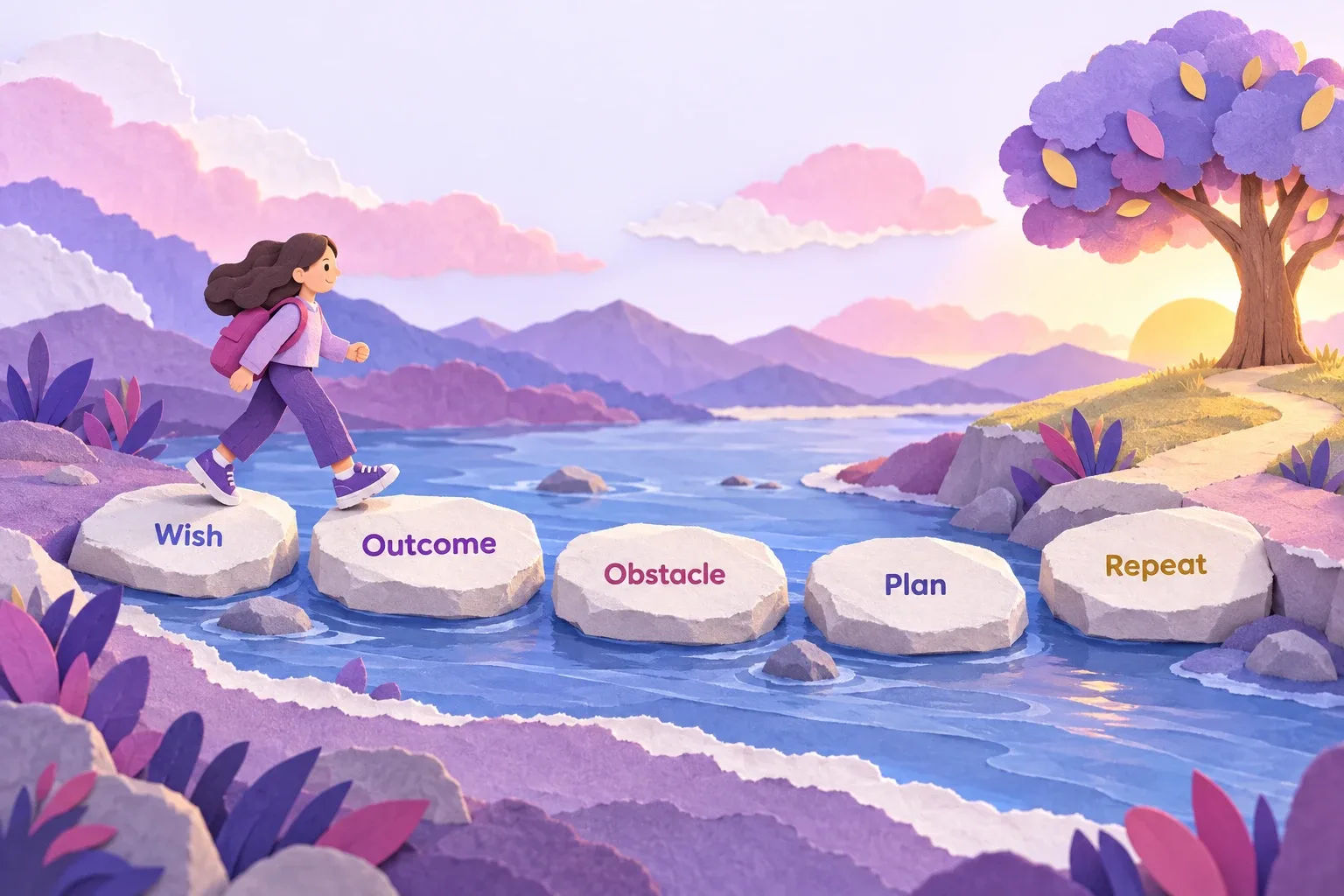
Use mental contrasting with if-then plans, a method from psychologist Gabriele Oettingen's research, often called WOOP: name your wish, picture the best outcome briefly, name the real obstacle inside you, then write an if-then plan for it. It turns a hopeful picture into a plan you can follow on a hard day.

How to manifest weight loss: paper-craft stepping stones showing the five WOOP steps from Wish to Repeat

1. Wish

One health wish for the next few weeks, as a scene: "I walk after dinner and feel calm going to bed."

2. Outcome

Close your eyes for one minute. Picture the best part: the evening air, your breathing, the good tired feeling. Keep it short.

3. Obstacle

Picture what really gets in the way: "I get home at 6, I'm tired, and I sit on the couch with my phone."

4. Plan

Write one if-then line for that obstacle:

  • "If it's 6 p.m. and I'm tired, then I put my shoes on before I sit down and walk to the corner."
  • "If I'm standing at the fridge at 9 p.m. and I'm not hungry, then I make a cup of tea and text a friend."
  • "If it's raining, then I do a 10-minute walking video in the living room."

A review of 23 studies found if-then plans helped people eat more healthy foods (a medium effect) and, less strongly, fewer less-healthy ones, though weak control groups may have inflated the first result (Adriaanse et al., 2011). In a trial of 255 women aged 30 to 50, adding mental contrasting and if-then plans kept fruit and vegetable intake higher two years later, while the information-only group slid back (Stadler et al., 2010). It measured food, not weight.

5. Repeat until it's automatic

In one study, new habits took 66 days on average to feel automatic, with a range of 18 to 254 days (Lally et al., 2010). If your walk still feels hard in week six, that's normal, not failure.

Do Weight Loss Affirmations Work?

Weight loss affirmations can help when you believe them and they point to actions. Statements you don't believe can make you feel worse. In one study, people with low self-esteem felt worse after repeating "I'm a lovable person," while people with high self-esteem felt slightly better (Wood et al., 2009).

So skip lines that praise a body shape or name a weight. Try believable, action-based and kind lines instead:

  • "I am someone who takes a walk after dinner."
  • "I eat foods that give me energy, and I enjoy them."
  • "One meal doesn't decide my week. I can start again at the next one."
  • "My body carried me through today, and I'm thankful."

For more, see our self-love affirmations, a gentle set of morning affirmations, or write your own with the free affirmation generator. The shifts below move outcome thinking toward process thinking.

๐Ÿ”„From the number to the next small step
Goals
Before

I need to hit a certain number on the scale by March.

โ†’
After

I walk for 20 minutes after dinner on weekdays.

1 of 6 mindset shifts

Why Does Shame Make Weight Loss Harder?

Shame tends to make eating feel less in your control, not more. A survey of over 2,000 women in a weight-management programme tied shame and self-criticism to more out-of-control eating and less weight lost, while self-reassurance went with more. Early research suggests self-compassion helps you recover from a slip instead of spiraling.

  • Shame and self-criticism. That survey of 2,236 women also linked harsh comparison with others to harder eating (Duarte et al., 2017). It was a one-time survey, so it shows a link, not cause.
  • Weight stigma. A 2018 review argues that weight stigma harms health through stress and by pushing people away from exercise and medical care (Tomiyama et al., 2018).
  • Self-compassion after a slip. In a lab study, students who tended to restrict food and were guided to think kindly after eating a food they felt guilty about felt less distress and ate less afterwards (Adams & Leary, 2007). A 2025 pilot of 34 women found similar early promise (Haley et al., 2025). All of this is early evidence.

Scenario: the birthday cake. Say you ate far more cake than you meant to at a friend's party and felt awful. The shame voice says, "I've blown it. Might as well give up this week." Try this script instead:

"That happened, and I enjoyed the party. It's one evening, not my whole year. Anyone would find this hard. My next step is a glass of water and my usual breakfast tomorrow."

It names the moment, treats you like a friend, and points to the next small step. Drop words like "good," "bad," "cheat" and "clean" for food, too.

Can a Vision Board Help With Weight Loss?

A vision board can help if it shows the life you want to live, not the body you think you should have. Fill it with scenes of doing: a sunrise walk, a hike with friends, a table of food you love, a good night's sleep. Treat it as a daily reminder of your if-then plans, not a plan by itself.

What to put on it: a trail or beach you want to walk, a full table with your people around it, you playing with your kids or dog, a local 5K finish line, a calm bedroom and an early night.

What to leave off: goal weights, measurements, before-and-after photos, clothes in a "goal size" and pictures of other people's bodies. These invite comparison and body-checking, and point your mind at the fantasy result the 1991 study warns about. If you searched "manifest your dream body," this is the swap: dream about the life, not the shape.

For more ideas, see our health vision board guide and the honest look at whether vision boards work. Pictures of you living those scenes can feel more real than magazine cut-outs, and this guide to seeing your future self shows how to picture that person kindly. Manifest Mosaic turns your written wishes and one selfie into photos of you already living them. Write each wish as a scene, like "I'm walking on the beach at sunrise with plenty of energy," never as a weight or size. The full board also brings 30 morning letters from your future self, each about a wish on your board: a kind note, not medical advice.

What Does a Kinder 12-Month Plan for 2027 Look Like?

A kinder plan for 2027 starts with a doctor's check-in and one tiny habit, adds if-then plans over the first few months, reviews gently at six months, and spends the back half of the year on keeping habits steady. It focuses on energy, strength, sleep and daily life, not a date on the scale.

How to manifest weight loss: two friends walk and laugh along a shaded botanical garden path
  1. January: See your doctor. Pick one tiny habit, like a 10-minute walk after dinner. Write your health scene.
  2. February to March: Add one if-then plan a month for your biggest obstacle.
  3. April to May: Add one food habit you enjoy, like a vegetable at lunch. Protect your sleep.
  4. June: Six-month review. What feels easier? Where did shame creep in?
  5. July to September: Try one activity you'd enjoy for its own sake, like a weekend hike.
  6. October to December: Focus on keeping habits steady, since regain is common. Plan for the holidays with if-then lines.

Health is one wish among several for the year. For the others, see how to manifest a job, how to manifest a house, how to manifest love and the ethics-first guide to manifesting someone.

Tell a friend. In a small 2015 study, people who wrote goals down and sent a friend weekly progress updates did best: 76% reached their goals or got more than halfway, versus 43% of those who didn't write them down. It was a conference paper, not peer-reviewed (Matthews research summary). A weekly text about your walks counts. The same method works for manifesting money, and a letter from your future self can help you see the whole year.

When Should You Skip Manifesting Weight Loss?

Skip this practice, and talk to a doctor or therapist first, if thoughts about food, weight or shape take up much of your day, or if you restrict, binge, purge or exercise compulsively. Also skip it if you faint, lose your period, have a history of an eating disorder, are under 18 or are pregnant.

Affirmations and vision boards are a mindset practice, not a substitute for medical, mental-health or financial advice.

The NHS lists warning signs, including:

  • Spending a lot of time worrying about your weight and body shape
  • Avoiding socialising when you think food will be involved
  • Very strict habits or routines around food
  • Feeling cold, tired or dizzy
  • Other people noticing dramatic weight loss

Dieting itself can be a risk. In a three-year study of teenagers in Australia, girls who dieted severely were 18 times more likely to develop an eating disorder than non-dieters, and moderate dieters 5 times more likely (Patton et al., 1999). That was teenage girls, not adults, but it's a reason for care.

Where to get help:

  • ANAD Helpline (US): (888) 375-7767, free, Monday to Friday, 9 a.m. to 9 p.m. Central. It's peer support and referrals, not medical care.
  • Alliance for Eating Disorders (US): free helpline at +1 (866) 662-1235.
  • NEDA (US): NEDA closed its phone helpline in 2023, but its website offers a confidential screening tool and treatment finder.
  • Beat (UK): see the Beat helplines page.
  • Elsewhere: contact your doctor or local health services.

If you're struggling or thinking about suicide, call or text 988 (US) or contact your local emergency number. 988 Suicide & Crisis Lifeline.

See yourself living it in 2027 โ€” make your first picture free โ†’

Sources & Methodology

Methodology: This guide draws on published trials, reviews and public-health guidance (CDC, NHS, NIDDK) on imagery, planning, safe pace and self-compassion. Manifestation is presented as a belief tradition and mindset practice, not as a cause of weight change. Helplines were checked on their own websites in September 2026. This is general information, not medical advice.


Questions

Frequently asked questions

Not by thought alone. Manifesting can help as a mindset practice that keeps you clear, motivated and kind to yourself, which supports the daily habits that change health. Your body changes through food, movement, sleep and medical care, not through wishing or visualising a number.

Picture the doing, not the result. Imagine the walk after dinner, the meal you cook, and the tired evening when you stick to your plan anyway. A small 1991 study linked effortless-loss fantasies to less weight lost, while trained process imagery did well in a 2019 trial.

Put scenes of the life you want to live: a morning hike, a walk with a friend, a full table of food you enjoy, playing with your kids, a good night's sleep. Leave off goal weights, measurements, before-and-after photos and pictures of other people's bodies.

The CDC says about 1 to 2 pounds a week, and the NHS says 0.5 to 1 kg a week. The NIDDK suggests a first goal of 5 to 10 percent of your starting weight over six months. Check with a doctor first, especially with a health condition.

They can help if you believe them and they point to actions. Statements you don't believe, like praise for a body you don't feel you have, can backfire for people with low self-esteem. Try 'I take a walk after dinner' or 'I can start again at my next meal.'

Your first picture is free

See yourself in 2027.

Write what you want from next year, add one selfie, and see a photo of you already living it. Then turn all nine wishes into your board.