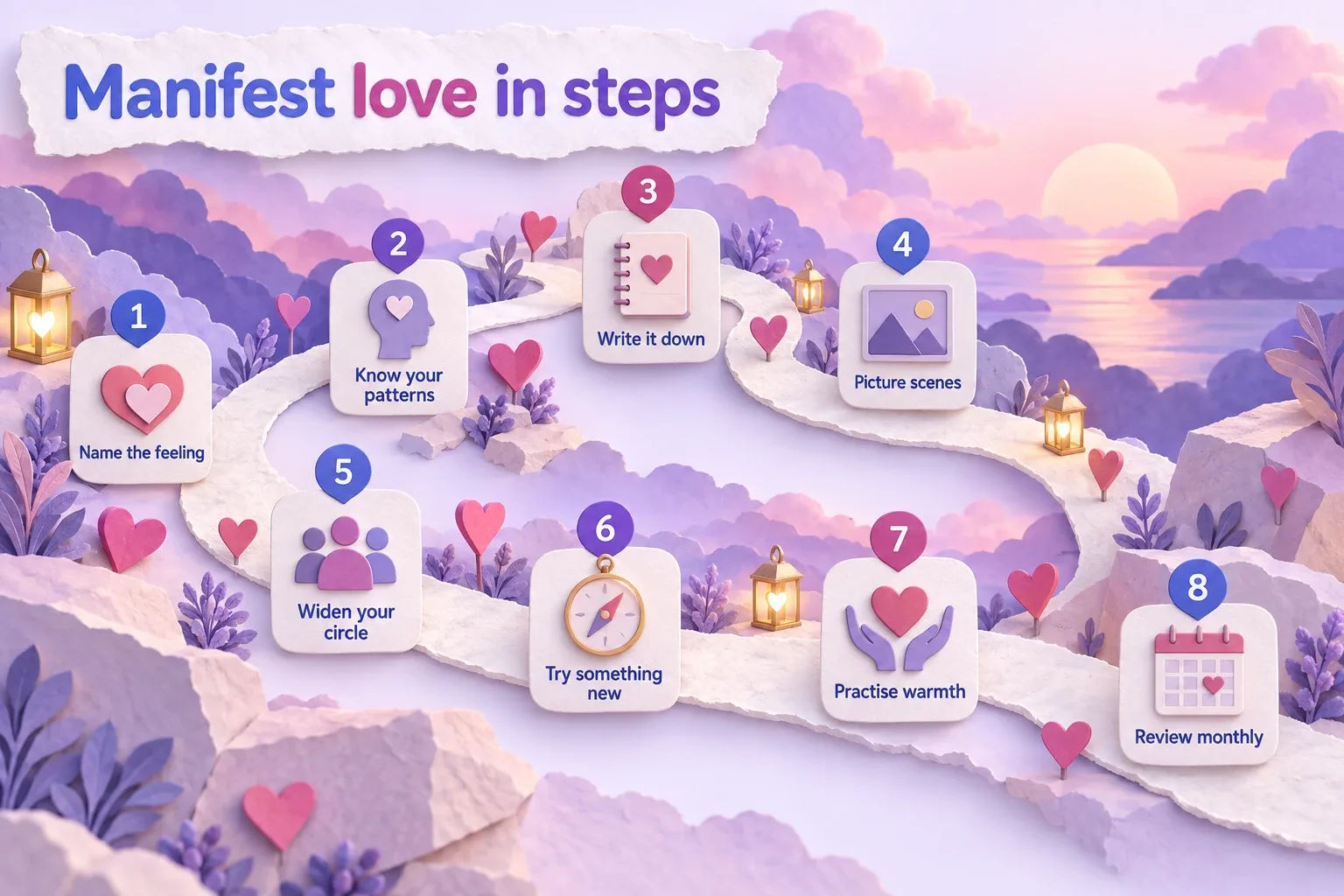
 Manifest Mosaic
How to manifest love: get clear on the kind of relationship and life you want, picture it often, and act in ways that put you near new people and ready for closeness. It's a mindset practice from the New Thought tradition. It can sharpen your focus and your nerve. It can't make a particular person love you.
This guide keeps the parts of the practice that hold up, adds what relationship research actually says, and draws two clear lines: consent and safety.
- Manifesting love works best as clarity plus action. No study shows thoughts alone attract a partner.
- People tend to bond with those they see often. Returning to the same places each week is the most practical step you can take.
- Don't try to "manifest" a specific person. If someone has said no, the loving move is to stop.
- Choose affirmations you can believe. "I'm a lovable person" made people with low self-esteem feel worse in one study.
- There's no honest timeline. Plan a 66-day practice and count your actions, not your outcomes.
- Learn the warning signs of love bombing, abuse and romance scams before you start dating.
Does manifesting love actually work?
Manifesting love can help, but not in the way many posts claim. No research shows that thinking about love sends out a signal that draws a partner to you. What the practice can do is make you clear about what you want, build steady self-belief and push you into rooms where you meet people. The action is the part that works.
The law of attraction grew out of the 19th-century New Thought movement. It was popularized in 2006 by Rhonda Byrne's The Secret. Critics call it untestable, and they point to a harsh flipside: if you "attract" everything, you get blamed for everything, including being single (Wikipedia: Law of attraction). You never need to carry that blame.
The goal is still worth chasing. The Harvard Study of Adult Development has followed hundreds of men, and later their children, since 1938. People who were most satisfied in their relationships at 50 were the healthiest at 80. As study director Robert Waldinger puts it, "Good relationships keep us happier and healthier" (Harvard Gazette, 2017).
New to the tradition? Start with how to manifest.
What does relationship science say about meeting someone?
Relationship research says love usually starts with repeated, easy contact. People tend to bond with those they see often, in places they return to. Familiarity tends to build liking, but only when the first impression is neutral or good. And online is now the most common way couples meet.
- Proximity. In 1950 housing studies at MIT, people living near stairwells and mailboxes made more friends, because they crossed paths more often (Wikipedia: Propinquity).
- Familiarity, with a limit. People tend to like what feels familiar. Liking usually peaks within about 10 to 20 exposures. If someone disliked you at first, seeing you more tends to make it worse (Wikipedia: Mere-exposure effect). It's a reason to join a weekly class, not to keep showing up where one person is.
- Online matters. In a national 2017 U.S. survey, about 39% of heterosexual couples who met that year met online, up from about 22% in 2009. For same-sex couples it was about 65% (Rosenfeld, Thomas & Hausen, 2019).
How the usual advice lines up with the evidence:
| Manifesting idea | What research supports | What to do this week |
|---|---|---|
| Get clear on what you want | Writing goals down helped in a small, non-peer-reviewed study | Write three sentences about an ordinary day in the relationship |
| Feel worthy of love | Big positive self-statements can backfire when self-esteem is low | Use small, believable lines you can act on |
| Be open to receive | People bond with those they see often, in shared places | Join one thing that meets every week |
| Take inspired action | Online is now the most common way couples meet | Start or refresh one dating profile |
| Visualize the feeling | Mental imagery uses many of the same brain systems as seeing | Picture a two-minute everyday scene, not a person |
| Trust the timing | New habits take an average of 66 days to feel automatic | Commit to 66 days of small actions |